Indirect Immunofluorescence: A Comprehensive Guide
Laboratory technique to detect circulating autoantibodies in serum for diagnosing autoimmune blistering skin diseases.
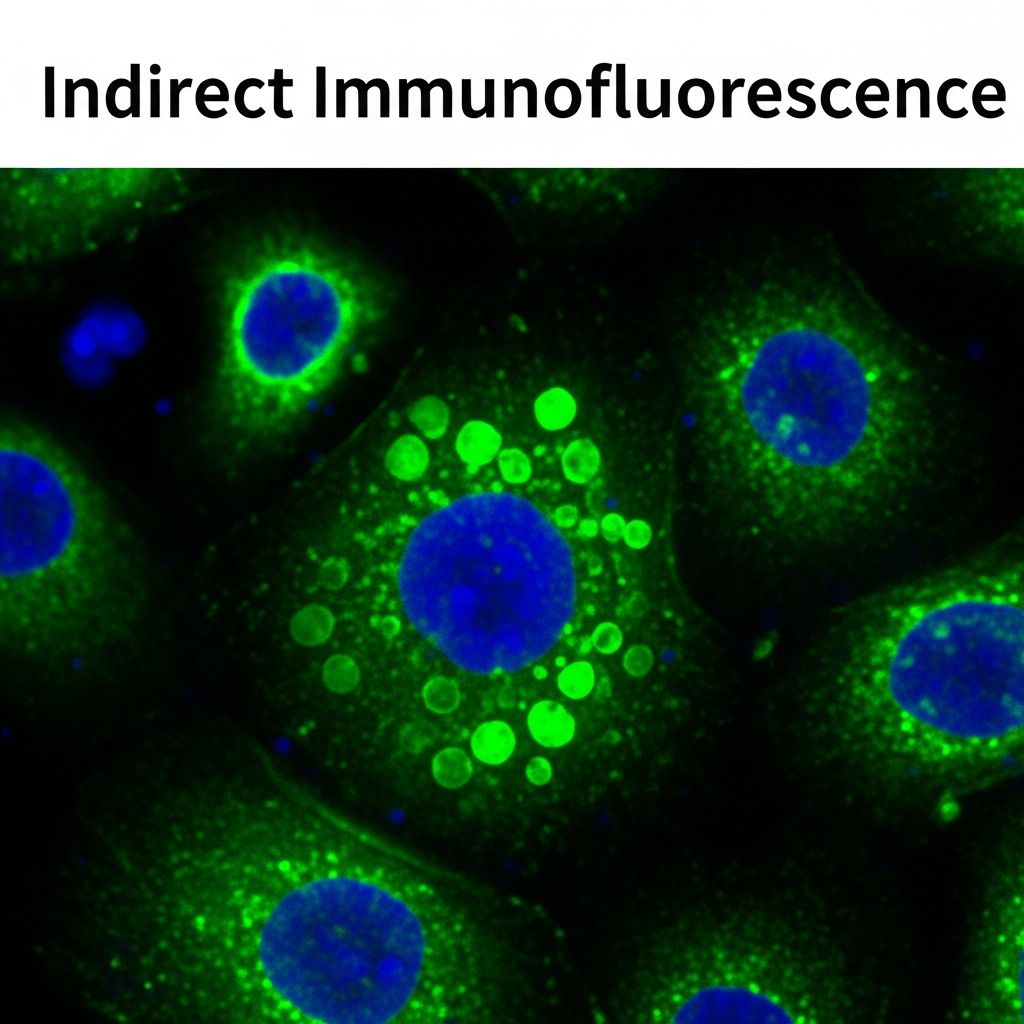
Indirect immunofluorescence (IIF), also known as secondary immunofluorescence, is a laboratory technique used to detect circulating
autoantibodies
in patient serum. It plays a crucial role in diagnosing autoimmune blistering skin diseases (AIBDs) such as pemphigus and pemphigoid by identifying specific antibody binding patterns on tissue substrates.What is Indirect Immunofluorescence?
IIF involves two main steps: first, patient serum is applied to a substrate (typically animal tissue like monkey esophagus or human salt-split skin), allowing autoantibodies to bind to their target antigens. Second, a fluorescently labeled secondary antibody is added to visualize the bound autoantibodies under a fluorescence microscope. This method is 10-15 times more sensitive than direct immunofluorescence (DIF) for detecting circulating antibodies.
Developed in 1964 by Beutner and Jordon for pemphigus diagnosis, IIF has become integral to dermatopathology labs worldwide. It helps differentiate diseases with overlapping clinical features, guides therapy, and monitors disease activity.
How Does Indirect Immunofluorescence Work?
The procedure requires precise steps for accuracy:
- Sample Preparation: Patient serum is diluted and layered onto cryosections of substrate tissue.
- Incubation 1: Autoantibodies bind to antigens (1 hour at room temperature).
- Washing: Unbound serum components are removed.
- Incubation 2: Fluorescein-conjugated anti-human IgG or C3 is applied (30-60 minutes).
- Final Wash and Mounting: Slides are examined under UV light for fluorescence patterns.
Common substrates include monkey esophagus for intraepidermal antibodies (pemphigus) and salt-split skin (SSS) for subepidermal ones (pemphigoid). Interpretation relies on staining location: epidermal roof, dermal floor, or cell surface.
Substrates Used in IIF
Different substrates optimize detection:
- Monkey or Guinea Pig Esophagus: Gold standard for pemphigus (intercellular substance staining).
- Rat Bladder: Alternative for pemphigus vulgaris.
- Human Salt-Split Skin (SSS): Distinguishes bullous pemphigoid (epidermal side) from epidermolysis bullosa acquisita (dermal side).
- Patient’s Own Skin (Immunomapping): For epidermolysis bullosa subtypes.
| Substrate | Primary Use | Key Diseases |
|---|---|---|
| Monkey Esophagus | Intraepidermal IgG | Pemphigus Vulgaris, Foliaceus |
| Salt-Split Skin | BMZ Staining | Bullous Pemphigoid, EBA |
| Rat Bladder | Cell Surface | Pemphigus |
Interpretation of IIF Patterns
Fluorescence patterns guide diagnosis:
- Intercellular Substance (ICS): Chicken-wire pattern in epidermis (pemphigus).
- Basement Membrane Zone (BMZ) Linear: Straight line along DEJ (pemphigoid).
- Salt-Split Patterns: Epidermal roof (BP180/230 antibodies), dermal floor (type VII collagen).
In pemphigus, IgG is detected in nearly 100% of cases; intensity correlates with activity. Negative IIF does not rule out disease if DIF is positive.
Specific Diseases and IIF Findings
Pemphigus Vulgaris and Foliaceus
IIF on monkey esophagus shows ICS IgG (PV: suprabasal; PF: superficial). Sensitivity: 90-100%. Pemphigus erythematosus adds BMZ deposits.
Bullous Pemphigoid
Linear BMZ IgG/C3 on SSS (epidermal side). Detects anti-BP180/230 antibodies.
Dermatitis Herpetiformis
Typically negative on routine IIF, but DIF shows granular IgA in dermal papillae. Circulating antibodies rare.
Linear IgA Bullous Dermatosis
Linear BMZ IgA; SSS shows epidermal or dermal binding.
Epidermolysis Bullosa Acquisita (EBA)
Dermal-side IgG on SSS (anti-type VII collagen). Only 40% serum positive.
Bullous Systemic Lupus Erythematosus
Linear BMZ IgG/IgA.
Pemphigoid Gestationis and Mucous Membrane Pemphigoid
BMZ staining; anti-laminin 332 linked to malignancy risk.
Antigen Mapping (Immunomapping)
A specialized IIF using patient’s skin split with 1M NaCl. Monoclonal antibodies detect BMZ proteins (collagen IV/VII, laminin 332). Determines cleavage plane in hereditary epidermolysis bullosa (EB):
Related Stories



- Simplex: Keratin 5/14 on epidermal side.
- Junctional: Laminin 332 absent.
- Dystrophic: Type VII collagen on dermal side.
Preferred over electron microscopy; uses non-sun-exposed skin.
Clinical Utility and Limitations
IIF monitors therapy (titers fall with remission), differentiates subtypes, and detects low-titer antibodies. Limitations: Operator-dependent, requires fresh serum, false negatives in early/low-activity disease. Sensitivity varies (e.g., 40% in EBA). Computer-aided IIF improves standardization.
Biopsy Site Recommendations for Related DIF/IIF
| Disease | Recommended Site |
|---|---|
| Pemphigus | Perilesional skin |
| Bullous Pemphigoid | Perilesional |
| Dermatitis Herpetiformis | Perilesional |
| Vasculitis | Erythematous border (<24h) |
| Porphyria Cutanea Tarda | Involved skin (no ulcers) |
Frequently Asked Questions (FAQs)
What is the difference between DIF and IIF?
DIF uses patient tissue with bound antibodies; IIF tests serum on external substrates for circulating antibodies.
Is monkey esophagus the best substrate for pemphigus?
Yes, it shows classic ICS pattern with high sensitivity.
What does dermal binding on salt-split skin indicate?
EBA, anti-laminin 332 MMP, or anti-p200 pemphigoid.
Can IIF replace DIF?
No, DIF confirms tissue-bound deposits; IIF detects serum antibodies.
How does IIF help in epidermolysis bullosa?
Immunomapping localizes protein defects for subtyping.
Advances in IIF
Biochip mosaics and ELISA complement IIF for higher specificity. Multicenter studies validate SSS IIF for pemphigoid differentiation. Automated readers reduce subjectivity.
IIF remains essential for AIBD diagnosis, prognosis, and management, evolving with technology for precision medicine.
References
- Immunofluorescence in dermatology — Indian Journal of Dermatology, Venereology and Leprology. 2017. https://ijdvl.com/immunofluorescence-in-dermatology/
- Standardized indirect immunofluorescence-based detection of autoantibodies against linear IgG binding at the basement membrane zone — British Journal of Dermatology, Oxford Academic. 2025-10-22. https://academic.oup.com/bjd/article/194/1/163/8271033
- Immunofluorescence in dermatology: A brief review — Journal of Skin and Sexually Transmitted Diseases. 2023. https://jsstd.org/immunofluorescence-in-dermatology-a-brief-review/
- Indirect immunofluorescence – DermNet — DermNet NZ. 2024. https://dermnetnz.org/topics/indirect-immunofluorescence
- Direct and Indirect Immunofluorescent Services — Weill Cornell Medicine Dermatopathology. 2024. https://dermpath.weill.cornell.edu/clinicians/direct-and-indirect-immunofluorescent-services
Similar Articles








Read full bio of Sneha Tete