Infantile Digital Fibroma: Diagnosis, Treatment, Prognosis
Rare benign nodules on infants' fingers and toes: causes, diagnosis, and management options.
Infantile digital fibroma
Infantile digital fibroma, also known as infantile digital fibromatosis or inclusion body fibromatosis, is a rare benign tumour that typically appears as single or multiple firm, pinkish or gelatinous nodules on the fingers or toes of infants and young children.
What is infantile digital fibroma?
**Infantile digital fibroma** is a uncommon benign proliferation of myofibroblasts occurring primarily in the digits of infants. It accounts for approximately 2.5% of all fibromatosis cases and has been reported in around 200 cases in medical literature as of recent reviews. These lesions are characterised by their location on the dorsal or lateral aspects of fingers and toes, sparing the thumb and great toe in most instances.
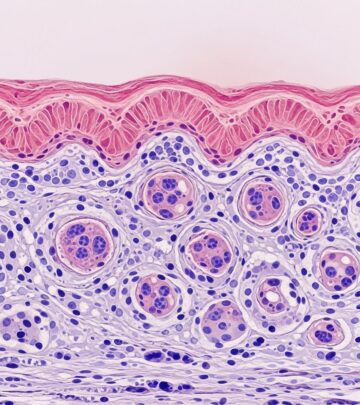
The tumour consists of spindle-shaped cells arranged in a collagen-rich dermis, with distinctive eosinophilic cytoplasmic inclusion bodies composed of actin and vimentin filaments. These inclusions are pathognomonic and aid in differentiating IDF from other fibrous tumours such as infantile myofibromatosis.
Who gets infantile digital fibroma?
Infantile digital fibroma predominantly affects infants and young children, with about one-third of cases present at birth and most manifesting within the first two years of life. It occurs equally in males and females.
Rare cases have been documented in older children up to age 10 and exceptionally in adults, such as a 52-year-old. Nondigital sites on hands, feet, arms, or other body areas are occasionally involved, though acral (digit) presentation is classic.
What causes infantile digital fibroma?
The exact cause of infantile digital fibroma remains unknown. Histologically, the lesions feature myofibroblasts—cells responsible for muscle fibre production—suggesting a possible dysregulation in myofibroblastic proliferation.
Electron microscopy reveals the inclusion bodies as densely packed actin and vimentin filaments, but no genetic or environmental triggers have been definitively identified. It was historically considered a subtype of infantile myofibromatosis due to similarities, but is now recognised as distinct.
What are the clinical features of infantile digital fibroma?
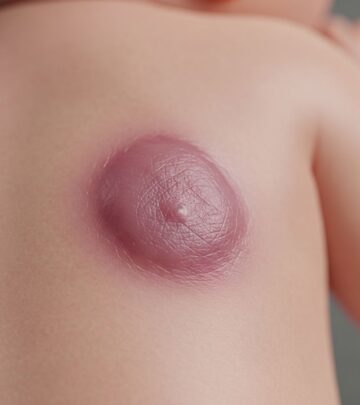
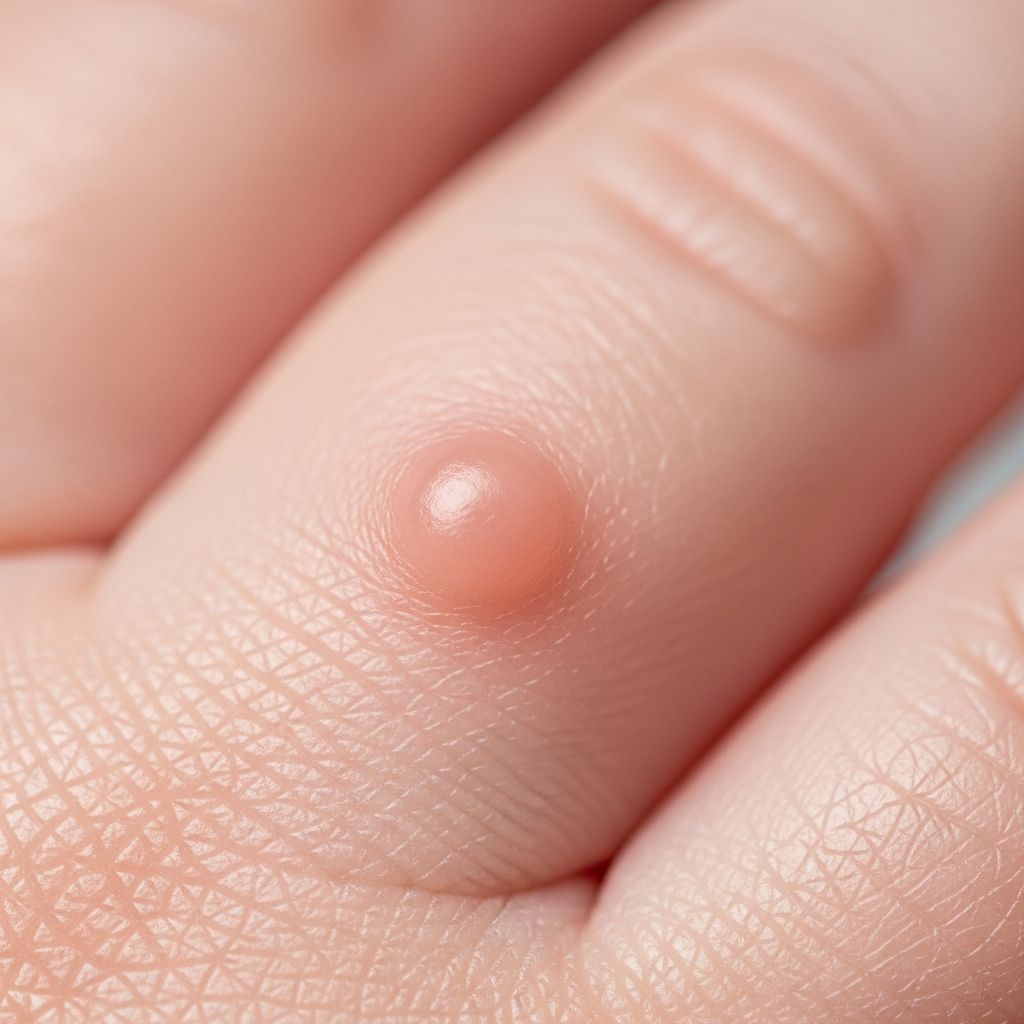
Lesions typically present as solitary, smooth, flesh-coloured to pink-red, dome-shaped nodules, usually smaller than 2 cm in diameter, though larger tumours up to 4.5 cm have been reported.
They are located on the dorsal or lateral surfaces of the last four fingers or toes, and are generally asymptomatic unless large enough to impair joint function, cause pain, or rub against footwear. Multiple lesions occur in up to 30% of cases, with one report noting 74 lesions.
Growth is slow but progressive, potentially leading to epidermal flattening, periosteal invasion, or bone erosion in advanced cases. Clinical images often show mildly erythematous, indurated nodules without affecting mobility initially.
Diagnosis
Diagnosis is primarily clinical in infants with characteristic digital nodules, supported by imaging and histopathology.
Imaging: Cutaneous ultrasound reveals a well-defined hypoechoic subcutaneous nodule without vascularity or bone involvement. X-rays may be used to rule out bony exostosis.
Histopathology: Biopsy shows interlaced spindle cells and collagen in the dermis and subcutaneous tissue, with pathognomonic round, eosinophilic paranuclear inclusion bodies. These are confirmed by immunofluorescence for actin and vimentin, or stains like Masson trichrome. Cells are positive for desmin immunohistochemically.
Differential diagnoses include infantile myofibromatosis, exostosis, and other fibromatoses; inclusions distinguish IDF.
What is the treatment for infantile digital fibroma?
Treatment is often conservative due to the benign nature, but options depend on size, symptoms, and functional impairment.
- Observation: Many lesions regress spontaneously; monitoring is suitable for small, asymptomatic nodules.
- Intralesional corticosteroids: Injections to reduce growth in select cases.
- Surgical excision: Complete resection for symptomatic, growing, or functionally limiting lesions. Recurrence rates are high, up to 60% post-excision.
In severe recurrent cases, digital amputation has been performed, though rarely. No systemic therapies are standard.
What is the outcome for infantile digital fibroma?
Prognosis is excellent as lesions are benign and often regress without intervention. Recurrence after surgery is common but usually manageable; malignant transformation does not occur.
Long-term follow-up shows good functional outcomes, even with multiple recurrences.
Clinical images
Typical appearances include pink, firm nodules on digit borders (descriptions based on case reports).
Histology images
Microscopy reveals spindle cell proliferations with eosinophilic inclusions (H&E stain); immunohistochemical positivity for desmin.
Frequently Asked Questions
Is infantile digital fibroma painful?
Usually asymptomatic, but larger lesions may cause pain or functional issues.
Does it go away on its own?
Many regress spontaneously, supporting observation.
Can it recur after surgery?
Yes, recurrence is frequent, often under the scar.
Is it cancerous?
No, it is a benign tumour with no malignant potential.
How is it diagnosed?
By clinical features and biopsy showing characteristic inclusions.
Related topics
- Infantile myofibromatosis
- Fibromatosis
- Dermatofibroma
- Exostosis
References
- Infantile digital fibromatosis – Wikipedia — Wikipedia. 2021. https://en.wikipedia.org/wiki/Infantile_digital_fibromatosis
- Infantile Digital Fibromatosis/Inclusion Body Fibromatosis — National Institutes of Health (PMC). 2023-01-11. https://pmc.ncbi.nlm.nih.gov/articles/PMC9827721/
- Infantile digital fibromatosis: A clinical case report — Anales de Pediatría. 2025. https://www.analesdepediatria.org/en-infantile-digital-fibromatosis-a-clinical-articulo-S2341287925000675
- Infantile digital fibroma (fibromatosis) — DermNet NZ. 2004 (updated). https://dermnetnz.org/topics/infantile-digital-fibroma
- [Translated article] Infantile Digital Fibromatosis: Primum Non Nocere — Actas Dermo-Sifiliográficas. 2022. https://www.actasdermo.org/es-infantile-digital-fibromatosis-primum-articulo-S0001731022001880
Similar Articles




Read full bio of Sneha Tete