Inferior Vena Cava (IVC) Filter Placement
Complete guide to IVC filter placement, procedure details, recovery and filter removal options.
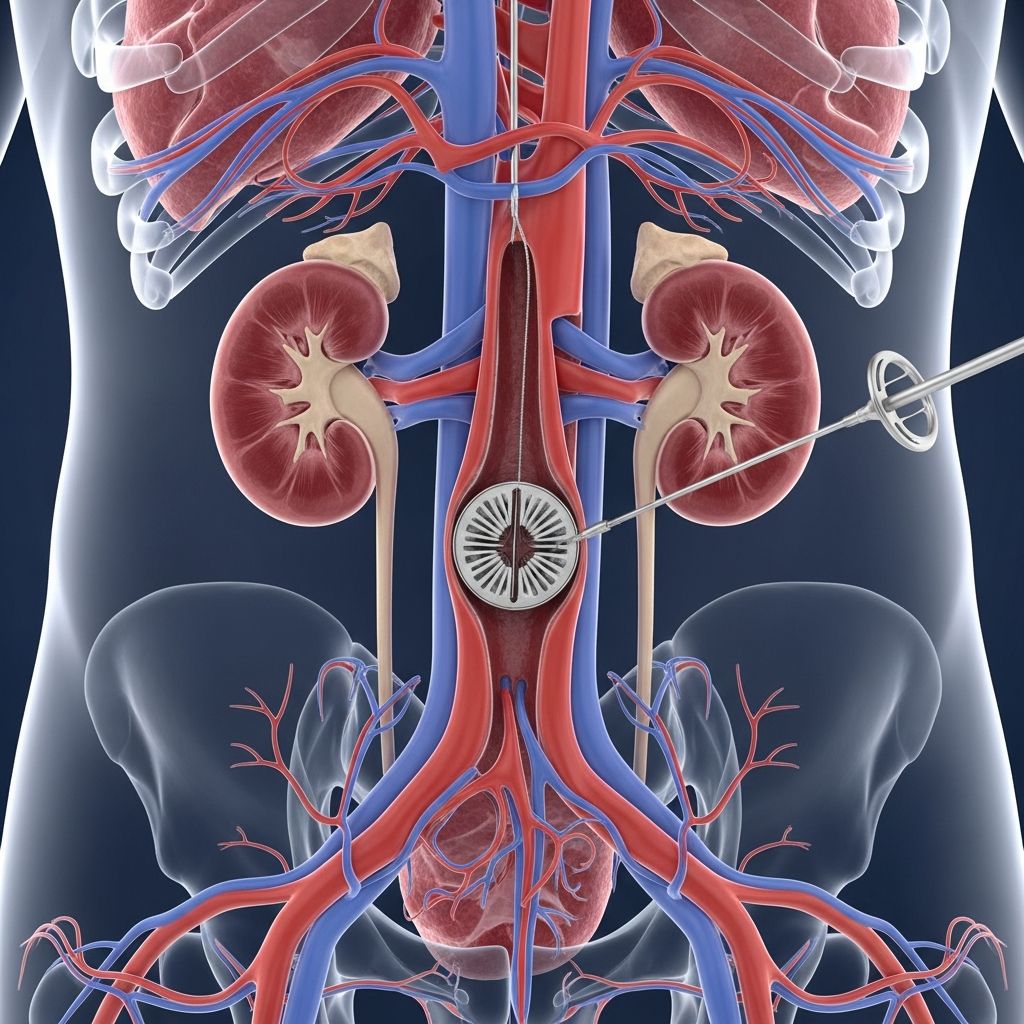
An inferior vena cava (IVC) filter is a small, umbrella-shaped medical device designed to trap blood clots and prevent them from traveling through the bloodstream to the lungs. The procedure to place an IVC filter is a minimally invasive intervention performed by interventional radiologists using real-time imaging guidance. This treatment option serves as an important preventive measure for patients at high risk of developing life-threatening pulmonary embolism or those who cannot tolerate blood-thinning medications.
What is the Inferior Vena Cava?
The inferior vena cava (IVC) is the largest vein in the human body responsible for transporting blood from the lower extremities, pelvis, and abdomen back to the heart. Located in the abdominal cavity, this major blood vessel runs vertically on the right side of the spine. Understanding the anatomy of the IVC is crucial for comprehending why filter placement in this location is so effective at preventing dangerous blood clots from reaching the lungs. When blood clots form in the deep veins of the legs or pelvic region, they can break free and travel through the venous system toward the heart and lungs, where they can cause a potentially fatal pulmonary embolism.
Why Might You Need an IVC Filter?
IVC filters are indicated for patients who face significant risks of blood clot formation or complications from existing clots. The primary candidates for this procedure include:
- Patients diagnosed with deep vein thrombosis (DVT)
- Patients who have experienced a pulmonary embolus
- Trauma victims with immobility concerns
- Patients who are immobilized for extended periods
- Individuals who cannot tolerate or have contraindications to anticoagulation therapy (blood thinners)
- Patients with failed anticoagulation attempts
IVC filters serve as a safety net when conventional treatments prove ineffective or unsuitable. While anticoagulation therapy remains the first-line treatment for preventing blood clots, some patients may be allergic to these medications, experience bleeding complications, or have other medical conditions that make blood thinners dangerous. In such cases, an IVC filter provides an alternative protective mechanism.
Types of IVC Filters
There are two main categories of IVC filters: temporary and permanent. Temporary filters are designed for short-term use and can be removed once the risk of blood clots has diminished. These are particularly useful for patients recovering from trauma or surgery who may eventually be able to resume anticoagulation therapy. Permanent filters, conversely, remain in place indefinitely and are typically used for patients with chronic conditions or repeated clot formation despite anticoagulation. The decision between temporary and permanent filter placement depends on individual patient circumstances, the underlying cause of clot risk, and prognosis. Your interventional radiologist will help determine which type best suits your medical situation.
How the IVC Filter Placement Procedure Works
Pre-Procedure Preparation
Before undergoing IVC filter placement, your medical team will conduct a thorough evaluation of your condition. This typically includes blood tests, imaging studies of the abdomen and pelvis, and assessment of your venous anatomy through cross-sectional imaging or ultrasound. These preparatory steps ensure that your interventional radiologist has detailed knowledge of your individual vascular anatomy and can plan the most effective approach for your specific case.
Access Site Selection
The interventional radiologist can access the venous system through two primary routes: the internal jugular vein in the neck or the common femoral vein in the groin. Each approach offers distinct advantages. Jugular access provides a straighter pathway to the IVC and avoids potential complications associated with lower-extremity access, such as missed clots in the iliac veins. Femoral access, while also effective, may be preferred in certain anatomical situations. Your physician will determine the optimal access site based on your individual anatomy and medical history.
Related Stories



Catheter Insertion and Imaging
Using ultrasound guidance, the interventional radiologist makes a small puncture through the skin at the chosen access site and introduces a thin, flexible tube called a catheter into the vein. Once venous access is established, a guidewire is advanced through the catheter into the inferior vena cava. A pigtail catheter is then positioned, and contrast material is injected to create a venogram—a detailed X-ray image of the venous system. This imaging is essential for assessing the vein’s anatomy, identifying any anatomical variants (such as duplicated IVC or retroaortic renal veins), and detecting any existing stenosis or thrombus that might affect filter placement.
Filter Deployment
Once the optimal positioning location is identified, a larger delivery sheath is advanced over the guidewire to the predetermined site in the infrarenal IVC. The collapsed filter, housed within the delivery catheter, is then carefully advanced to the exact location. When the interventional radiologist confirms proper positioning through fluoroscopic imaging, the filter is released. As it is deployed, the filter expands to conform to the diameter of the vein and its legs attach securely to the vessel walls, creating a scaffold to trap blood clots while allowing blood to continue flowing normally through the center of the filter.
Completion and Recovery
After successful filter deployment, the delivery catheter and guidewire are carefully removed. The interventional radiologist applies direct pressure to the puncture site to prevent bleeding and then covers the small opening with a sterile dressing or bandage. The entire procedure typically takes approximately 30 to 60 minutes from start to finish. Most patients receive local anesthesia combined with moderate sedation to ensure comfort throughout the procedure, and they can usually return home the same day as outpatients.
Advanced Placement Techniques
Modern interventional radiology has developed sophisticated techniques to optimize filter placement and positioning. One notable advancement is the over-the-wire (OTW) technique, which uses a guidewire to stabilize and center the filter within the IVC during deployment. This method proves particularly valuable in patients with tortuous (winding) blood vessels, as the anchored guidewire provides longitudinal stability that minimizes filter tilt. By reducing filter tilt at the time of initial placement, the OTW technique can facilitate easier filter removal if the filter needs to be retrieved in the future. Such technical innovations represent the ongoing evolution of interventional radiology to improve patient outcomes and reduce complications.
What to Expect After Your Procedure
Immediate Post-Procedure
Following IVC filter placement, you will be monitored in a recovery area for several hours to ensure there are no immediate complications. Most patients experience minimal discomfort, with only mild soreness at the puncture site. You may notice slight bruising or swelling, which typically resolves within a few days. Your healthcare team will provide specific instructions regarding activity restrictions and wound care before you leave the facility.
Activity and Restrictions
While IVC filter placement is minimally invasive, allowing for faster recovery compared to surgical procedures, you should still follow your physician’s recommendations regarding activity. Most patients can resume normal daily activities within a few days, though strenuous exercise or heavy lifting may need to be postponed for a week or two. Your care team will provide individualized guidance based on your specific situation and overall health status.
Monitoring and Follow-up
Regular follow-up appointments are essential after IVC filter placement. Your physician may order imaging studies to confirm proper filter positioning and assess for any complications. If you have a temporary filter, your medical team will establish a timeline for removal based on your clinical progress and resolution of the underlying clotting risk.
IVC Filter Removal Procedure
For patients with temporary IVC filters, removal is a straightforward minimally invasive procedure that typically takes less than an hour. The removal process begins with radiographic imaging to locate and confirm the filter’s exact position within the vein. Under fluoroscopic guidance, the interventional radiologist advances a catheter through a vein in the neck or groin to reach the filter. Using specialized retrieval devices, usually a snare or lasso-like instrument, the radiologist grasps the top of the filter, carefully collapses it back into its compact form, and withdraws it through the catheter. After confirming complete filter removal through imaging, the catheter is removed and pressure is applied to the puncture site, which is then covered with a dressing. Like filter placement, removal is performed using local anesthesia with moderate sedation, allowing patients to return home the same day.
Potential Benefits and Considerations
The primary benefit of IVC filter placement is the prevention of pulmonary embolism in high-risk patients who cannot receive or have failed anticoagulation therapy. For trauma victims, post-surgical patients, or those with medical conditions precluding blood thinner use, an IVC filter provides critical protection against a life-threatening complication. The minimally invasive nature of the procedure means shorter hospital stays, faster recovery times, and reduced trauma compared to open surgical alternatives.
However, like all medical procedures, IVC filter placement carries some considerations. Filters occasionally tilt slightly during deployment, which may affect their ability to trap clots efficiently. Newer filter designs and advanced placement techniques, such as the over-the-wire method, have significantly reduced this risk. Additionally, while uncommon, filters can occasionally accumulate a large thrombus burden, and migration or tilting can rarely occur. This underscores the importance of proper patient selection, appropriate imaging, and skilled interventional radiologist placement.
Frequently Asked Questions
Q: Is IVC filter placement painful?
A: No. The procedure is performed under local anesthesia with moderate sedation, so you should not experience pain during the procedure. You may feel mild pressure or discomfort during catheter insertion, but sedation keeps you comfortable throughout. Mild soreness at the puncture site afterward is normal and easily managed with over-the-counter pain relievers.
Q: How long does an IVC filter last?
A: Temporary filters are typically removed within 2-4 weeks, though this timeline varies based on your clinical situation. Permanent filters can remain in place indefinitely. Your physician will determine the appropriate duration based on your specific medical condition and risk factors.
Q: Can I travel after IVC filter placement?
A: Most patients can resume travel after a few days of recovery. However, avoid long periods of immobility, which can increase clot risk. Take frequent breaks during long flights or car rides, and consult your physician before making extended travel plans.
Q: Will the IVC filter affect normal blood flow?
A: No. IVC filters are specifically designed to trap blood clots while allowing normal blood flow to continue unimpeded through the center of the filter. Blood continues circulating normally through your veins.
Q: What happens if the filter becomes full of clots?
A: Filters are designed with a large capacity to trap multiple clots. However, if significant clot accumulation occurs, your physician may recommend filter removal or replacement. Regular follow-up imaging helps monitor for this potential complication.
Q: Are there any lifestyle changes needed with an IVC filter?
A: While most patients can return to normal activities, you should follow your physician’s recommendations regarding anticoagulation therapy, compression stockings, and activity levels. Staying active, maintaining proper hydration, and following medical advice helps optimize outcomes.
References
- IVC Filters – Placement and Removal — Radiology Info. 2024. https://www.radiologyinfo.org/en/info/venacavafilter
- Over-the-Wire Inferior Vena Cava Filter Placement: How We Do It — National Institutes of Health. 2021. https://pmc.ncbi.nlm.nih.gov/articles/PMC8175103/
- Inferior Vena Cava (IVC) Filter Placement and Removal — Yale Medicine. 2024. https://www.yalemedicine.org/conditions/ivc-filter-placement-and-removal
- Inferior Vena Cava (IVC) Filters — University of Washington Radiology. 2024. https://rad.uw.edu/sections/interventional-radiology/procedures/inferior-vena-cava-ivc-filters
- Inferior Vena Cava Filters — Stony Brook Medicine Center for Vein Care. 2024. https://vein.stonybrookmedicine.edu/treatments/inferior-vena-cava-filters
Similar Articles








Read full bio of Sneha Tete