Inflammatory Breast Cancer: 7 Signs, Diagnosis, Treatment
Understanding the rare, aggressive form of breast cancer: symptoms, diagnosis, treatment, and survival insights.
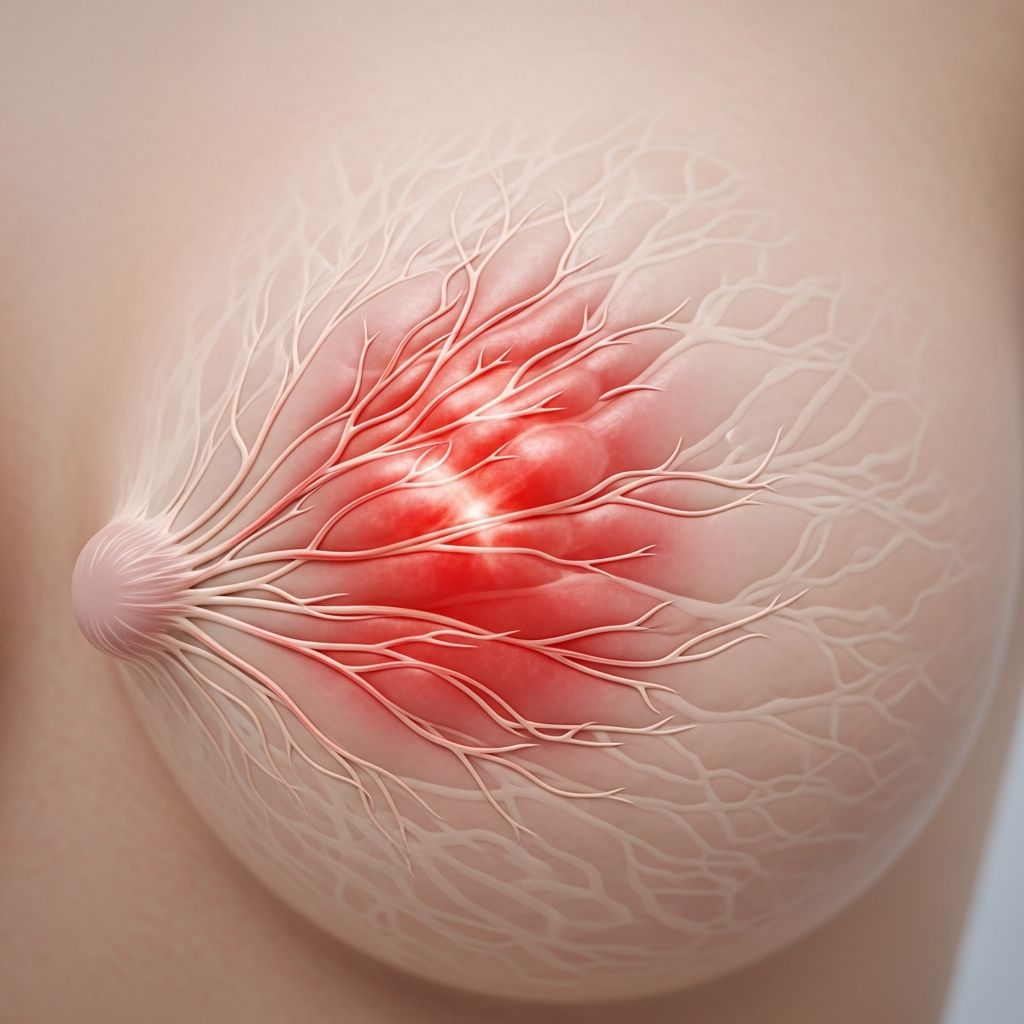
Inflammatory breast cancer (IBC) is a rare and aggressive form of breast cancer that accounts for 1-5% of all cases but contributes disproportionately to mortality, representing up to 7% of breast cancer deaths. Unlike typical breast cancers, IBC grows rapidly, blocking the lymph vessels in the skin of the breast, leading to characteristic inflammation, redness, and swelling that can mimic an infection. This condition requires prompt diagnosis and aggressive multimodal treatment, including neoadjuvant chemotherapy, surgery, and radiation, to improve outcomes.
What Is Inflammatory Breast Cancer?
Inflammatory breast cancer, often abbreviated as IBC, is classified as a locally advanced breast cancer under the TNM staging system, specifically T4d in the American Joint Committee on Cancer (AJCC) system. It is predominantly an invasive ductal carcinoma, where cancer cells originate in the milk ducts and infiltrate the dermal lymphatics of the breast skin. This blockage prevents normal lymph drainage, causing the breast to appear inflamed—hence the name. IBC tends to affect younger women and spreads more quickly than other breast cancers, often presenting without a distinct lump.
Rapid onset is a hallmark: symptoms develop over days to weeks, not months. The breast skin may show erythema (redness) covering at least one-third of the breast, edema (swelling), peau d’orange (orange-peel texture due to blocked lymphatics), warmth, and tenderness. These changes occur because cancer cells clog the lymphatic vessels, leading to fluid buildup and inflammation. IBC is harder to detect early via mammograms due to the diffuse skin involvement rather than a mass.
Symptoms of Inflammatory Breast Cancer
IBC symptoms differ markedly from other breast cancers, often mistaken for mastitis or infection. Key signs include:
- Rapid breast swelling and redness: The breast enlarges quickly, with red or pink skin covering at least one-third of the area, sometimes extending to the chest wall.
- Peau d’orange appearance: Dimpled, thickened skin resembling orange peel due to lymphatic obstruction.
- Warmth and tenderness: The breast feels warm to the touch and may be painful.
- Itching or rash: Persistent itching or a rash-like appearance on the breast skin.
- Enlarged lymph nodes: Swollen nodes under the arm or near the collarbone.
- Flattening or inversion of the nipple: The nipple may turn inward or flatten.
- No palpable lump in many cases: Unlike other cancers, IBC often lacks a discrete tumor mass.
These symptoms typically arise within three to six months and do not resolve with antibiotics, prompting further investigation. Early recognition is critical as IBC can progress to stage IV in about one-third of cases at diagnosis.
Causes and Risk Factors
The exact causes of IBC remain unclear, but it arises from genetic mutations leading to uncontrolled cell growth that invades lymphatics. Risk factors mirror those of other breast cancers but with some distinctions:
- Younger age: More common in women under 40.
- Obesity: Higher body mass index correlates with increased risk.
- Family history: Genetic predispositions like BRCA mutations may play a role.
- No association with breastfeeding or hormone replacement therapy specifically for IBC.
Related Stories



IBC is not caused by injury or infection but can be misdiagnosed as such initially.
Diagnosis of Inflammatory Breast Cancer
Diagnosing IBC relies on clinical presentation plus biopsy confirmation. Diagnostic criteria per AJCC include:
- Rapid onset of erythema, edema, peau d’orange, or warmth (duration ≤6 months).
- Erythema over ≥1/3 of breast skin.
- Biopsy-proven invasive carcinoma with dermal lymphatic invasion.
Initial evaluation involves physical exam, mammogram, ultrasound, MRI, and core biopsy of skin and breast tissue. PET/CT scans check for metastases, as 20-30% present with distant spread to bones, liver, lungs, or brain. IBC is staged as at least Stage IIIB (T4d) or IV if metastatic.
Staging Inflammatory Breast Cancer
IBC is inherently locally advanced:
| Stage | Description |
|---|---|
| Stage IIIB/IIIC (Non-metastatic) | Cancer confined to breast, skin, and regional lymph nodes. |
| Stage IV (Metastatic) | Spread to distant organs; ~1/3 of cases at diagnosis. |
Staging guides aggressive therapy.
Treatment for Inflammatory Breast Cancer
IBC demands a trimodality approach: neoadjuvant systemic therapy, surgery, and radiation. Guidelines from NCCN and IBC experts emphasize this for optimal local control and survival.
Neoadjuvant Therapy (Pre-Surgery)
Treatment starts with chemotherapy to shrink the tumor: anthracycline-based (e.g., doxorubicin) plus taxane (e.g., paclitaxel), often with HER2-targeted agents like trastuzumab if HER2-positive. This downsizes the cancer for surgery and assesses response. Hormone therapy or immunotherapy may be added based on receptors.
Surgery
Modified radical mastectomy with axillary lymph node dissection follows neoadjuvant therapy if response is good. Breast-conserving surgery is not possible due to skin involvement. Immediate reconstruction is avoided due to high recurrence risk.
Adjuvant Therapy (Post-Surgery)
Radiation to chest wall and nodes, plus additional systemic therapy: hormone therapy (for ER/PR+), HER2 therapies, or PARP inhibitors for BRCA mutations.
Metastatic IBC
Systemic therapy prioritizes palliation; locoregional treatment if response allows. Goal: prolong survival, manage symptoms.
Prognosis and Survival Rates
IBC has poorer prognosis than other breast cancers, but modern treatments improve outcomes. For non-metastatic IBC, 5-year survival is 50-70%, median survival ~8 years. Overall 5-year rates: 30-70%. Stage III: ~52% per ACS.
Factors Affecting Survival
- HER2 and Hormone Status: HER2+ fares better with targeted therapy; triple-negative worst.
- Lymph Nodes: More involved nodes worsen prognosis.
- Response to Neoadjuvant Chemo: Poor responders have higher recurrence risk.
Advances in targeted therapies continue enhancing survival.
Side Effects and Complications
Treatment risks include lymphedema (50% risk post-axillary dissection/radiation), infection, fatigue, neuropathy from chemo, and heart issues from HER2 drugs.
Frequently Asked Questions (FAQs)
What is the main difference between IBC and other breast cancers?
IBC presents with rapid inflammation and skin changes without a lump, due to lymphatic invasion, unlike lump-forming cancers.
Can IBC be cured?
Many achieve long-term remission with trimodality therapy, though recurrence risk is high; survival improving.
Is IBC hereditary?
Not always, but BRCA genes increase risk; genetic counseling advised.
How fast does IBC spread?
Symptoms develop in weeks; can metastasize quickly.
Can IBC occur in men?
Rare, but possible; symptoms similar.
References
- Inflammatory Breast Cancer (IBC) — Susan G. Komen®. Accessed 2026. https://www.komen.org/breast-cancer/treatment/by-diagnosis/inflammatory-breast-cancer/
- Inflammatory Breast Cancer – StatPearls — NCBI Bookshelf. 2023-10-20. https://www.ncbi.nlm.nih.gov/books/NBK564324/
- Inflammatory Breast Cancer: Symptoms, Diagnosis, Treatment — National Breast Cancer Foundation. Accessed 2026. https://www.nationalbreastcancer.org/inflammatory-breast-cancer/
- Inflammatory Breast Cancer (IBC) — University of Michigan Health. Accessed 2026. https://www.uofmhealth.org/our-care/specialties-services/breast-cancer/inflammatory-breast-cancer-ibc
- Inflammatory Breast Cancer: Symptoms, Causes & Treatment — Cleveland Clinic. 2023-08-01. https://my.clevelandclinic.org/health/diseases/17925-inflammatory-breast-cancer
Similar Articles








Read full bio of Sneha Tete