Integumentary System: Anatomy, Functions And Care Guide
Discover the integumentary system's vital role in protection, sensation, and regulation for optimal body health.
The
integumentary system
is the body’s largest organ system, comprising skin, hair, nails, and associated glands. It acts as a protective barrier against environmental threats while performing critical regulatory functions.What Is the Integumentary System?
The integumentary system forms the outer covering of the body, serving as the first line of defense. It includes the
skin
(cutaneous membrane),hair
,nails
, andglands
(sweat, sebaceous, and others), supported by nerves and blood vessels. This system protects against pathogens, regulates temperature, and enables sensation.As the largest organ, skin alone accounts for about 16% of total body weight in adults, spanning roughly 2 square meters. It prevents dehydration, synthesizes vitamin D, and stores fat and water.
Anatomy of the Integumentary System
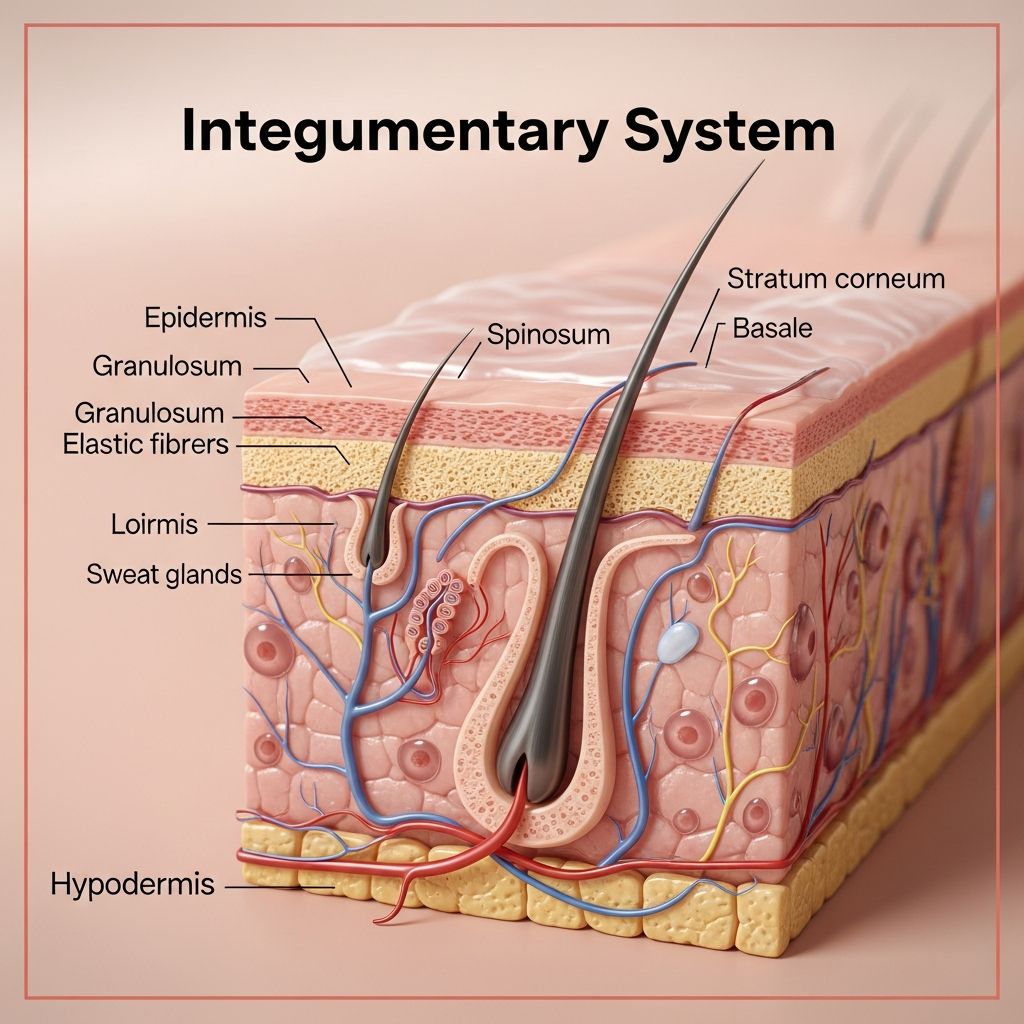
The system’s structure is multilayered, with skin divided into
epidermis
,dermis
, andhypodermis
(subcutis). Each layer contributes unique properties.Skin Layers
- Epidermis: Outermost avascular layer, composed of stratified squamous epithelium. Key sublayers include:
- Stratum basale (basal layer): Site of cell division and melanocytes for pigment.
- Stratum spinosum: Spiny cells for strength.
- Stratum granulosum: Waterproofing via keratohyalin granules.
- Stratum lucidum: Present in thick skin (palms/soles).
- Stratum corneum: Dead, keratinized cells forming a barrier.
- Dermis: Vascular connective tissue with collagen/elastin for strength and elasticity. Contains blood vessels, nerves, glands, and hair follicles. Papillary (upper) and reticular (lower) regions provide nutrients to epidermis.
- Hypodermis (Subcutaneous layer): Adipose tissue anchoring skin to muscles, aiding insulation and shock absorption.
Hair
Hair grows from follicles in the dermis, with a shaft, root, and bulb. It provides insulation, protection, and sensory function. Scalp hair varies; forensic analysis requires multiple samples due to variability.
Nails
Nails are keratin plates protecting fingertips/toenails, aiding dexterity. Composed of nail plate, matrix (growth area), bed, and cuticle.
Glands
- Sebaceous glands: Holocrine glands secreting sebum via cell rupture; lubricate skin/hair, connected to follicles.
- Sudoriferous (sweat) glands: Eccrine (thermoregulation, everywhere) and apocrine (scent, axillae/genitals).
- Other: Ceruminous (earwax), mammary.
Functions of the Integumentary System
The integumentary system multitasks for homeostasis:
- Protection: Barrier against microbes, UV, chemicals, dehydration.
- Sensation: Free nerve endings detect pain, temperature, itch; mechanoreceptors for touch/pressure.
- Thermoregulation: Vasodilation/constriction, sweating, piloerection.
- Excretion: Water, salts, urea via sweat.
- Synthesis: Vitamin D from UV on 7-dehydrocholesterol.
- Absorption/Storage: Fat, water, glucose; immune support via Langerhans cells.
It interacts with other systems: immune (barrier/white cells), skeletal (vitamin D for calcium), respiratory (nasal hairs filter).
Common Integumentary Conditions
Disruptions range from benign to severe. Early detection via assessment is key.
| Condition | Description | Symptoms |
|---|---|---|
| Acne | Clogged sebaceous glands. | Papules, pustules, cysts. |
| Eczema (Atopic dermatitis) | Inflammatory, genetic barrier defect. | Itchy, dry, inflamed patches. |
| Psoriasis | Autoimmune rapid cell turnover. | Scaly plaques. |
| Skin Cancer (Melanoma, Basal/Squamous Cell) | UV-induced mutations. | Asymmetric moles, changing lesions. |
| Pressure Injuries | Prolonged pressure on tissue. | Ulcers over bony prominences. |
| Jaundice | Bilirubin buildup. | Yellowing skin. |
| Edema/Lymphedema | Fluid retention. | Swelling, pitting. |
Other: Burns (1st-4th degree), infections (impetigo, cellulitis), alopecias.
Integumentary Assessment
Related Stories



Routine nursing assessment establishes baselines, especially within 24 hours of admission. Includes subjective/objective components.
Subjective Assessment
Ask about:
- Itching, rashes, lesions.
- Past diagnoses (acne, cancer, edema).
- Medications/creams.
- Changes in hair/nails.
Objective Assessment
Inspect/palpate:
- Color: Uniform for ethnicity; cyanosis, pallor, jaundice abnormal.
- Temperature: Warm/dry normal; cool/diaphoretic flags issues.
- Moisture: No excess.
- Turgor: No tenting (dehydration).
- Lesions: Size, type (macule, vesicle), distribution.
- Edema: Pitting (1-4+ scale).
- Capillary refill: <3 seconds.
- Focus: Bony prominences, folds, devices.
Hair: Texture, distribution. Nails: Color, shape, brittleness.
Sample Documentation
Normal: “Skin even color for ethnicity, warm/dry, no edema/lesions. Cap refill <3s, good turgor.”
Abnormal: “Itchy perioral rash x3 days; crusted pustules noted. Antibiotics prescribed; hygiene education given.”
Checklist for Integumentary Assessment
- Hand hygiene; check precautions.
- Introduce self, confirm ID.
- Subjective interview.
- Expose skin systematically (head-to-toe).
- Inspect color, lesions; palpate temp/moisture/turgor/edema/cap refill.
- Assess hair/nails.
- Document/report abnormalities.
- Hand hygiene.
Adapt for age/ethnicity: Infants thinner skin; elderly decreased elasticity.
Frequently Asked Questions (FAQs)
What is the main function of the integumentary system?
It protects against infection/injury, regulates temperature, and synthesizes vitamin D.
How do you assess skin turgor?
Pinch skin on forearm/hand; immediate recoil is normal, tenting indicates dehydration.
What causes yellow skin (jaundice)?
Bilirubin accumulation from liver issues or hemolysis.
Why is capillary refill important?
Tests circulation; >3 seconds suggests poor perfusion.
How does skin help with vitamin D?
UV converts 7-dehydrocholesterol to vitamin D3 precursor.
What are risk areas for pressure injuries?
Bony prominences, skin folds, perineum, under devices.
References
- Chapter 14 Integumentary Assessment – Nursing Skills — NCBI Bookshelf, National Center for Biotechnology Information. 2021. https://www.ncbi.nlm.nih.gov/books/NBK593218/
- Integumentary System: What It Is, Function & Organs — Cleveland Clinic. 2022-04-25. https://my.clevelandclinic.org/health/body/22827-integumentary-system
- Anatomy Lecture Notes Section 1: The Integumentary System — San Diego Miramar College. 2024-01. https://sdmiramar.edu/sites/default/files/2024-01/%234%20Integumentary%20Anat%20Lect%20Notes.pdf
Similar Articles








Read full bio of medha deb