Intercostal Muscles: Anatomy, Function & Role in Breathing
Understanding the intercostal muscles: their anatomy, function, and critical role in respiration.
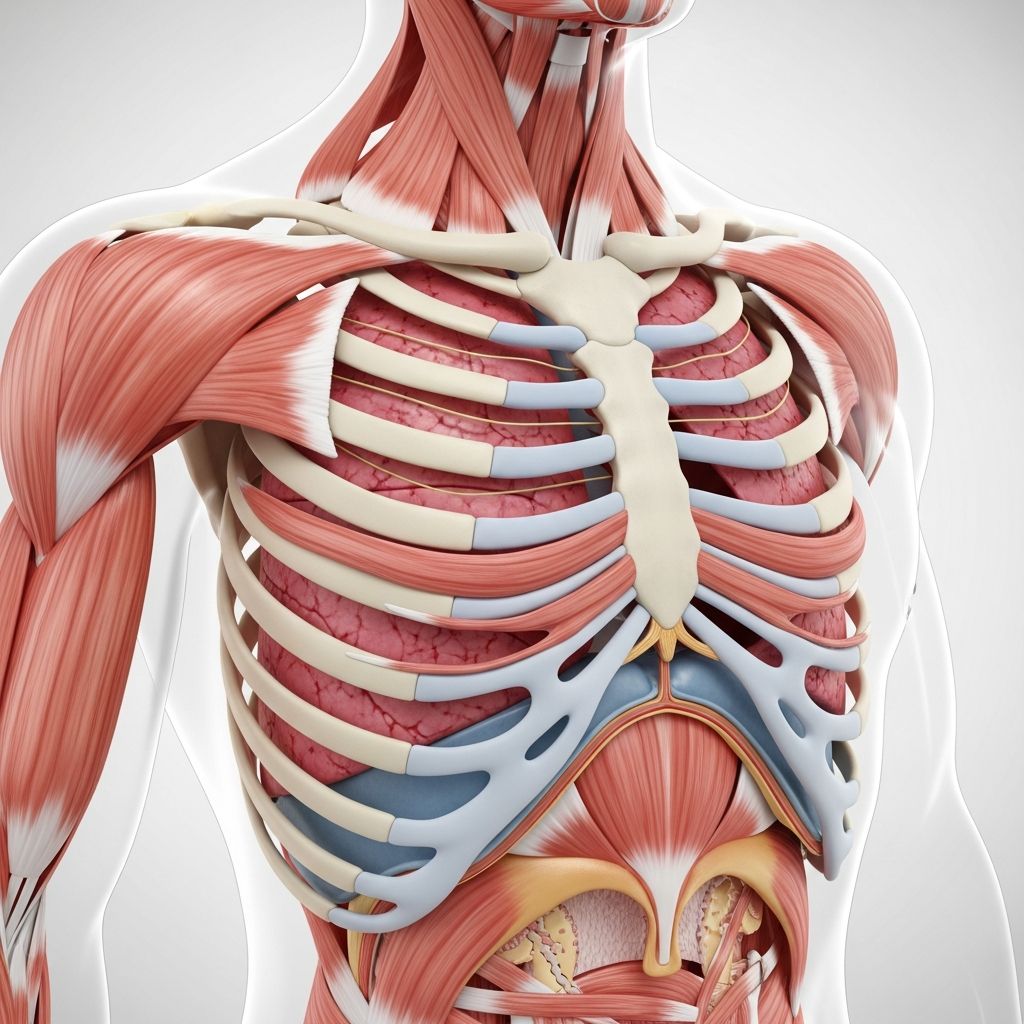
The intercostal muscles are a group of specialized muscles located between the ribs that form an essential part of your thoracic wall. These muscles play a critical role in respiration and provide structural support to your rib cage. Understanding their anatomy and function helps explain how your body accomplishes the fundamental process of breathing.
What Are Intercostal Muscles?
Intercostal muscles are intrinsic rib cage muscles that occupy the 11 intercostal spaces between your ribs. The term “intercostal” literally means “between the ribs,” and these muscles extend from where your ribs attach to your spine posteriorly all the way around to where they connect to your breastbone anteriorly. Your intercostal muscles are divided into three distinct layers, arranged from superficial to deep, each with specific anatomical characteristics and functions.
All three groups of intercostal muscles serve dual purposes: they provide mechanical support to your thoracic cage and function as accessory respiratory muscles that participate in forced breathing. This means they work with your diaphragm to help you breathe, especially during physical activity or when you need to take deep breaths.
The Three Layers of Intercostal Muscles
Your intercostal muscles are organized into three distinct anatomical layers, each with unique structural characteristics and functions. Understanding these layers is essential to comprehending how your rib cage moves during breathing.
External Intercostal Muscles
The external intercostal muscles form the most superficial, or outermost, layer of intercostal musculature. These muscles originate from the inferior border of one rib and course in an inferomedial direction, inserting into the superior border of the rib immediately below. The fiber direction of the external intercostals is often described as running in a “hands in pockets” direction—anteriorly and inferiorly—which is important to understanding their function.
The external intercostal muscles extend from the rib tubercle posteriorly all the way around to the costochondral junction anteriorly, where they continue as thin connective tissue aponeuroses known as the anterior intercostal membrane. During inspiration, these muscles contract and raise the lateral part of the ribs, increasing the transverse diameter of the thorax in what is called a “bucket handle motion.” This action increases the volume of your thoracic cavity, allowing air to flow into your lungs.
Internal Intercostal Muscles
The internal intercostal muscles form the intermediate or middle layer of the intercostal musculature. Unlike the external intercostals, the internal intercostals originate from the costal groove of one rib and course in an inferolateral direction, inserting into the superior border of the rib below. Notably, their fiber direction is perpendicular to that of the external intercostals, running roughly horizontally across the ribs.
The internal intercostals extend from the sternum anteriorly to the rib angle posteriorly, where they continue as the posterior intercostal membrane. Because of their unique fiber orientation and anatomical arrangement, these muscles have the opposite effect of the external intercostals. During forced expiration, the internal intercostals contract and pull the ribs downward and inward, decreasing the volume of your thoracic cavity and helping to push air out of your lungs.
Related Stories



Innermost Intercostal Muscles
The innermost intercostal muscles form the deepest layer of intercostal musculature. These muscles originate from the costal groove of one rib, but posteriorly to the origin of the internal intercostals. They course inferomedially in the same fashion as the internal intercostals and insert into the superior border of the rib below. The innermost intercostals run from the sternum anteriorly to approximately the angle of the rib posteriorly.
The innermost intercostals are sometimes considered deep parts of the internal intercostal muscles, but they are actually separate muscle layers distinguished by distinct connective tissue arrangements. These muscles function similarly to the internal intercostals, assisting in the depression of ribs during forced expiration. They help reduce thoracic volume and facilitate the expulsion of air from your lungs.
Anatomical Attachments and Structure
The structural organization of intercostal muscles is highly precise and directly relates to their function. Each intercostal muscle layer has specific points of origin and insertion that determine how they move your ribs.
The external intercostals originate from the inferior border of one rib and insert on the superior border of the rib below, spanning from the rib tubercle posteriorly to the costochondral junction anteriorly where they transition to aponeuroses. The internal and innermost intercostals originate from the costal groove and extend from the sternum to the rib angle. This anatomical arrangement creates a coordinated system where opposing muscle groups work together to create rib movements in different directions depending on the phase of respiration.
Nerve Supply and Innervation
All three layers of intercostal muscles receive their nerve supply from the intercostal nerves, which are the anterior rami of spinal nerves T1 through T11. Each intercostal space is supplied by the intercostal nerve of that corresponding space. This organized pattern of innervation ensures that each muscle layer receives appropriate nerve signals to coordinate breathing movements.
The intercostal nerves are clinically significant because they can be targeted for nerve blocks to alleviate pain associated with rib fractures or other chest wall conditions. During an intercostal nerve block procedure, a needle penetrates through the skin, superficial fascia, serratus anterior muscle, external intercostal muscle, and internal intercostal muscle to reach the intercostal nerve. Clinicians typically anesthetize adjacent intercostal nerves as well because of nerve collaterals and overlapping of contiguous dermatomes.
Blood Supply
The vascular supply to the intercostal muscles comes from multiple arterial sources that ensure adequate oxygen and nutrient delivery to these active muscles. The external intercostal muscles receive blood from the anterior and posterior intercostal arteries. The internal and innermost intercostals have a more extensive blood supply, receiving contributions from the anterior and posterior intercostal arteries, as well as from the costocervical trunk, internal thoracic artery, and musculophrenic arteries. This rich vascular supply reflects the metabolic demands of muscles that are constantly engaged in the breathing process.
Functions in Respiration
The primary function of intercostal muscles is to facilitate breathing by changing the volume and pressure of your thoracic cavity. During normal, quiet breathing, your diaphragm does most of the work. However, during forced or labored breathing, your intercostal muscles become active accessories that significantly enhance ventilation.
Inspiration Process
During inspiration, the external intercostal muscles contract and elevate the ribs upward and outward. This contraction, combined with diaphragmatic contraction, increases the transverse and anteroposterior diameters of your thorax. The increase in thoracic volume creates negative pressure within the lungs, causing air to flow inward. This mechanism is particularly important during forced or deep breathing, such as during exercise or when taking deliberate deep breaths.
Expiration Process
During forced expiration, the internal and innermost intercostal muscles contract and depress the ribs, pulling them downward and inward. This action decreases the volume of your thoracic cavity, creating positive pressure that helps push air out of your lungs. During quiet breathing, expiration is often passive—the elastic recoil of your lungs and chest wall naturally returns them to their resting position without active muscle contraction.
Structural Support Function
Beyond their respiratory functions, intercostal muscles form an important muscular wall that provides structural support to your rib cage. These muscles, working together with your ribs and connective tissues, create a “pressure barrel” that resists the pressure changes created during breathing and maintains the integrity of your thoracic cavity. This structural role is particularly important in protecting your heart and lungs from external injury.
Intercostal Muscles and Physical Activity
During physical activity and exercise, your intercostal muscles become increasingly active to support the increased breathing demands of your body. Your external intercostal muscles work harder to expand your rib cage and draw in more air, while your internal intercostals assist in expelling air more forcefully. This increased muscular activity is why some people experience muscle soreness or strain in their rib cage after intense exercise or unfamiliar physical activity.
Clinical Significance
Understanding intercostal muscle anatomy and function has important clinical applications. Intercostal muscle strain can occur with excessive coughing, sudden movements, or intense physical activity. Pain in the intercostal spaces can also result from rib fractures, where nerve blocks targeting the intercostal nerves are used to provide pain relief. Additionally, conditions affecting the intercostal nerves, such as herpes zoster (shingles), can cause significant chest wall pain.
Frequently Asked Questions
Q: Where exactly are the intercostal muscles located?
A: The intercostal muscles are located between your ribs, filling the 11 intercostal spaces. They extend from where your ribs attach to your spine in the back to where they connect to your breastbone in the front. There are three layers: external (outermost), internal (middle), and innermost (deepest).
Q: What is the main function of intercostal muscles?
A: The primary function of intercostal muscles is to facilitate breathing by changing the volume of your thoracic cavity. The external intercostals lift the ribs during inspiration to increase lung volume, while the internal and innermost intercostals pull the ribs down during expiration to decrease lung volume and push air out.
Q: Do intercostal muscles work during normal, quiet breathing?
A: During quiet breathing at rest, your diaphragm does most of the work. However, intercostal muscles become active during forced or labored breathing, such as during exercise, physical exertion, or when taking deep breaths.
Q: Can intercostal muscles become strained or injured?
A: Yes, intercostal muscles can become strained through excessive coughing, sudden movements, or intense physical activity. Intercostal muscle strain typically causes pain in the rib cage area and can be managed with rest, ice, and pain management strategies.
Q: What nerves supply the intercostal muscles?
A: The intercostal muscles are supplied by the intercostal nerves, which are the anterior branches of spinal nerves T1 through T11. Each intercostal space receives nerve supply from the corresponding intercostal nerve.
Q: How do intercostal muscles differ from the diaphragm?
A: While both the diaphragm and intercostal muscles are involved in respiration, they function differently. The diaphragm is the primary breathing muscle and contracts during inspiration to increase thoracic volume. Intercostal muscles are accessory muscles that become more active during forced or labored breathing and help support the rib cage structure.
References
- Intercostal muscles: Attachments, innervation, functions — Kenhub. 2025. https://www.kenhub.com/en/library/anatomy/intercostal-muscles
- Anatomy, Thorax, Muscles — StatPearls, National Center for Biotechnology Information (NCBI), National Institutes of Health (NIH). 2024. https://www.ncbi.nlm.nih.gov/books/NBK538321/
- Intercostal muscles — YouTube. 2025. https://www.youtube.com/watch?v=qdNdJYg_qjM
- Chest (Thorax) Anatomy & Function — Cleveland Clinic. 2025. https://my.clevelandclinic.org/health/body/chest-thorax
- Respiratory System: Organs, Facts, Anatomy & Function — Cleveland Clinic. 2025. https://my.clevelandclinic.org/health/body/21205-respiratory-system
Similar Articles








Read full bio of medha deb