Interleukin-17 in Inflammatory Skin Disorders
Exploring the pivotal role of IL-17 in driving pathogenesis and targeted therapies for psoriasis, hidradenitis suppurativa, and other skin diseases.
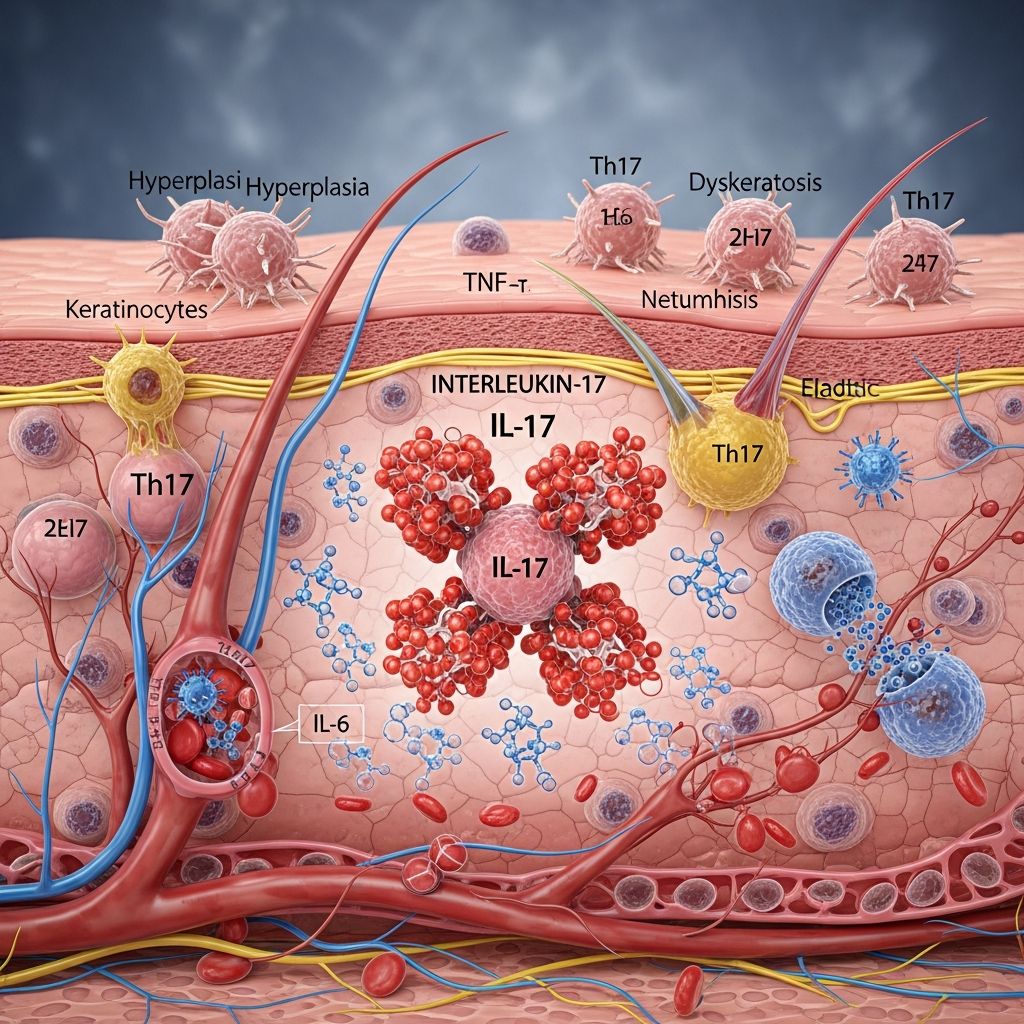
Interleukin-17 (IL-17) cytokines represent a key family of proinflammatory mediators central to the pathogenesis of numerous inflammatory skin disorders. Produced primarily by Th17 cells and innate lymphoid cells, IL-17 drives keratinocyte hyperproliferation, neutrophil recruitment, and antimicrobial peptide production, hallmarks of conditions like psoriasis.
What are the interleukin-17 cytokines?
The IL-17 family comprises six structurally related cytokines: IL-17A through IL-17F. IL-17A and IL-17F form homodimers or heterodimers that bind to a receptor complex consisting of IL-17RA and IL-17RC. This binding activates NF-κB and MAPK pathways, inducing expression of chemokines (e.g., CXCL1, CXCL8), cytokines (IL-6, IL-8), and antimicrobial peptides (defensins, S100 proteins).
IL-17C, highly expressed in keratinocytes, signals via IL-17RE and promotes psoriasiform inflammation independently of IL-17A in preclinical models. Sources of IL-17 include Th17 CD4+ T cells, γδ T cells, innate lymphoid cells (ILC3), neutrophils, mast cells, and CD8+ T cells, particularly abundant in lesional skin.
Who gets inflammatory skin disorders involving interleukin-17?
IL-17-driven diseases affect individuals genetically predisposed to Th17 dysregulation, often with HLA associations (e.g., HLA-Cw6 in psoriasis). Environmental triggers like skin trauma (Koebner phenomenon), infections, and microbiome alterations exacerbate flares. Neutrophilic dermatoses (Sweet syndrome, pyoderma gangrenosum) and pustular psoriasis show strong IL-17 elevation correlating with disease activity.
Patient demographics vary: psoriasis affects 2-3% globally, hidradenitis suppurativa (HS) 1%, with higher prevalence in smokers and obese individuals. Atopic dermatitis (AD) shows more complex IL-17 involvement, potentially protective against Staphylococcus aureus.
What causes inflammatory skin disorders involving interleukin-17?
Pathogenesis centers on the IL-23/IL-17 axis. IL-23 from dendritic cells expands Th17 cells, which produce IL-17A/F, IL-22, and IL-21. IL-17 stimulates keratinocytes to release CXCL8 (neutrophil chemoattractant), CCL20 (Th17/Treg recruiter), and β-defensins, perpetuating inflammation.
In psoriasis, IL-17A upregulates S100A7/A8/A9, activating NLRP3 inflammasome and IL-1β release. Microbiome dysbiosis amplifies IL-17 via pattern recognition receptors. In HS, Th17 cells infiltrate nodules, promoting follicular occlusion and abscesses. Genetic polymorphisms in IL23R and TRAF3IP2 enhance susceptibility.
What are the clinical features of interleukin-17-driven inflammatory skin disorders?
- Psoriasis: Erythematous plaques with silver scale; pustular variants show sterile pustules.
- Hidradenitis suppurativa: Painful nodules, abscesses, sinus tracts in intertriginous areas.
- Sweet syndrome: Fever, neutrophilic plaques, pathergy.
- Pyoderma gangrenosum: Rapidly progressive ulcers with undermined violaceous borders.
- Pityriasis rubra pilaris: Follicular hyperkeratosis, orange palmoplantar keratoderma.
Common features include neutrophilic infiltrates, epidermal hyperplasia, and parakeratosis. Disease flares coincide with IL-17 spikes in serum and tissue.
How is the diagnosis of interleukin-17-driven inflammatory skin disorders made?
Diagnosis relies on clinical features, histopathology (e.g., Munro microabscesses in psoriasis, neutrophilic dermal infiltrates), and exclusion of infection. Elevated serum IL-17/IL-23 or lesional Th17 cells support IL-17 involvement, though not routine. Biologics response predicts IL-17 axis dominance.
What is the treatment for inflammatory skin disorders involving interleukin-17?
Topicals (corticosteroids, vitamin D analogs) provide initial control. Phototherapy (NB-UVB) modulates Th17. Conventional systemics (methotrexate, cyclosporine) offer interim relief.
Biologic therapies targeting IL-17/IL-23:
| Agent | Target | Indications | Efficacy |
|---|---|---|---|
| Secukinumab | IL-17A | Psoriasis, HS | ~80% PASI90 |
| Ixekizumab | IL-17A | Psoriasis | Up to 42% clear skin |
| Bimekizumab | IL-17A/F | Psoriasis | Superior to IL-17A alone |
| Guselkumab | IL-23p19 | Psoriasis, HS | Outperforms TNF/IL-12/23 inhibitors |
| Ustekinumab | IL-12/23p40 | Psoriasis | Effective but inferior to IL-23 selective |
Related Stories



IL-17 inhibitors excel in neutrophilic diseases, inducing rapid pustule clearance. HS trials show 50% HiSCR with secukinumab.
Which inflammatory skin disorders are driven by interleukin-17?
Psoriasis
Psoriasis exemplifies IL-17 pathology. Lesional skin shows elevated IL-17A/F/C from diverse cells; IL-17 drives CCL20/CCR6 loop recruiting Th17. Keratinocytes amplify via NF-κB/MAPK, yielding hyperproliferation and neutrophil influx. IL-17 inhibitors achieve unprecedented clearance rates.
Pustular psoriasis
Generalized/acute pustular psoriasis features IL-36/IL-17 synergy. IL-17A spurs IL-36γ, forming feed-forward loop with massive neutrophilia.
Hidradenitis suppurativa
HS lesions overexpress IL-17, IL-23, TNF-α. Th17/Treg imbalance promotes S100A8/9 and NLRP3 activation in keratinocytes, fostering occlusion and suppuration.
Neutrophilic dermatoses
- Sweet syndrome: IL-17+ cells correlate with flares; anti-IL-17 responsive.
- Pyoderma gangrenosum: Th17 predominant; IL-17 inhibitors effective.
- Erythema elevatum diutinum: Vasculitic with IL-17 neutrophils.
Pityriasis rubra pilaris
PRP mirrors psoriasis with IL-17A elevation; ustekinumab/ixekizumab yield remissions.
Atopic dermatitis
IL-17 role ambiguous; may counter S. aureus via AMPs. Th2 dominant, but Th17 subset in chronic lesions.
Other associations
Alopecia areata, pemphigus, systemic sclerosis show IL-17 upregulation correlating with severity.
Frequently asked questions (FAQs) — Interleukin-17 in inflammatory skin disorders
Q. What is interleukin-17?
A. IL-17 is a proinflammatory cytokine family (A-F) produced by Th17 cells, driving neutrophil recruitment and epidermal hyperplasia in skin inflammation.
Q. Which skin disease responds best to IL-17 inhibitors?
A. Psoriasis shows highest response rates, with >80% achieving near-clearance on secukinumab or ixekizumab.
Q. Are IL-17 inhibitors safe long-term?
A. Phase III data confirm sustained efficacy/safety up to 5 years; monitor for candidiasis and IBD.
Q. Can IL-17 blockers treat hidradenitis suppurativa?
A. Yes, secukinumab achieves HiSCR50 in ~50% of patients.
Q. What role does the microbiome play?
A. Dysbiosis triggers IL-17 via TLRs; IL-17 alters microbiota composition.
Q. Is IL-17 involved in atopic dermatitis?
A. Role unclear; possibly antimicrobial rather than pathogenic.
References
- The many faces of interleukin-17 in inflammatory skin disorders — PubMed. 2016-04-27. https://pubmed.ncbi.nlm.nih.gov/27117954/
- Interleukin-17 in inflammatory skin disorders — PubMed. 2007-10-01. https://pubmed.ncbi.nlm.nih.gov/17873575/
- Interleukin-17 family members in health and disease — Oxford Academic. 2021-12-01. https://academic.oup.com/intimm/article/33/12/723/6382060
- The IL-23/IL-17 Pathway in Inflammatory Skin Diseases — Frontiers. 2020-11-27. https://www.frontiersin.org/journals/immunology/articles/10.3389/fimmu.2020.594735/full
- Targeting interleukin-17 in chronic inflammatory disease — Rockefeller University Press. 2019-12-17. https://rupress.org/jem/article/217/1/e20191123/132585/Targeting-interleukin-17-in-chronic-inflammatory
Similar Articles








Read full bio of medha deb