Iridocorneal Endothelial Syndrome Explained
Discover the causes, symptoms, and advanced treatments for this rare eye disorder affecting the cornea, iris, and glaucoma risk.
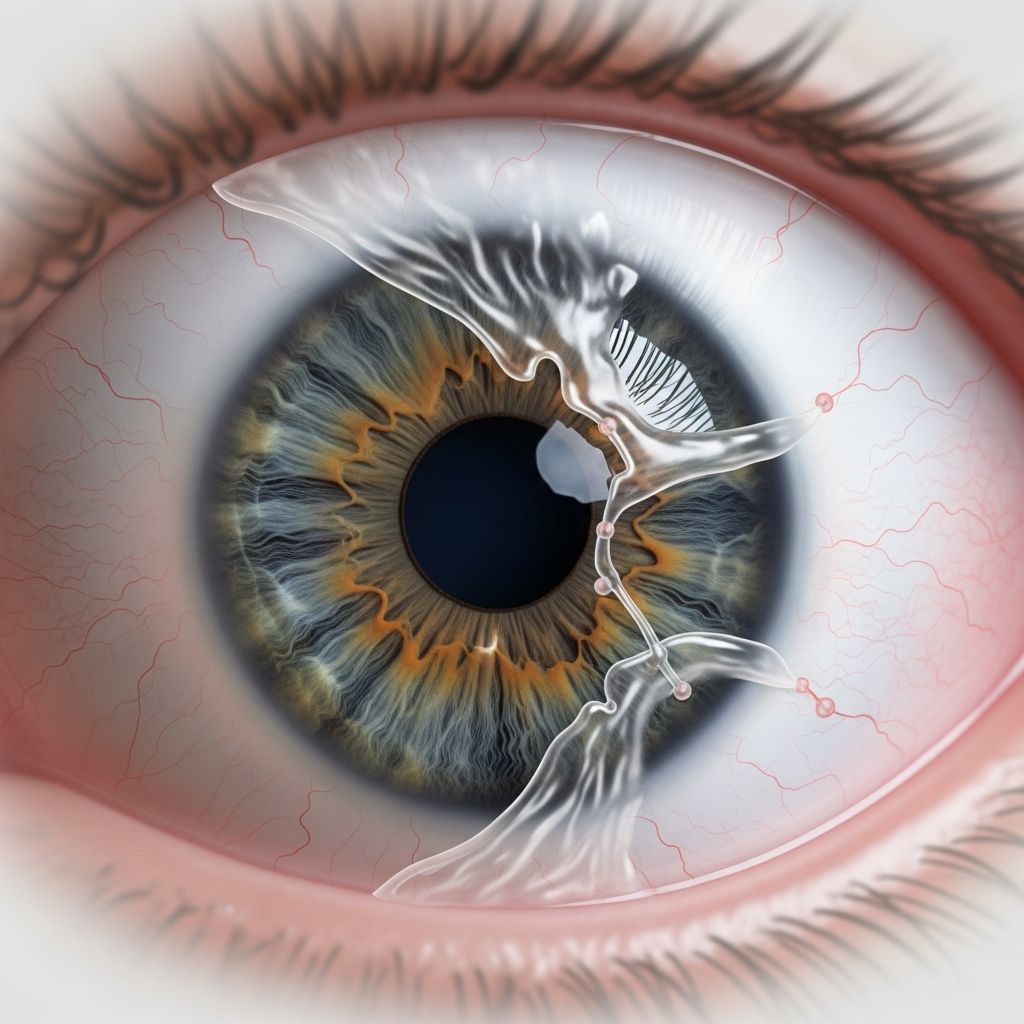
Iridocorneal Endothelial (ICE) Syndrome represents a spectrum of rare anterior segment disorders characterized by the abnormal behavior of corneal endothelial cells. These cells, normally responsible for maintaining corneal clarity by pumping fluid out, undergo transformation and migrate abnormally onto the iris and trabecular meshwork, leading to vision-threatening complications like corneal edema and glaucoma.
Understanding the Pathophysiology of ICE Syndrome
At the heart of ICE syndrome lies a dysfunction in the corneal endothelium, the single layer of cells on the inner surface of the cornea. In healthy eyes, these cells prevent fluid accumulation to keep the cornea transparent. In ICE, they acquire epithelial-like properties, proliferating and migrating beyond their normal boundaries toward the iridocorneal angle and iris surface.
This migration forms a pathological membrane that contracts, pulling the iris forward and creating peripheral anterior synechiae (PAS)—adhesions between the iris and cornea that obstruct aqueous humor outflow. The result is elevated intraocular pressure (IOP), secondary glaucoma, and potential corneal decompensation due to depleted endothelial cell density.
- Key pathological features: ‘Beaten metal’ or hammered silver appearance of endothelium, vesicular lesions, and broad bands on specular microscopy.
- Cell characteristics: Enlarged, pleomorphic cells expressing epithelial markers like cytokeratin.
- Consequences: Iris stretching, corectopia (pupil distortion), polycoria (multiple pupils), and stromal atrophy.
Clinical Variants of ICE Syndrome
ICE syndrome manifests in three interrelated subtypes, each emphasizing different degrees of iris involvement alongside shared endothelial and glaucomatous features. These variants often overlap, but distinct presentations guide classification.
| Variant | Primary Features | Common Symptoms | Glaucoma Risk |
|---|---|---|---|
| Chandler’s Syndrome | Corneal edema dominant; mild iris atrophy; hammered endothelium | Blurry vision, halos; normal initial IOP | Moderate, progresses later |
| Essential Iris Atrophy | Severe iris thinning, holes, corectopia; less corneal edema | Pupil distortion, pain, vision loss | High due to extensive PAS |
| Cogan-Reese (Iris Nevus) | Corneal changes + iris nodules (pigmented lesions) | Iris lumps, glaucoma symptoms | High |
Chandler’s syndrome prioritizes endothelial dysfunction with corneal bullae and ectopia pupillae, while iris atrophy variant shows dramatic stretching and full-thickness iris defects. Cogan-Reese adds surface nodules from pinched iris tissue.
Etiology and Risk Factors
The precise cause of ICE remains elusive, with no hereditary pattern identified—it typically affects one eye in adults aged 30-50, predominantly women of lighter skin tones. Theories include:
- Viral trigger: Low-grade infection by herpes simplex virus (HSV) or Epstein-Barr virus (EBV), prompting endothelial inflammation and transdifferentiation.
- Neural crest origin: Abnormal proliferation of neural crest-derived cells, which form endothelium, iris, and trabecular meshwork.
- Membrane dysfunction: Initial endothelial degeneration leading to compensatory epithelial shift.
No preventive measures exist due to unknown etiology, but early detection in at-risk groups is crucial.
Recognizing Symptoms and Early Warning Signs
Patients often present unilaterally with subtle initial changes progressing to significant vision impairment. Common symptoms include:
Related Stories



- Blurry or hazy vision, worse upon waking due to overnight corneal swelling.
- Photophobia, halos around lights, and ocular pain from edema or high IOP.
- Visible iris alterations: asymmetry, stretching, holes, or nodules.
- Glaucoma indicators: peripheral vision loss, headaches.
Advanced cases reveal distorted pupils drawn toward synechiae clusters.
Diagnostic Approaches for Accurate Identification
Diagnosis relies on comprehensive ophthalmic evaluation, as ICE mimics other glaucomas or dystrophies. Essential steps include:
- Slit-lamp biomicroscopy: Detects iris atrophy, PAS, endothelial ‘beaten metal’ sheen.
- Gonioscopy: Reveals angle closure by membrane or synechiae, sometimes subtle open-angle appearance.
- Specular microscopy: Confirms ICE cells—enlarged, polymorphic with guttae-like lesions.
- Anterior segment OCT (AS-OCT): Visualizes synechiae, membrane extent, iris defects.
- IOP measurement and fundus exam: Assesses glaucoma damage to optic nerve.
Visual acuity, pachymetry (corneal thickness), and endothelial cell count quantify severity.
Treatment Strategies: Managing Endothelial Dysfunction and Glaucoma
ICE lacks a cure; management targets symptoms—corneal edema, glaucoma, and iris complications. Multidisciplinary care is key.
Medical Therapies
- IOP-lowering drops: Prostaglandins, beta-blockers, carbonic anhydrase inhibitors to control glaucoma.
- Hypertonic saline: Reduces corneal edema.
- Anti-inflammatories: If viral etiology suspected.
Surgical Interventions
Laser trabeculoplasty fails due to membrane obstruction; instead:
- Filtering surgery: Trabeculectomy or tube shunts for refractory glaucoma.
- Endothelial keratoplasty (DSEK/DSAEK): Replaces dysfunctional endothelium, though recurrence risk exists.
- Iris reconstruction: Rare, for severe distortion.
Prognosis varies; early glaucoma control preserves vision, but progressive endothelial loss often requires lifelong monitoring.
Prognosis, Complications, and Long-Term Outlook
Untreated ICE leads to corneal decompensation and blindness from glaucoma. With vigilant management, many maintain functional vision. Complications include bullous keratopathy, intractable glaucoma, and membrane regrowth post-keratoplasty. Regular follow-ups every 3-6 months are recommended.
FAQs About Iridocorneal Endothelial Syndrome
Is ICE syndrome hereditary?
No, it lacks a familial pattern and is usually unilateral.
Can ICE affect both eyes?
Rarely; it’s predominantly unilateral, though contralateral involvement can occur later.
How is ICE different from Fuchs’ dystrophy?
ICE involves iris changes and glaucoma; Fuchs’ spares the iris and is bilateral.
Can laser treatment cure ICE?
No, lasers are ineffective; surgery and meds are mainstay.
Who is at higher risk for ICE?
Women aged 30-50 with lighter skin tones.
Advances in Research and Future Directions
Recent studies explore antiviral therapies for suspected HSV links and novel endothelial modulators. Immunohistochemistry confirms epithelial shift, spurring targeted interventions. AS-OCT enhances monitoring precision.
References
- What Is Iridocorneal Endothelial Syndrome (ICE)? — Valley Eye Care AZ. 2023. https://valleyeyecareaz.com/what-is-iridocorneal-endothelial-syndrome-ice/
- Iridocorneal Endothelial Syndrome — San Antonio Eye Center. 2024. https://saeye.com/services/cornea/iridocorneal-endothelial-syndrome/
- Iridocorneal Endothelial Syndrome and Secondary Glaucoma — EyeWiki (AAO). 2025-01-15. https://eyewiki.org/Iridocorneal_Endothelial_Syndrome_and_Secondary_Glaucoma
- What Is Irido Corneal Endothelial Syndrome (ICE)? — Glaucoma Research Foundation. 2023. https://glaucoma.org/articles/what-is-irido-corneal-endothelial-syndrome-ice
- Iridocorneal endothelial syndrome — Frontiers in Ophthalmology. 2025. https://www.frontiersin.org/journals/ophthalmology/articles/10.3389/fopht.2025.1655669/full
- Iridocorneal Endothelial Syndrome: Keys to Diagnosis and Management — Glaucoma Today. 2012-09-01. https://glaucomatoday.com/articles/2012-sept-oct/iridocorneal-endothelial-syndrome-keys-to-diagnosis-and-management
- Iridocorneal Endothelial Syndrome — StatPearls (NCBI). 2023-07-17. https://www.ncbi.nlm.nih.gov/books/NBK594227/
Similar Articles








Read full bio of Sneha Tete