Squamous Cell Carcinoma: Is It Deadly? 95-99% Survival Facts
Understanding the risks, prognosis, and survival rates of cutaneous squamous cell carcinoma for informed skin cancer management.
Is Squamous Cell Carcinoma Deadly?
Cutaneous squamous cell carcinoma (SCC) is the second most common skin cancer, arising from keratinocytes in the epidermis, and is rarely deadly when detected and treated early, with excellent prognosis for localized disease. However, high-risk cases can metastasize, leading to potential fatality if untreated.
What is cutaneous squamous cell carcinoma?
Cutaneous squamous cell carcinoma (SCC), also known as cutaneous SCC or CSCC, is a keratinocyte cancer derived from squamous cells in the epidermis that produce keratin, the protein forming skin, hair, and nails. It is an invasive malignancy where cancer cells extend beyond the epidermis into the dermis, distinguishing it from in situ forms like actinic keratosis or Bowen disease. SCC typically develops on sun-exposed areas such as the head, neck, ears, arms, and hands, but can occur in scars, chronic wounds, or mucous membranes like the mouth or genitals.
A key genetic driver is mutation in the p53 (or TP53) tumor suppressor gene, impairing normal cell regulation and leading to uncontrolled proliferation. Risk is heightened by UV radiation from sun or tanning beds, causing DNA damage that prompts rapid cell division and tumor formation.
Who is at risk of cutaneous squamous cell carcinoma?
Several factors elevate risk for cutaneous SCC, primarily chronic UV exposure leading to cumulative DNA damage. Key risks include fair skin (Fitzpatrick types I-II), older age, male gender, immunosuppression (e.g., organ transplant recipients on therapy, with 65-250-fold increased risk), previous SCC or actinic keratosis history, chronic wounds (Marjolin ulcer), and genetic syndromes.
- Fair skin and light hair/eyes: Reduced melanin offers less UV protection.
- Immunosuppression: Solid organ transplants or HIV increase incidence dramatically.
- Environmental exposures: Cumulative sun exposure, tanning beds, arsenic, or HPV infection.
- Pre-existing conditions: Actinic keratosis, lichen sclerosus, porokeratosis, or chronic inflammation.
Immunosuppressed patients face higher metastasis rates, emphasizing vigilant screening.
What does cutaneous squamous cell carcinoma look like?
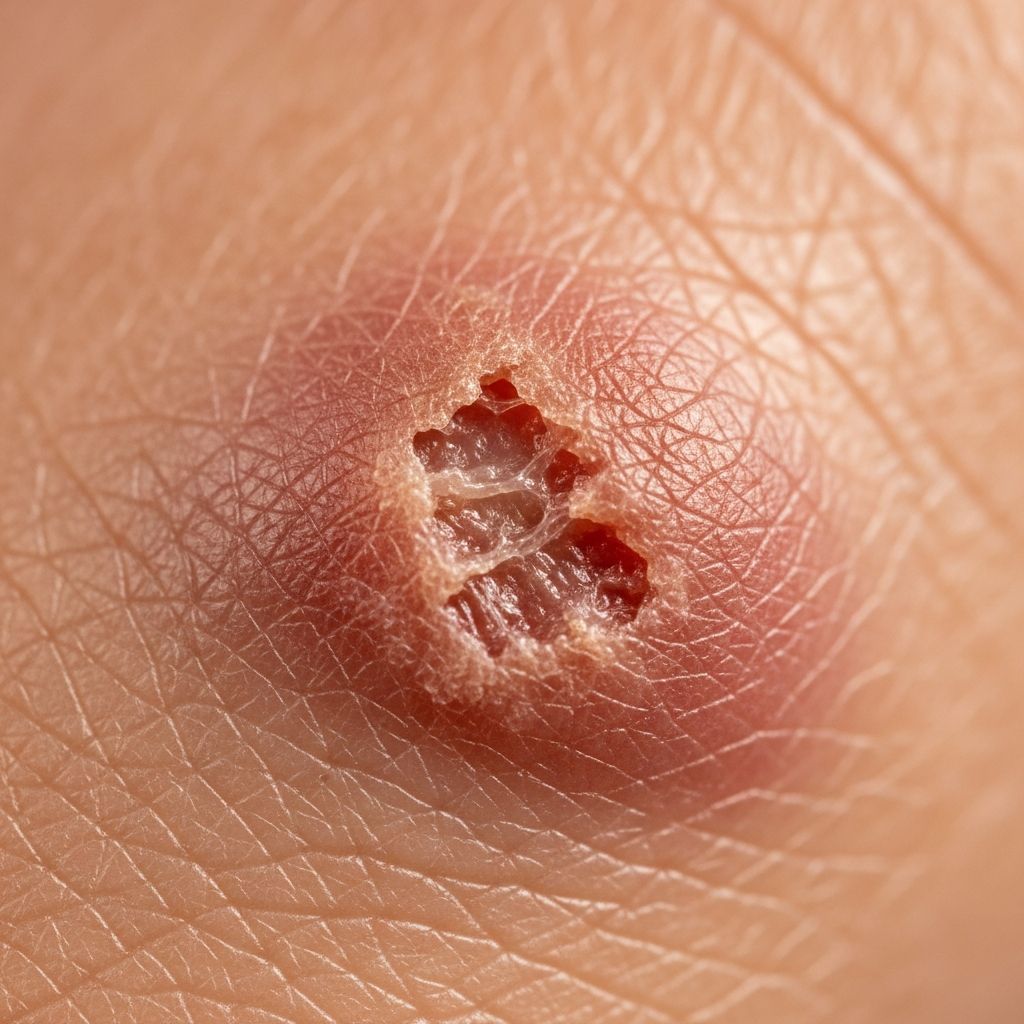
Cutaneous SCC presents as enlarging, scaly, or crusted lumps, often arising from actinic keratosis. Common features include persistent, firm nodules with hyperkeratosis, ulceration, or bleeding, typically on sun-damaged skin.
Distinct clinical types include:
- Classic SCC: Firm, hyperkeratotic papule or plaque.
- Morphaic or sclerosing: Sclerosing plaque with indistinct borders, often on the face.
- Verrucous: Warty, exophytic growth.
- Cutaneous horn: Cone-shaped keratin projection.
- Intraepidermal SCC (in situ): Bowen disease—red, scaly patch.
High-risk sites include ears, lips, scalp, genitalia, and digits. Poorly differentiated tumors appear more aggressive with irregular borders.
How is the diagnosis of cutaneous squamous cell carcinoma made?
Diagnosis begins with clinical examination of suspicious lesions, followed by skin biopsy for histopathological confirmation. Shave, punch, or excisional biopsy reveals invasive atypical keratinocytes beyond the epidermis, graded as well, moderate, poor, or anaplastic differentiation.
Staging assesses risk:
| Low-risk features | High-risk features |
|---|---|
| <2 cm diameter Well-differentiated Superficial dermis invasion Sun-exposed non-high-risk site | >2 cm diameter Poorly differentiated Perineural invasion Immunosuppression Recurrent or ear/lip location |
Imaging (CT/MRI/PET) or sentinel lymph node biopsy evaluates advanced cases for metastasis.
What is the treatment for cutaneous squamous cell carcinoma?
Treatment prioritizes complete excision for cure. Surgical options include:
- Mohs micrographic surgery: Preferred for high-risk sites (face, ears) ensuring 100% margin control, ideal for >2 cm lesions or recurrent tumors.
- Standard excision: With 4-6 mm margins for low-risk SCC.
- Curettage and electrodessication: For small, low-risk lesions.
Non-surgical alternatives for inoperable or elderly patients:
- Cryotherapy, topical 5-FU/imiquimod, photodynamic therapy, or radiation.
Advanced/metastatic SCC requires multidisciplinary care: systemic therapy (e.g., cemiplimab immunotherapy), chemotherapy, or targeted EGFR inhibitors.
What is the outlook for cutaneous squamous cell carcinoma?
Most cutaneous SCC is curable, with 95-99% 5-year survival for localized disease and overall mortality of 1-2%. Metastasis occurs in 2-5%, primarily to lymph nodes (80%), then lungs, liver, brain, bones; single node metastasis yields 90% 5-year survival.
High-risk factors worsen prognosis: immunosuppression, perineural invasion, poor differentiation increase recurrence (10-20%) and metastasis risk up to 70% mortality in advanced cases. Early detection via regular skin checks is crucial.
How can cutaneous squamous cell carcinoma be prevented?
Prevention focuses on UV protection:
- Sun avoidance: 10 AM-4 PM, seek shade.
- Protective clothing: Hats, long sleeves, UPF clothing.
- Sunscreen: Broad-spectrum SPF 50+ reapplied every 2 hours.
- Regular screening: Annual dermatologist exams, especially high-risk groups.
- Avoid tanning beds and manage immunosuppression.
Treating actinic keratoses early prevents progression.
Frequently Asked Questions
Is squamous cell carcinoma deadly?
Most are not; early treatment cures 95-99%. High-risk or metastatic cases can be fatal.
Can squamous cell carcinoma spread?
Yes, rarely (2-5%), mainly to lymph nodes, but slowly.
How fast does squamous cell carcinoma grow?
Variable; low-risk slowly, high-risk can invade locally within months.
Is squamous cell carcinoma worse than basal cell?
SCC metastasizes more often than BCC, though both are curable early.
What happens if squamous cell carcinoma is left untreated?
It grows, invades tissue, and may metastasize, risking death.
References
- Squamous Cell Carcinoma: What it is, Causes & Treatment — Cleveland Clinic. 2023-10-27. https://my.clevelandclinic.org/health/diseases/17480-squamous-cell-carcinoma
- Cutaneous squamous cell carcinoma — DermNet NZ. 2024-05-15. https://dermnetnz.org/topics/cutaneous-squamous-cell-carcinoma
- Squamous cell carcinoma of the skin – Symptoms and causes — Mayo Clinic. 2023-11-07. https://www.mayoclinic.org/diseases-conditions/squamous-cell-carcinoma/symptoms-causes/syc-20352480
- Cutaneous Squamous Cell Carcinoma — NCBI StatPearls. 2023-12-11. https://www.ncbi.nlm.nih.gov/books/NBK441939/
- What Are Basal and Squamous Cell Skin Cancers? — American Cancer Society. 2024-01-17. https://www.cancer.org/cancer/types/basal-and-squamous-cell-skin-cancer/about/what-is-basal-and-squamous-cell.html
- Overview of Cutaneous Squamous Cell Carcinoma — American Journal of Managed Care. 2023-06-20. https://www.ajmc.com/view/overview-of-cutaneous-squamous-cell-carcinoma
Similar Articles



Read full bio of medha deb