Undefined JAK Inhibitors: 4 Key Insights For Eczema
Discover how JAK inhibitors are transforming eczema management through targeted immune modulation and promising clinical outcomes.
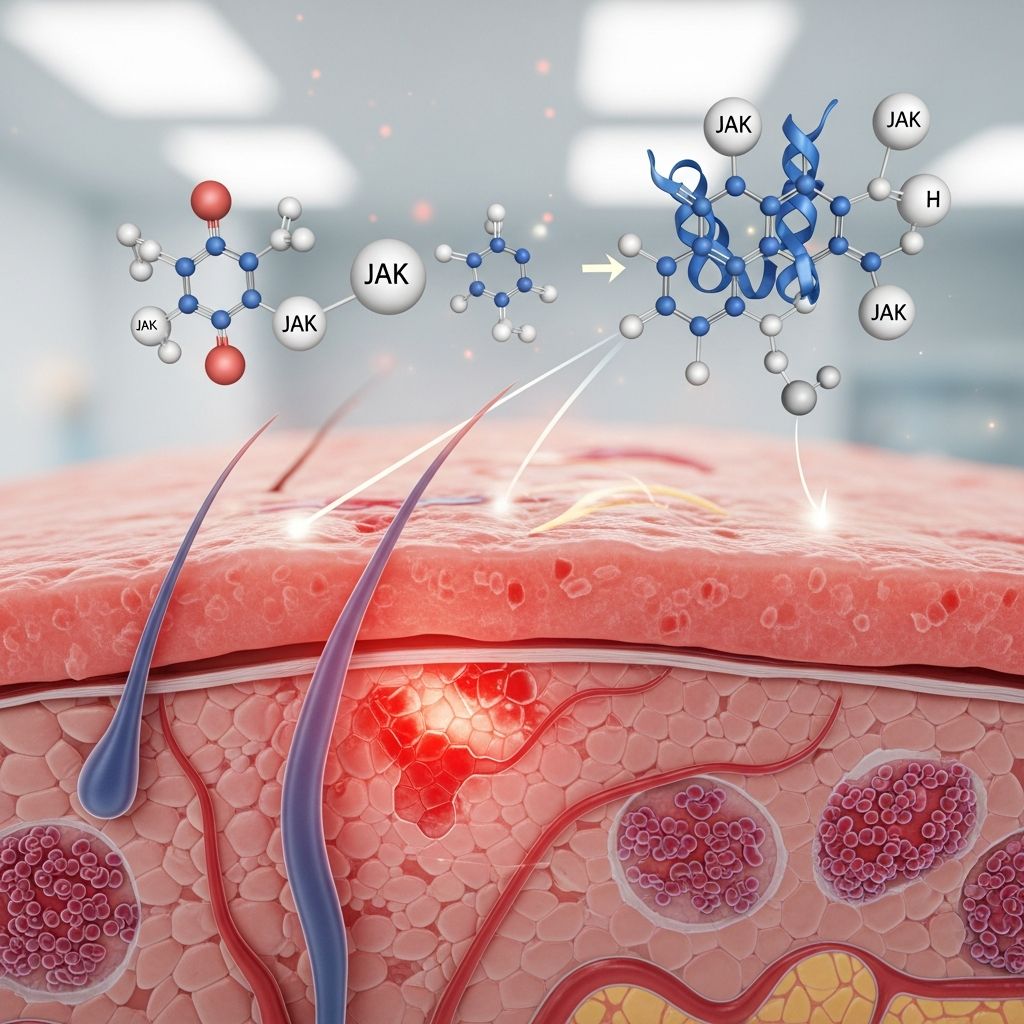
Janus kinase (JAK) inhibitors have emerged as a revolutionary class of medications for managing atopic dermatitis, commonly known as eczema. These oral and topical small-molecule drugs precisely target the JAK-STAT signaling pathway, which drives excessive inflammation in the skin.
The Science Behind JAK-STAT Signaling in Skin Inflammation
The JAK-STAT pathway serves as a critical intracellular communication system that relays signals from cytokines—small proteins that regulate immune responses—to the cell nucleus. When pro-inflammatory cytokines such as interleukin-4 (IL-4), IL-13, IL-31, and interferon-gamma (IFN-γ) bind to receptors on skin cells like keratinocytes and immune cells, they activate associated JAK enzymes.
There are four main JAK family members: JAK1, JAK2, JAK3, and TYK2. These enzymes phosphorylate signal transducer and activator of transcription (STAT) proteins, which then dimerize, enter the nucleus, and trigger gene expression that promotes inflammation, itch, and barrier dysfunction in eczema. For instance, JAK1 pairs with JAK3 to transduce IL-4 and IL-13 signals, central to Th2-driven eczema pathology, while TYK2 contributes to IFN-γ pathways in Th1 responses.
- JAK1: Involved in multiple cytokines including IL-6, IL-10, and type I interferons; key for atopic dermatitis and alopecia areata.
- JAK2: Supports erythropoiesis and IFN-γ signaling; less dominant in eczema but relevant in broader inflammation.
- JAK3: Exclusive to gamma-chain cytokines (IL-2, IL-4, IL-7, IL-9, IL-15, IL-21); highly specific for adaptive immunity.
- TYK2: Aids IL-12, IL-23, and type I IFN pathways; implicated in psoriasis but also eczema flares.
JAK inhibitors disrupt this cascade by competing for the ATP-binding site in the kinase domain, preventing phosphorylation and downstream effects. This selectivity varies: some drugs pan-inhibit all JAKs, while others preferentially target JAK1 or JAK3 for tailored efficacy.
From Bench to Bedside: Development of JAK Inhibitors for Eczema
Research into JAK inhibitors accelerated after insights into their role in autoimmune diseases. Early compounds like tofacitinib, initially for rheumatoid arthritis, showed skin benefits, paving the way for dermatology applications. Topical formulations addressed systemic side effect concerns, making them ideal for chronic skin conditions like eczema.
The first JAK inhibitor approved for eczema was ruxolitinib cream (Opzelura) in 2021, targeting JAK1 and JAK2. It rapidly reduces itch and lesions by locally blocking cytokine signaling without broad immunosuppression. Oral options like abrocitinib (Cibinqo, JAK1-selective) and upadacitinib (Rinvoq, JAK1-preferential) followed, offering convenience for moderate-to-severe cases.
| Drug Name | Type | Primary JAK Targets | Approval Year (Eczema) | Key Benefits |
|---|---|---|---|---|
| Ruxolitinib (Opzelura) | Topical cream | JAK1, JAK2 | 2021 | Fast itch relief, suitable for mild-moderate eczema |
| Abrocitinib (Cibinqo) | Oral | JAK1 | 2021 | High efficacy in severe cases, once-daily dosing |
| Upadacitinib (Rinvoq) | Oral | JAK1 > JAK2,3, TYK2 | 2022 | Broad cytokine inhibition, rapid EASI score improvement |
| Lebrikizumab (Ebglyss) | Injectable (not JAK but comparator) | IL-13 blocker | 2023 | Complements JAK therapy |
Clinical Evidence Supporting Efficacy
Pivotal trials like JADE MONO-1/2 for abrocitinib demonstrated 40-60% of patients achieving clear or almost clear skin (IGA 0/1) at week 12, far surpassing placebo. Similarly, ruxolitinib cream trials (TRuE-AD) showed 50% lesion reduction in just 8 weeks for mild cases. These outcomes stem from inhibiting itch-inducing IL-31 (via JAK1/JAK3-STAT5) and barrier-disrupting IL-4/IL-13 (JAK1/2-STAT6).
Related Stories



Real-world data reinforces this: patients report sustained remission with combination topical JAK inhibitors and emollients. Pediatric approvals, such as ruxolitinib for ages 12+, expand access. Head-to-head studies position JAK inhibitors comparably to dupilumab, with orals preferred for needle-phobic patients.
Safety Profile and Risk Management
While effective, JAK inhibitors carry black-box warnings for serious infections, malignancy, thrombosis, and cardiovascular events, based on oral rheumatoid arthritis data. Topical forms minimize systemic exposure, showing acne at application sites as the main adverse event (7-10%).
Oral agents require baseline labs (lipids, CBC, LFTs) and monitoring. JAK1-selectivity may reduce hematologic risks versus pan-inhibitors. Long-term extensions (up to 4 years) report no new signals beyond known class effects. Contraindications include active infections and recent live vaccines.
- Common side effects (topical): Application-site acne, nasopharyngitis, headache.
- Serious risks (oral): Herpes zoster (use vaccination), anemia, elevated cholesterol.
- Monitoring: Quarterly labs first year, then biannual.
Comparing JAK Inhibitors to Traditional and Biologic Therapies
Topicals like corticosteroids offer quick relief but risk atrophy; calcineurin inhibitors avoid this but burn. Biologics (dupilumab, tralokinumab) target single cytokines effectively but require injections. JAK inhibitors bridge gaps: topicals for localized control, orals for widespread disease.
Cost-effectiveness favors generics emerging post-patent, though biologics may win in severe refractory cases. Patient preference leans toward orals for lifestyle fit.
Emerging Research and Future Directions
Ongoing trials explore JAK3-selective inhibitors like ritlecitinib for alopecia areata spillover to eczema, and TYK2 allosteric modulators for milder profiles. Combination therapies (JAK + PDE4 inhibitors) aim at multi-pathway blockade. Pediatric and head/neck studies address unmet needs.
Biomarker research identifies STAT phosphorylation levels as predictors of response, enabling precision medicine. Long-term registries track malignancy risks in eczema cohorts, distinct from rheumatology.
Practical Guidance for Patients and Providers
Start with topicals for face/body maintenance; escalate to orals if EASI >16 or failed topicals/biologics. Educate on “flare prevention” via trigger avoidance alongside therapy. Multidisciplinary care integrates allergists for food-related eczema.
Frequently Asked Questions (FAQs)
Are JAK inhibitors safe for long-term eczema use?
Yes, with monitoring; topicals show excellent safety, orals require risk assessment.
Can children use JAK inhibitors?
Ruxolitinib approved >12 years; trials ongoing for younger.
How quickly do they work?
Itch relief in days, skin clearance in 2-4 weeks.
Do they cure eczema?
No, they control symptoms; relapse possible upon stopping.
Interactions with other meds?
Avoid strong CYP3A4 inhibitors; check with pharmacist.
JAK inhibitors mark a paradigm shift in eczema care, offering targeted relief where legacy treatments fall short. Consult dermatologists for personalized plans.
References
- Mechanism of Action of JAK Inhibitors — YouTube (Animation). 2023. https://www.youtube.com/watch?v=dnnsqiDjAgM
- Basic Mechanisms of JAK Inhibition — PMC (PubMed Central). 2020-07-10. https://pmc.ncbi.nlm.nih.gov/articles/PMC7361186/
- Understanding the Mechanism of Action in JAK Inhibitors — Dermatology Times. 2023. https://www.dermatologytimes.com/view/understanding-the-mechanism-of-action-in-jak-inhibitors
- Janus kinase inhibitors: Mechanisms of action — Australian Prescriber. 2022. https://australianprescriber.tg.org.au/articles/janus-kinase-inhibitors-mechanisms-of-action.html
- Janus kinase inhibitors for the therapy of atopic dermatitis — PMC (PubMed Central). 2021. https://pmc.ncbi.nlm.nih.gov/articles/PMC8439108/
- Upadacitinib: Mechanism of action, clinical, and translational science — Wiley (ASCPT). 2022. https://ascpt.onlinelibrary.wiley.com/doi/10.1111/cts.13688
Similar Articles








Read full bio of Sneha Tete