Jet Lag: Causes, Symptoms, Treatment & Prevention
Understanding jet lag: comprehensive guide to causes, symptoms, and effective treatment strategies.
What is Jet Lag?
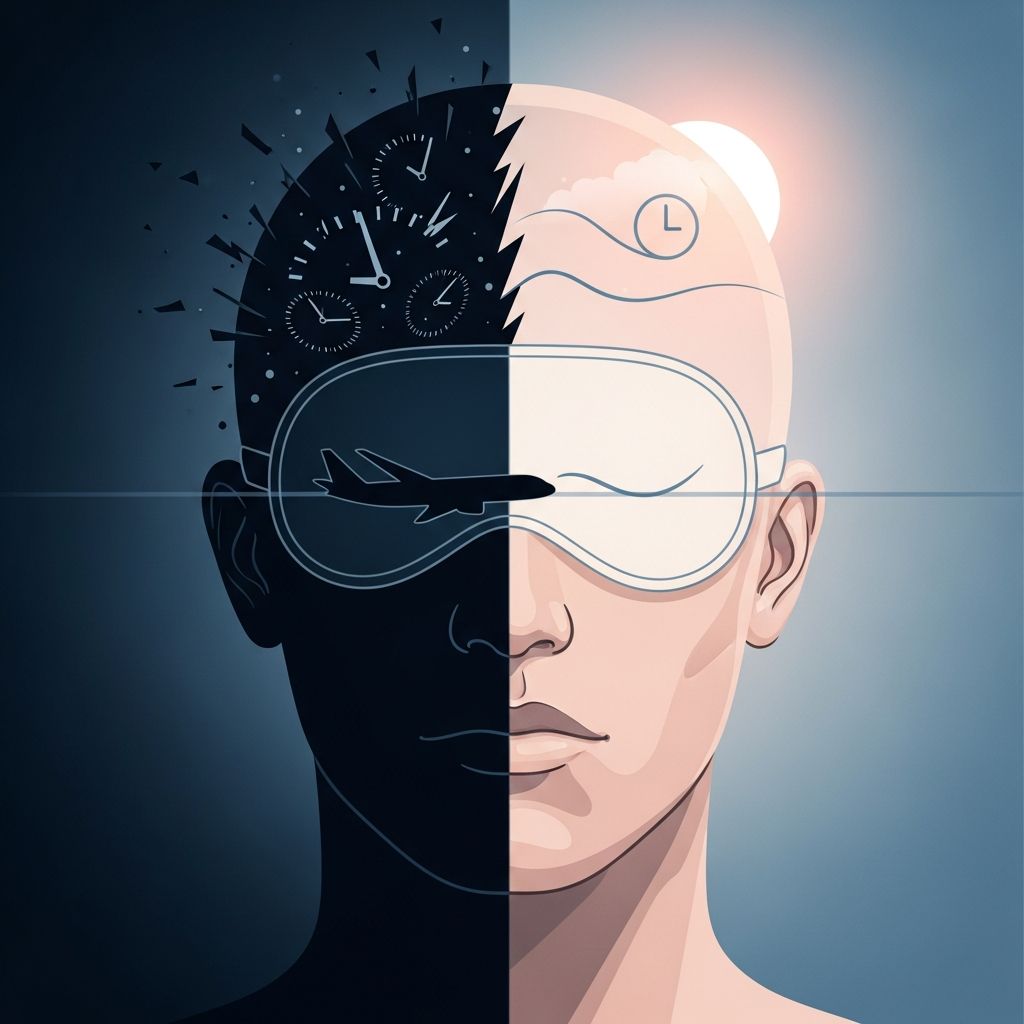
Jet lag, also known as desynchronosis or jet lag sleep disorder, is a temporary sleep condition that affects individuals who rapidly travel across multiple time zones by airplane. Unlike common misconceptions, jet lag is not simply caused by a lack of sleep during flight. Instead, it results from a misalignment between your body’s internal circadian rhythm and the external light-dark cycle of your destination. Your internal clock, regulated by 24-hour biological cycles, remains anchored in your departure time zone while your body physically travels to a new location. This dyssynchrony between your biological clock and the actual time at your destination creates the uncomfortable symptoms associated with jet lag.
Jet lag is considered a normal consequence of modern air travel and is classified as a circadian rhythm disorder. The condition typically resolves naturally within days to weeks, depending on the number of time zones crossed and individual factors. However, understanding the mechanisms behind jet lag and implementing evidence-based strategies can significantly reduce symptom severity and accelerate recovery.
Understanding Circadian Rhythms and How They Affect Jet Lag
Your circadian rhythm is your body’s internal 24-hour biological clock that regulates numerous physiological processes, including sleep-wake cycles, body temperature, hormone release, and digestive function. The suprachiasmatic nucleus (SCN), a small region in the brain’s hypothalamus, acts as your body’s master clock, synchronizing these biological processes with the external environment through exposure to light and other environmental cues.
The adjustment capacity of your internal clock is limited. Your circadian pacemaker can naturally shift approximately one to one and a half hours per day at most. This means that if you cross a nine-hour time zone difference, your body requires approximately six to nine days to fully adjust, even under optimal conditions. The more time zones you cross, the longer adjustment takes and the more severe your symptoms become.
Light is the most powerful regulator of your circadian rhythm. When light enters your eyes, specialized cells on the retina send signals to your brain about whether it is day or night, helping to set and adjust your internal clock. This fundamental mechanism explains why strategic light exposure and avoidance are among the most effective non-pharmaceutical interventions for jet lag recovery.
Symptoms of Jet Lag
Jet lag manifests through a variety of symptoms that can significantly impact your productivity, mood, and overall well-being during travel. Common symptoms include:
- Daytime drowsiness and excessive fatigue
- Insomnia and difficulty falling or staying asleep
- Headaches and general malaise
- Difficulty concentrating and impaired cognitive function
- Gastrointestinal distress, including nausea, constipation, or diarrhea
- Mood swings, irritability, and emotional disturbances
- Reduced appetite or unusual hunger patterns
- General disorientation and confusion
Symptom severity depends on multiple factors, including the number of time zones crossed, direction of travel, individual chronotype (whether you are naturally a morning or evening person), age, and overall health status. Some individuals are more sensitive to time zone changes and may experience noticeable symptoms after crossing just two time zones, while others might tolerate three or four-hour differences with minimal disruption.
Eastward vs. Westward Travel: Which Direction Causes Worse Jet Lag?
An important distinction exists between eastward and westward travel. Flying eastward typically produces more severe and longer-lasting jet lag symptoms than flying westward. This asymmetry occurs because your body adapts more easily to staying awake longer (phase delay) than to going to bed earlier than normal (phase advance). When flying eastward, you arrive at your destination having “lost” hours from your day, requiring your body to advance its clock earlier. Your body naturally resists this phase advance, making adjustment more difficult.
Related Stories



Conversely, westward travel involves a phase delay, allowing your internal clock more time to catch up. Your body finds it easier to stay up later than to fall asleep significantly earlier, making westward travel generally easier to tolerate. For example, flying from New York to Los Angeles (a three-hour westward journey) typically causes less severe jet lag than flying the same distance eastward.
Duration of Jet Lag Symptoms
Jet lag is not a permanent condition and resolves naturally through circadian re-entrainment, the process by which your internal clock gradually synchronizes with your new environment. The duration of symptoms depends primarily on the number of time zones crossed:
- Crossing one to two time zones: Symptoms typically resolve within one to two days
- Crossing three to five time zones: Recovery generally takes three to five days
- Crossing six to nine time zones: Adjustment may require six to nine days or longer
- Crossing ten or more time zones: Full adjustment can take two weeks or more
Individual variation is considerable. Some travelers recover quickly while others require additional time, even with identical time zone crossings. Age also plays a role, with older adults sometimes experiencing slower adjustment than younger travelers.
Nondrug Therapies for Jet Lag Management
Multiple evidence-based non-pharmaceutical strategies can effectively reduce jet lag symptoms and accelerate circadian re-entrainment.
Strategic Light Exposure
Light exposure is the most powerful environmental regulator of your circadian rhythm and represents the cornerstone of jet lag management. Experts recommend obtaining at least ten minutes of sunlight exposure within 30 to 60 minutes of waking at your destination. The timing and intensity of light exposure should be strategically planned based on your direction of travel:
- For eastward travel: Seek morning light exposure at your destination to advance your circadian clock earlier
- For westward travel: Seek afternoon and evening light exposure to delay your circadian clock later
- Avoid bright light: Between 10 P.M. and 4 A.M. in your new destination, particularly during the first few days
Additionally, consider wearing sunglasses to block bright light during times when you want to sleep, and maximize your exposure to natural daylight when you want to remain alert.
Sleep Environment Optimization
Creating an optimal sleep environment supports faster circadian adjustment. Maintain a cool room temperature (around 65-68°F), ensure complete darkness or use blackout curtains, minimize noise, and establish consistent pre-sleep routines. Avoiding screens and blue light one to two hours before bed can further improve sleep quality during the adjustment period.
Pre-Travel Preparation
Adjusting your sleep schedule several days before departure can ease the transition. The Mayo Clinic recommends:
- For eastward flights: Going to bed one hour earlier each night for three to five days before departure
- For westward flights: Going to bed one hour later for several nights before travel
This gradual adjustment begins the circadian re-entrainment process before you travel, reducing the total adjustment burden at your destination.
Dietary Strategies
Recent research published in Chaos, an Interdisciplinary Journal of Nonlinear Science, suggests that meal timing and composition significantly influence circadian adjustment. Computational experiments studying six-hour time zone crossings found that eating a substantial breakfast in the morning at your new destination, followed by lighter lunch and dinner meals, more effectively synchronizes your circadian rhythm than consuming three evenly portioned meals throughout the day. This approach works better during the critical first three days of adjustment, when your circadian rhythm is most malleable.
Pharmacological Treatments for Jet Lag
Several medications can help alleviate jet lag symptoms or improve sleep quality during circadian adjustment, though non-pharmaceutical approaches should be considered first.
Melatonin
Melatonin is a natural hormone produced by your pineal gland that regulates sleep-wake cycles. Supplemental melatonin can improve sleep and alleviate daytime jet lag symptoms. Immediate-release melatonin preparations appear more effective than slow-release formulations. Dosing typically ranges from 0.5 to 10 mg, with timing strategically planned based on travel direction. Melatonin should be taken in the evening at your destination to promote sleep and advance your circadian rhythm more quickly.
Sedative-Hypnotic Medications
Prescription sleep medications such as zopiclone (5 to 7.5 mg) have demonstrated favorable outcomes in counteracting jet-lag-induced insomnia for both eastward and westward travel. These medications should be used judiciously and only when other strategies prove insufficient, as they carry risks of dependency and side effects.
Caffeine and Stimulants
Caffeine can strategically enhance alertness during times when you need to remain awake, particularly during the adjustment period. However, consumption should be timed carefully to avoid interfering with sleep at appropriate times. Avoid caffeine within six to eight hours of your intended sleep time.
Pre-Flight and In-Flight Strategies
Preparation before and during your flight significantly impacts post-arrival adjustment.
Before Your Flight
- Gradually shift your sleep schedule toward your destination’s time zone
- Stay well-hydrated and maintain healthy eating patterns
- Ensure adequate sleep before travel to minimize sleep debt
- Consult your healthcare provider about appropriate interventions for your specific travel plans
During Your Flight
- Adjust your watch and mental clock to your destination’s time zone immediately after takeoff
- Avoid excessive alcohol and caffeine, as both disrupt sleep quality and delay circadian adjustment
- Stay hydrated with water and herbal tea
- Move around the cabin periodically to promote circulation and alertness
- Use strategic napping aligned with your destination’s nighttime hours
- Manage light exposure during the flight when possible
Frequently Asked Questions
Q: How quickly can my body adjust to a new time zone?
A: Your circadian rhythm can shift approximately one to one and a half hours per day at most. Therefore, complete adjustment typically requires one day per one to two time zones crossed, though individual variation exists.
Q: Is jet lag the same as simply being tired from travel?
A: No. Jet lag is distinct from general travel fatigue caused by sleep deprivation during flights. While both can occur simultaneously, jet lag specifically results from circadian rhythm misalignment with your new environment and persists until your internal clock re-synchronizes.
Q: Why is eastward travel harder on my body than westward travel?
A: Your body finds it easier to stay awake longer (westward phase delay) than to fall asleep significantly earlier (eastward phase advance). This natural preference makes eastward travel more challenging for most people.
Q: Can melatonin prevent jet lag?
A: Melatonin can help improve sleep and alleviate symptoms when taken strategically, but it does not completely prevent jet lag. It works best as part of a comprehensive approach including light exposure management and sleep schedule adjustment.
Q: Does my age affect how severe jet lag is?
A: Yes. Age influences both symptom severity and adjustment duration. Older adults may experience more pronounced symptoms and require longer adjustment periods than younger travelers.
Q: Should I sleep on the airplane?
A: Strategic napping aligned with your destination’s nighttime can help. For eastward travel, sleeping on the plane helps you stay rested, though minimizing sleep may be preferable to ease the phase advance. For westward travel, sleeping longer on the plane can be beneficial since staying awake later is easier for your body.
References
- Circadian Rhythm Disorders: Symptoms, Treatment & Types — Cleveland Clinic. Accessed December 2025. https://my.clevelandclinic.org/health/diseases/12115-circadian-rhythm-disorders
- The New Cure for Jet Lag May Be a Big Breakfast — Outside Magazine. Accessed December 2025. https://www.outsideonline.com/adventure-travel/advice/jet-lag-cure/
- Jet lag and shift work sleep disorders: How to help reset the internal clock — Cleveland Clinic Journal of Medicine, Vol. 78, No. 10. October 2011. https://www.ccjm.org/content/ccjom/78/10/675.full.pdf
- Jet lag and shift work sleep disorders: how to help reset the internal clock — PubMed/NCBI. Accessed December 2025. https://pubmed.ncbi.nlm.nih.gov/21968474/
- Jet lag sleep disorder and shift work sleep disorder — Semantic Scholar. Accessed December 2025. https://www.semanticscholar.org/paper/Jet-lag-and-shift-work-sleep-disorders:-How-to-help-Kolla-augeR/6c8f70d4323004f21fb5b7c2d7d8b0a88c339e2b
- Jet lag and shift work sleep disorders: how to help reset the internal clock — PubMed Central. Accessed December 2025. https://pubmed.ncbi.nlm.nih.gov/21968474/
Similar Articles








Read full bio of medha deb