Job Syndrome: Complete Guide To Causes, Symptoms & Treatment
Rare inherited immune deficiency causing severe recurrent skin infections, high IgE levels, and multi-organ involvement.

Author: Hon A/Prof Amanda Oakley, Dermatologist, Waikato Hospital, Hamilton, New Zealand. Updated: 2025.
What is Job syndrome?
Job syndrome, also called
hyper-IgE syndrome
(HIES), is a rare inherited immune deficiency characterised by severe infections of the skin and other organs. It is a primary immunodeficiency disorder with autosomal dominant (AD-HIES, classic Job syndrome) and autosomal recessive forms. The name derives from the biblical Job, who suffered draining skin sores and pustules.Prevalence is less than 1 in 1,000,000. AD-HIES results from STAT3 gene mutations on chromosome 17q21, impairing Th17 cell differentiation, IL-17 production, and immune responses to extracellular bacteria and fungi. This leads to defective neutrophil chemotaxis, excessive interferon-gamma, and markedly elevated serum IgE (>2000 IU/mL).
Autosomal recessive HIES (AR-HIES) involves mutations in IL12RB1, IL12B, SPINK5, TYK2, STAT3 (different), or ERBB2IP genes, with more viral infections and malignancy risk but fewer skeletal issues.
Who gets Job syndrome?
Job syndrome affects both sexes equally. Symptoms often start in infancy with neonatal rash. AD-HIES presents early with eczema and infections; AR-HIES later with lung involvement.
What causes Job syndrome?
Heterozygous dominant-negative STAT3 mutations cause AD-HIES (70-90% of cases). These disrupt signal transducer and activator of transcription 3, vital for cytokine signaling in immune cells, epithelium, and connective tissue. Impaired Th17 immunity increases susceptibility to Staphylococcus aureus, Candida, and extracellular pathogens.
Defective chemokine-induced neutrophil chemotaxis causes ‘cold’ abscesses lacking typical inflammatory signs. High IgE promotes eosinophilia and atopy-like dermatitis.
What are the clinical features of Job syndrome?
**Immunological features** predominate early:
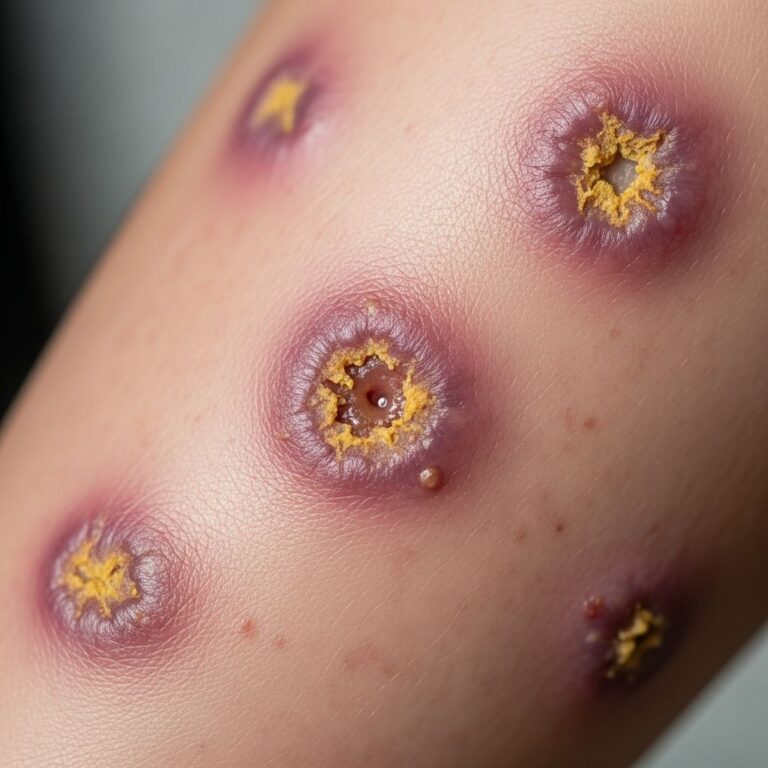
- Recurrent skin infections: Cold staphylococcal abscesses (boils without pain/redness), impetigo, cellulitis, ecthyma. Abscesses form ‘punched-out’ scars.
- Eczema: Neonatal papulopustular rash on scalp/face evolves to crusted eczematoid dermatitis; 65% meet atopic dermatitis criteria.
- Mucocutaneous candidiasis: Persistent oral/perianal/nail infections.
- Recurrent pneumonias: S. aureus, H. influenzae, Pseudomonas; lead to pneumatoceles, bronchiectasis.
- High IgE (>2000 IU/mL), eosinophilia (>700/μL), low IFN-γ production.
**Non-immunological features** (more in AD-HIES) develop later:
- Characteristic facies: Broad nose, deep-set eyes, prominent forehead, thick lips, facial asymmetry (by adolescence).
- Skeletal abnormalities: Scoliosis, fractures (minimal trauma), hyperextensible joints, retained primary teeth.
- Craniofacial: High-arched palate, prominent palatal ridges.
- Vascular: Coronary artery aneurysms, tortuous vessels.
Dermatological manifestations are key early signs:
- Neonatal rash (scalp/face, eosinophilic).
- Cold abscesses, cellulitis.
- Mucocutaneous candidiasis, onychomycosis.
- Psoriasis/psoriasiform lesions (rare).
- Fusarium infections, noma neonatorum.
Diagnosis of Job syndrome
Diagnosis combines clinical, laboratory, and genetic findings. NIH score for AD-HIES: ≥40 points probable; genetic confirmation definitive.
| Feature | Points |
|---|---|
| Highest IgE >2000 IU/mL | 3 |
| Skin abscesses (>2) | 3 |
| Recurrent pneumonias (>3) | 3 |
| Retained primary teeth | 2 |
| Scoliosis | 2 |
| Characteristic facies | 2 |
| Fractures | 1 |
Laboratory: IgE, eosinophilia, low IgM sometimes; STAT3 sequencing.
Differentiate from atopic dermatitis, Wiskott-Aldrich, Netherton syndrome.
Treatment of Job syndrome
No cure; multidisciplinary management.
- Infections: Prolonged antibiotics (e.g., trimethoprim-sulfamethoxazole prophylaxis). Drain abscesses.
- Candidiasis: Topical/systemic antifungals.
- Eczema: Emollients, topical steroids, calcineurin inhibitors.
- Immunomodulators: Prophylactic trimethoprim-sulfamethoxazole, itraconazole; IVIG if needed.
- Skeletal/lung: Monitor scoliosis, lung function; HSCT for severe cases.
- Experimental: JAK inhibitors, anti-IL-4/IL-13 for eczema.
Related Stories



What is the outcome for Job syndrome?
Improved survival with prophylaxis (median >40 years). Complications: bronchiectasis, pneumatoceles, infections, malignancy (AR-HIES). Regular monitoring essential.
Frequently Asked Questions (FAQs)
Q: Is Job syndrome curable?
A: No cure exists, but prophylactic antibiotics, antifungals, and supportive care control symptoms effectively.
Q: Why are abscesses ‘cold’ in Job syndrome?
A: Defective neutrophil recruitment causes minimal inflammation/pain.
Q: Does Job syndrome affect adults?
A: Yes, non-immune features progress; lifelong management required.
Q: Can Job syndrome be prevented?
A: Genetic counselling for families with known mutations.
Main menu
Common skin conditions | NEWS | Join DermNet PRO | Quick links
References
- Dermatologic presentations of hyper IgE syndrome in pediatric patients — PMC/NCBI. 2024. https://pmc.ncbi.nlm.nih.gov/articles/PMC12049024/
- Job syndrome (hyper-IgE syndrome) — DermNet NZ. 2024. https://dermnetnz.org/topics/job-syndrome
- Hyperimmunoglobulin E Syndrome — UF Health. 2025. https://ufhealth.org/conditions-and-treatments/hyperimmunoglobulin-e-syndrome/
- Hyper IgE (Job) Syndrome: Causes, Symptoms & Treatment — Cleveland Clinic. 2025. https://my.clevelandclinic.org/health/diseases/hyper-ige-syndrome/
- Autosomal Dominant Hyper IgE Syndrome — NORD. 2024. https://rarediseases.org/rare-diseases/autosomal-dominant-hyper-ige-syndrome/
- Autosomal dominant hyper-IgE syndrome — MedlinePlus Genetics/NIH. 2025. https://medlineplus.gov/genetics/condition/autosomal-dominant-hyper-ige-syndrome/
- Hyper IgE syndrome — Immune Deficiency Foundation. 2024. https://primaryimmune.org/understanding-primary-immunodeficiency/types-of-pi/hyper-ige-syndrome/
Similar Articles








Read full bio of Sneha Tete