Joints in the Human Body: Anatomy, Types & Function
Understanding joint structure, types, and function in your skeletal system.
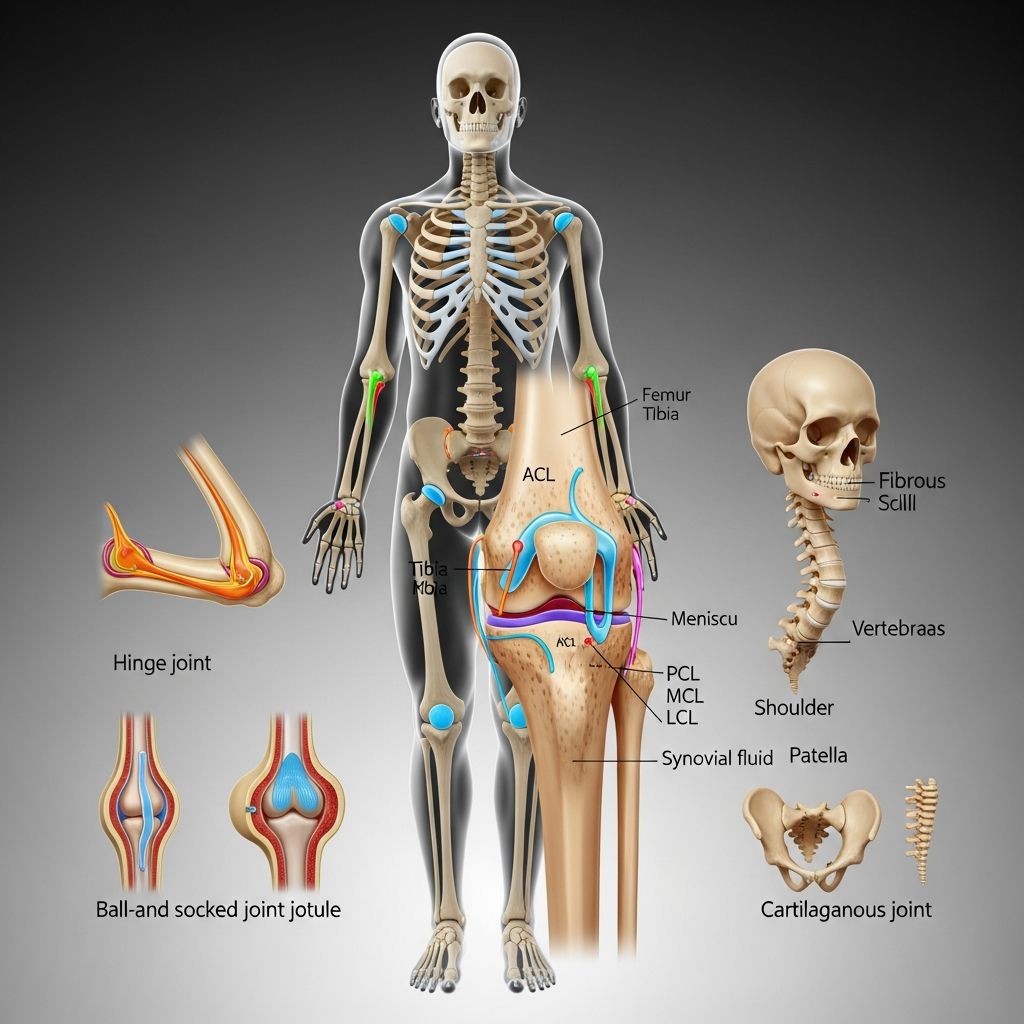
A joint is any place in your body where two bones meet, forming a fundamental component of your skeletal system. Joints are also referred to as articulations and serve as critical connection points that enable movement, provide stability, and allow your body to function effectively. Understanding the anatomy and types of joints helps explain how your body moves and maintains structural integrity.
What Are Joints?
Joints represent the intersection points where two or more bones connect. These connections are not simply rigid attachments; instead, they are sophisticated biological structures designed to facilitate movement while maintaining stability. Your body contains numerous joints, each with specific characteristics that suit their particular function and location. Whether you’re walking, reaching, or simply maintaining posture, joints are working to enable these activities through their unique structural design.
The term articulation is used interchangeably with joint in anatomical contexts, both referring to the same fundamental concept of bone-to-bone connections. These connections are supported by various tissues including cartilage, ligaments, tendons, and synovial fluid, all working together to create functional movement points throughout your body.
Types of Joints
Your body contains several different types of joints, each classified based on their structure and the degree of movement they allow. Understanding these classifications helps explain why certain joints can move freely while others have limited mobility or are essentially fixed.
Synovial Joints
Synovial joints represent the most mobile classification of joints and have the most freedom to move throughout your body. These joints are characterized by their unique structural design, which includes a cavity in one bone that another bone fits into, similar to a ball-and-socket arrangement. This design allows for a greater range of motion compared to other joint types.
The ends of bones that comprise a synovial joint are covered with slippery hyaline cartilage, a specialized tissue that reduces friction during movement. A synovial membrane—a fluid-filled sac that lines the space between the bones—provides lubrication and protection for the joint. This extra cushioning helps synovial joints move with minimal friction, enabling smooth and relatively pain-free motion. Examples of synovial joints include your shoulders, hips, knees, and elbows, all capable of substantial movement in multiple directions.
Fibrous Joints
Fibrous joints are characterized by dense fibrous connective tissue that holds bones together with little to no movement allowed. These joints are primarily found in the skull, where the bones of the cranium are connected by immovable joints called sutures. The tight connections created by fibrous tissue make these joints extremely stable, which is essential for protecting the brain and maintaining the integrity of the skull structure. While these joints lack mobility, their primary function is protection and structural support rather than facilitation of movement.
Cartilaginous Joints
Cartilaginous joints feature cartilage as the primary connecting tissue between bones. These joints allow for limited movement and are found in locations such as the spine, where vertebrae are connected by intervertebral discs. The cartilage in these joints provides some flexibility while maintaining structural stability, making them ideal for areas requiring both support and modest mobility. The intervertebral discs act as shock absorbers and allow for slight bending and twisting movements of the spine.
Related Stories



Joint Structure and Components
Each joint contains several key structural components that work together to enable movement and provide stability. Understanding these components clarifies how joints function and why they are vulnerable to damage or disease.
Cartilage
Cartilage is a smooth, rubbery tissue that covers the ends of bones within joints. Hyaline cartilage, the most common type found in joints, acts as a shock absorber and allows bones to glide smoothly over one another without friction. This tissue is avascular, meaning it lacks its own blood supply, which is why cartilage injuries heal slowly or not at all in severe cases.
Synovial Fluid
Synovial fluid is a thick, viscous substance secreted by the synovial membrane that lubricates the joint, reduces friction during movement, and nourishes the cartilage. This fluid acts as a shock absorber and maintains joint health by distributing nutrients and removing waste products from the joint space.
Ligaments and Tendons
Ligaments are fibrous tissues that connect bone to bone, providing stability and limiting excessive movement. Tendons, by contrast, connect muscle to bone and enable movement by transmitting the force generated by muscle contractions. Both tissues are essential for joint function and injury prevention.
Joint Capsule
The joint capsule is a connective tissue structure that surrounds the joint and contains the synovial fluid. It provides structural support and helps maintain joint stability while allowing for movement within normal ranges.
How Joints Function
Joints function through a coordinated interaction of their structural components, muscles, and nervous system. When muscles contract, they pull on tendons, which in turn move bones at the joints. The smooth cartilage surfaces, combined with synovial fluid lubrication, allow bones to move with minimal friction and wear.
Different joints function in different ways based on their classification and structure. Synovial joints can move in multiple directions, allowing for complex movements like rotating your arm or flexing your leg. Fibrous joints remain relatively fixed, providing stability rather than mobility. Cartilaginous joints allow for slight movement and flexibility, particularly important in the spine where controlled flexibility is necessary for bending and twisting while maintaining spinal integrity.
Major Joints in Your Body
Your body contains numerous joints, but several are particularly significant due to their size, mobility, or importance in daily function.
Shoulder Joint
The shoulder is a ball-and-socket synovial joint that provides the greatest range of motion of any joint in your body. It connects the humerus (arm bone) to the scapula (shoulder blade) and allows for movement in multiple planes, enabling activities like throwing, reaching, and rotating your arm.
Hip Joint
The hip is another ball-and-socket joint that bears significant weight and enables lower body movement. It connects the femur (thighbone) to the pelvis and allows for movement while supporting your body weight during walking, running, and sitting. The hip joint combines substantial load-bearing capacity with considerable mobility.
Knee Joint
The knee is the largest joint in your body, connecting the femur to the tibia (shinbone). It is primarily a hinge joint that allows for bending and straightening while also bearing significant body weight. The knee’s structure makes it both powerful and vulnerable to injury, particularly during activities involving running, jumping, or sudden directional changes.
Ankle Joint
The ankle is a hinge joint that connects the tibia and fibula to the talus bone of the foot. It allows for up-and-down movement of the foot while providing stability during walking and standing. The ankle’s design balances mobility with the need to support and stabilize your body weight.
Spinal Joints
The spine contains multiple cartilaginous joints between vertebrae connected by intervertebral discs. These joints allow for limited movement while providing crucial support for your body and protecting the spinal cord. The vertebral joints enable bending, twisting, and flexing movements while maintaining spinal stability and alignment.
Common Joint Problems and Conditions
Joints can be affected by various conditions that impact their function and cause pain or reduced mobility. Understanding common joint problems helps with early recognition and treatment.
Arthritis
Arthritis represents a group of conditions characterized by joint inflammation, pain, and stiffness. Osteoarthritis, the most common type, develops when protective cartilage wears down over time. Rheumatoid arthritis is an autoimmune condition where the body attacks joint tissues, causing inflammation and damage.
Joint Injuries
Injuries such as sprains, strains, and tears can damage ligaments, tendons, or cartilage. These injuries may result from trauma, overuse, or sudden movements. Proper treatment and rehabilitation are essential for recovery and preventing long-term joint damage.
Osteoporosis
Osteoporosis weakens bones, making them more susceptible to fractures, including those affecting joints. This condition develops when bone density decreases, often due to age, hormonal changes, or nutritional deficiencies.
Maintaining Healthy Joints
Maintaining joint health throughout your life is essential for mobility, independence, and quality of life. Several strategies can help preserve joint function and prevent or delay joint-related problems.
Exercise and Physical Activity
Regular physical activity strengthens muscles supporting joints, improves flexibility, and maintains cartilage health. Low-impact exercises like walking, swimming, and cycling are particularly beneficial for joint health without excessive stress on joint structures.
Healthy Weight Management
Maintaining a healthy weight reduces stress on weight-bearing joints like the knees and hips, decreasing the risk of joint damage and arthritis development. Even modest weight loss can significantly improve joint health and reduce pain in affected joints.
Proper Nutrition
Adequate intake of vitamins and minerals, particularly calcium, vitamin D, and antioxidants, supports bone and cartilage health. A balanced diet provides nutrients necessary for maintaining joint structures and reducing inflammation.
Injury Prevention
Using proper technique during activities, wearing appropriate protective equipment, warming up before exercise, and avoiding sudden high-impact movements help prevent joint injuries. Early treatment of injuries prevents long-term joint damage.
When to Seek Medical Attention
Certain joint symptoms warrant professional medical evaluation. Persistent pain, significant swelling, reduced range of motion, or instability in a joint should be assessed by a healthcare provider. Early diagnosis and treatment of joint conditions often prevents progression and preserves joint function.
Treatment Options for Joint Problems
Treatment approaches for joint conditions vary based on severity and specific diagnosis. Conservative treatments including physical therapy, anti-inflammatory medications, and activity modification often provide relief for many conditions. More advanced options such as joint preservation therapies, including platelet-rich plasma and bone marrow concentrate injections, may help some patients. Surgical interventions like joint replacement or fusion may be considered for severe damage when conservative treatments are insufficient.
Frequently Asked Questions
What is the difference between a joint and an articulation?
A joint and an articulation are the same thing—both terms refer to a point where two bones meet and connect. The term articulation is commonly used in anatomical and medical contexts interchangeably with joint.
Why do joints make cracking or popping sounds?
Joint sounds typically result from gas bubbles forming and collapsing in synovial fluid, ligament movement over bone prominences, or bone surfaces that are slightly misaligned. Most joint sounds are harmless and do not indicate damage, though persistent sounds accompanied by pain warrant medical evaluation.
How many joints are in the human body?
The human body contains approximately 360 joints, though this number can vary slightly depending on how joints are counted and individual anatomical variations. The majority of these joints are found in the spine, hands, and feet.
Can cartilage regenerate?
Cartilage has limited regenerative capacity due to its avascular nature, meaning it lacks blood supply. Severe cartilage damage typically does not repair completely on its own, though emerging therapies and surgical techniques aim to promote cartilage regeneration or replacement.
What is the best exercise for joint health?
Low-impact exercises that strengthen supporting muscles while minimizing stress on joints are ideal for joint health. Swimming, walking, cycling, and tai chi are excellent options that improve flexibility, strength, and joint function without excessive wear.
References
- Joints in the Human Body: Anatomy, Types & Function — Cleveland Clinic. 2024. https://my.clevelandclinic.org/health/body/25137-joints
- Joint Preservation Center — Cleveland Clinic. 2024. https://my.clevelandclinic.org/departments/orthopaedics-rheumatology/depts/joint-preservation
- Knee Joint: Function & Anatomy — Cleveland Clinic. 2024. https://my.clevelandclinic.org/health/body/24777-knee-joint
- Arthritis: Symptoms, Causes, Types, Treatment & Prevention — Cleveland Clinic. 2024. https://my.clevelandclinic.org/health/diseases/12061-arthritis
- Orthopaedic Surgery: Overview & Types — Cleveland Clinic. 2024. https://my.clevelandclinic.org/health/treatments/24801-orthopaedic-surgery
Similar Articles








Read full bio of medha deb