Juvenile Xanthogranuloma: Signs, Diagnosis, And Treatment
Benign skin disorder in infants and children featuring yellow-red nodules that typically regress spontaneously.
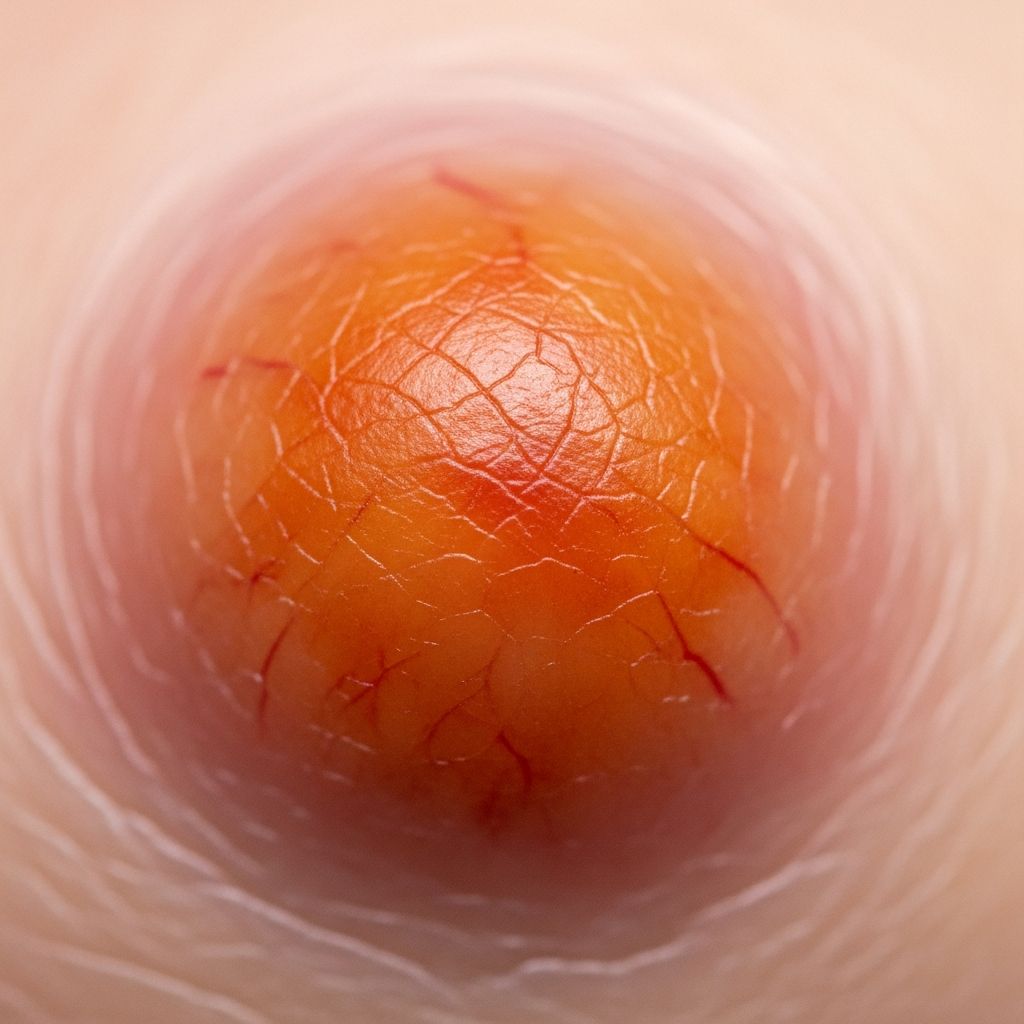
Authoritative facts about juvenile xanthogranuloma (JXG), what it looks like, who gets it, complications, differential diagnosis, and management.
What is juvenile xanthogranuloma?
Juvenile xanthogranuloma (JXG) is the most common form of non-Langerhans cell histiocytosis (NLCH). It is a benign disorder characterised by the proliferation of histiocytes, which are immature cells derived from monocytes/macrophages of the monocyte-phagocyte lineage. JXG typically affects infants and young children but can rarely occur in adults. The condition usually presents as solitary or multiple yellow-red-brown papules or nodules on the skin, which often regress spontaneously over months to years without treatment.
The histiocytes in JXG are lipid-laden (foamy) and Touton giant cells, which have a wreath of lipidised nuclei surrounded by pale lipidised rims, are characteristic. These cells express CD68 and CD163 but lack CD1a and langerin (CD207), distinguishing JXG from Langerhans cell histiocytosis (LCH).
Who gets juvenile xanthogranuloma?
JXG most commonly affects infants and young children, with 80–90% of cases diagnosed before the age of 1 year. It occurs in approximately 1 in 3500 live births. Males are affected slightly more often than females (male:female ratio 1.4:1). Congenital lesions are seen in about 10% of cases. Although rare, JXG can occur in adults, sometimes sharing features with other histiocytic disorders like Erdheim-Chester disease.
- Infants under 6 months are more likely to have multiple lesions.
- Skin-only involvement is most common (90% of cases).
- Extracutaneous sites occur in less than 10%, with eyes being the most frequent.
What are the clinical features of juvenile xanthogranuloma?
Skin lesions of JXG evolve through stages:
- Early telangiectatic stage: Initial red-brown papules due to dilated capillaries.
- Yellow regressing stage: Develop yellow colour from lipid accumulation in histiocytes.
- Final regressing stage: Lesions flatten, leaving hyperpigmentation or atrophy.
Lesions are usually asymptomatic but may rarely ulcerate. Common sites include the head and neck (especially scalp, cheeks, eyelids), trunk, and proximal extremities. Size ranges from 2–5 mm papules to 1–2 cm nodules. Multiple lesions occur in 25% of cases; disseminated forms are rare.
Rare variants
- Giant JXG (>2 cm)
- Atrophic plaque
- Cutaneous horn
- Subcutaneous mass
Extracutaneous JXG
Ocular involvement occurs in <0.5% but is serious, affecting the iris (most common), eyelid, orbit, conjunctiva, retina, choroid, or optic disc. Iris lesions cause spontaneous hyphema (40% of ocular cases) and secondary glaucoma, risking vision loss. 75% of patients have concurrent skin lesions. Deep sites include CNS (seizures, diabetes insipidus), liver, spleen, lungs, bone, and soft tissues. Systemic disease is rare (4%) and mostly in infants under 1 year.
How is the diagnosis of juvenile xanthogranuloma made?
Diagnosis is clinical for typical skin lesions but confirmed by biopsy if atypical, large, or extracutaneous.
Dermoscopy
Shows ‘setting sun’ appearance: red-yellow centre with erythematous halo.
Histology
Dermal infiltrate of histiocytes, foamy cells, Touton giant cells, and lymphocytes. No atypia or mitoses.
Immunohistochemistry
| Positive | Negative |
|---|---|
| CD68, CD163, Ki-M1p, factor XIIIa, fascin | CD1a, S100 (variable), langerin |
Investigations for extracutaneous disease
- Eye exam for all patients with skin JXG.
- MRI brain/orbit for orbital/CNS suspicion.
- Ultrasound/CT for liver/spleen.
- Skeletal survey for bone lesions.
Anterior segment OCT aids iris lesion diagnosis.
What is the differential diagnosis for juvenile xanthogranuloma?
- Benign: Spitz naevus, mastocytoma, xanthoma, molluscum, pyogenic granuloma.
- Malignant: LCH, leukaemia cutis, rhabdomyosarcoma (deep lesions).
- Ocular: Retinoblastoma, medulloepithelioma.
Biopsy distinguishes; LCH has CD1a+ grooved nuclei.
Related Stories



What is the treatment for juvenile xanthogranuloma?
Most cutaneous lesions regress spontaneously in 1–5 years; observation suffices.
Skin lesions
- Excision for single lesions (diagnostic/therapeutic).
- Intralesional/topical steroids for eyelid/limbal.
- Observation for small/regressing lesions.
Ocular lesions
Prompt treatment essential:
- Intralesional steroids (first-line).
- Topical steroids, excision, brachytherapy if refractory.
- Monitor for hyphema/glaucoma.
Systemic disease
- 2-Chlorodeoxyadenosine (cladribine), cytarabine for refractory CNS/epidural.
- Chemotherapy (vinblastine/prednisone), radiotherapy rarely.
What is the prognosis for juvenile xanthogranuloma?
Excellent for skin-limited JXG (self-resolves without scarring usually). Ocular lesions risk blindness if untreated (10–20% vision loss). Systemic JXG mortality <10%, higher in neonates with multiorgan failure. Recurrence post-regression is rare.
Frequently asked questions about juvenile xanthogranuloma
What does juvenile xanthogranuloma look like?
Red-yellow papules/nodules (2 mm–2 cm) on head/neck/trunk, evolving to yellow then regressing.
Is juvenile xanthogranuloma dangerous?
Usually benign/self-resolving. Ocular/CNS forms risk glaucoma, hyphema, seizures (rare).
Does juvenile xanthogranuloma go away?
Yes, 95% regress in 1–5 years without treatment.
Should my child see an eye doctor?
Yes, all with skin JXG need ophthalmic exam to rule out iris involvement.
Can juvenile xanthogranuloma be cured?
Most self-resolve; excision cures solitary lesions.
References
- Juvenile Xanthogranuloma — EyeWiki (American Academy of Ophthalmology). 2023-10-15. https://eyewiki.org/Juvenile_Xanthogranuloma
- Juvenile Xanthogranuloma — StatPearls (NCBI Bookshelf, NIH). 2023-08-08. https://www.ncbi.nlm.nih.gov/books/NBK526103/
- Juvenile Xanthogranuloma — MD Searchlight. 2024-01-20. https://mdsearchlight.com/child-health/juvenile-xanthogranuloma/
- Juvenile Xanthogranuloma (JXG) — Nationwide Children’s Hospital. 2023-05-12. https://www.nationwidechildrens.org/conditions/juvenile-xanthogranuloma
- What is a juvenile xanthogranuloma? — Society for Pediatric Dermatology. 2022-11-01. https://pedsderm.net/site/assets/files/1028/spd_jxg_bw_pub_rev.pdf
- Juvenile xanthogranuloma — British Association of Dermatologists (Skin Health Info). 2024-02-14. https://www.skinhealthinfo.org.uk/condition/juvenile-xanthogranuloma/
- Juvenile Xanthogranuloma (JXG) — Children’s Wisconsin. 2023-07-22. https://childrenswi.org/teaching-sheet/dermatology/juvenile-xanthogranuloma-jxg
Similar Articles








Read full bio of medha deb