Kaposi Sarcoma Images: 4 Clinical Presentations Photo Gallery
Comprehensive visual atlas of Kaposi sarcoma lesions across skin, mucous membranes, and organs in various clinical subtypes.
Author: Dr. Delwyn Dyall-Smith, Revised by: Dr. Amanda Oakley, Dermatologist, Hamilton, New Zealand
Kaposi sarcoma (KS) is a multicentric, endothelial-derived, malignancy mainly caused by human herpesvirus 8 (HHV8), also known as Kaposi sarcoma herpesvirus (KSHV). It manifests as vascular nodules and plaques on the skin, mucous membranes, and visceral organs. This image gallery showcases clinical presentations across subtypes: classic, endemic (African), iatrogenic (immunosuppression-related), and epidemic (AIDS-associated). Images highlight lesion morphology, distribution, and progression, aiding diagnosis. What is Kaposi sarcoma? Kaposi sarcoma | Human herpes virus 8 infection
What is the clinical presentation of Kaposi sarcoma?
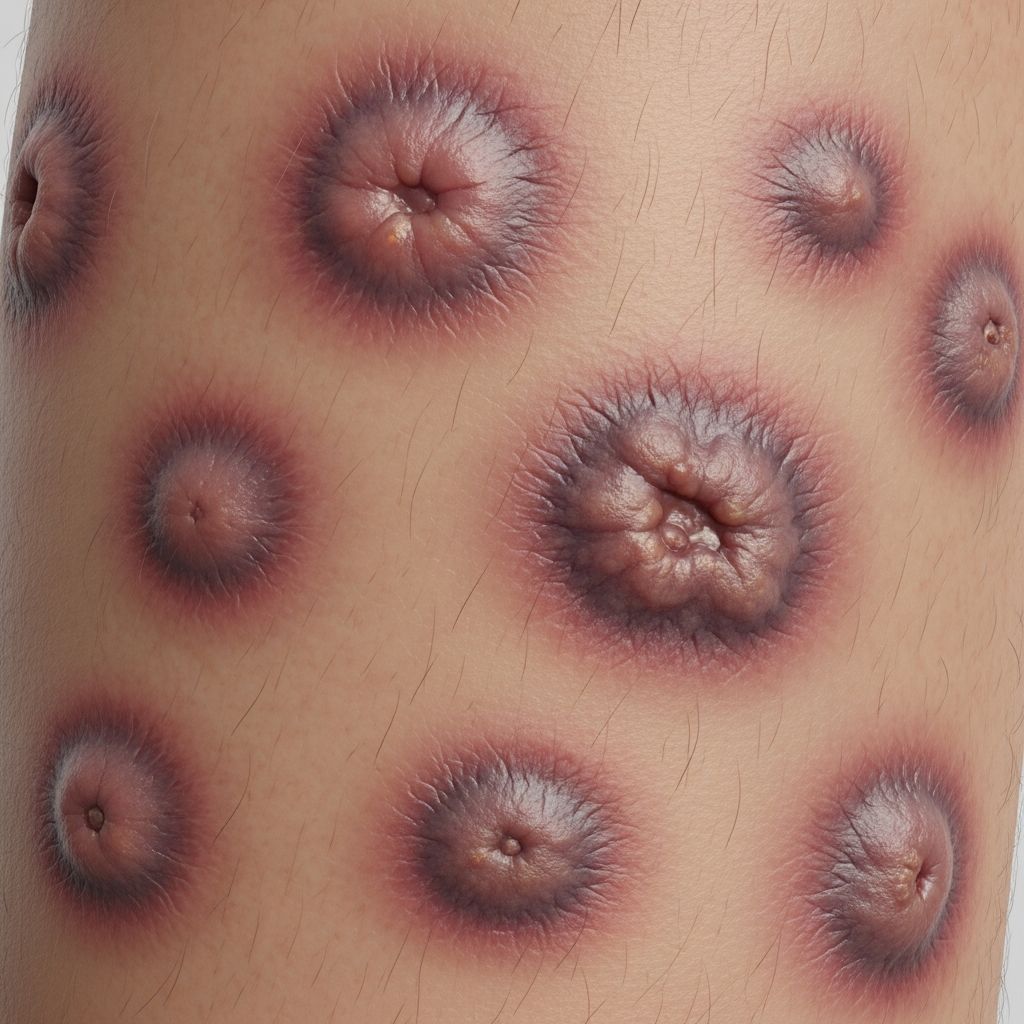
Kaposi sarcoma lesions typically appear as red, purple, or brown patches, plaques, nodules, or tumours. They often start on the lower legs in classic KS, progressing slowly. In epidemic KS, they are widespread, aggressive, and oedematous. Lesions can ulcerate, bleed, or cause lymphoedema. Mucosal involvement is common in AIDS-related cases.
- Early lesions: Macules or patches, violaceous (purple-red).
- Intermediate: Plaques, raised, indurated.
- Late: Nodular or tumour stage, may ulcerate.
Skin lesions
Skin manifestations vary by KS subtype. Classic KS shows symmetrical lower limb involvement with brown-purple patches coalescing into plaques. Epidemic KS features numerous oedematous purple nodules on trunk and limbs.
- Classic KS on legs: Multiple violaceous macules and plaques on ankles and shins, slowly enlarging over years.
- Patch stage: Flat, reddish-purple patches, often on feet or legs.
- Plaque stage: Thicker, raised plaques with hyperkeratosis, prone to ulceration.
- Nodular KS: Discrete dome-shaped purple nodules, 1-5 cm, on extremities.
- Oedematous KS: Diffuse swelling with overlying violaceous patches, common in HIV+ patients.
Mouth and mucous membrane lesions
Oral involvement affects up to 40% of epidemic KS cases, presenting as red-purple patches or nodules on palate, gingiva, or tongue. Lesions may bleed easily or cause pain.
- Palatal KS: Irregular purple plaques on hard palate.
- Gingival hypertrophy: Swollen, nodular gums with violaceous discolouration.
- Tongue nodules: Raised purple tumours interfering with speech or swallowing.
Lung lesions
Pulmonary KS occurs in advanced epidemic cases, causing respiratory symptoms. Radiographic images show nodular or interstitial patterns; bronchoscopy reveals endobronchial violaceous lesions.
- Chest X-ray: Bilateral nodular opacities or pleural effusions.
- CT findings: Flame-shaped lesions around bronchi, perihilar masses.
- Bronchoscopic view: Polypoid purple tumours in airways.
Gastrointestinal lesions
GI tract involvement is frequent in visceral KS, often asymptomatic but detectable endoscopically. Lesions appear as submucosal haemorrhagic nodules or plaques.
- Oesophagus: Longitudinal purple streaks or nodules.
- Stomach: Multiple raised lesions causing occult bleeding.
- Colon: Violaceous submucosal tumours, risk of obstruction.
Classic (sporadic) Kaposi sarcoma
Primarily affects elderly men of Mediterranean or Eastern European Jewish descent. Lesions are indolent, confined to lower limbs, with minimal systemic spread.
- Lower leg plaques: Symmetrical brown-purple indurated patches.
- Sole involvement: Hyperkeratotic plaques on feet causing pain.
Endemic (African) Kaposi sarcoma
Prevalent in sub-Saharan Africa, aggressive nodular form in young adults, lymphadenopathic in children.
Related Stories



- Nodular African KS: Rapidly growing tumours on limbs.
- Lymphadenopathic: Generalised lymph node enlargement with skin nodules.
Iatrogenic Kaposi sarcoma
Occurs in transplant recipients or on immunosuppressants. Lesions regress upon reducing immunosuppression.
- Post-transplant KS: Widespread purple nodules on skin and mucosa.
- Sirolimus-responsive: Regression after mTOR inhibitor switch.
Epidemic (AIDS-associated) Kaposi sarcoma
Most common in HIV/AIDS patients pre-HAART era; now less aggressive with ART. Lesions are florid, mucocutaneous, and visceral.
- Generalised skin KS: Hundreds of purple papules and nodules.
- Facial oedema: Periorbital violaceous swelling.
- Confluent truncal plaques: Extensive involvement mimicking lymphoma.
Frequently Asked Questions (FAQs)
Q: What do Kaposi sarcoma lesions look like on the skin?
A: KS skin lesions appear as red, purple, or brown macules, plaques, or nodules, often starting on the legs and spreading symmetrically. They may ulcerate or cause oedema.
Q: How is Kaposi sarcoma diagnosed from images?
A: Diagnosis relies on characteristic violaceous vascular lesions confirmed by biopsy showing HHV-8 LANA positivity. Imaging aids staging.
Q: Are oral KS lesions common?
A: Yes, especially in epidemic KS; they present as purple patches or nodules on palate and gums, often first sign in HIV patients.
Q: Can KS affect internal organs?
A: Yes, lungs show nodular infiltrates, GI tract has haemorrhagic lesions visible on endoscopy, causing bleeding or obstruction.
Q: Do all KS subtypes look the same?
A: No; classic is indolent lower limb plaques, epidemic is aggressive widespread nodules, endemic is nodular or lymphatic.
Histopathology images
Microscopically, KS shows spindle cell proliferation in dermis with slit-like vascular spaces, promontory sign, and hyaline globules. IHC confirms HHV8-LANA.
- Spindle cells: Whorled fascicles with erythrocyte extravasation.
- HHV8 stain: Nuclear positivity in endothelial cells.
Differential diagnosis
| Condition | Key Features | Distinguishing from KS |
|---|---|---|
| Bacillary angiomatosis | Red papules, cat-scratch | Warthin-Starry stain positive, no spindle cells |
| Angiosarcoma | Aggressive, elderly | More pleomorphic, no HHV8 |
| Haemangioma | Benign vascular | No atypia, well-circumscribed |
| Lymphoma | Systemic symptoms | Lymphoid markers, no vascular slits |
KS is distinguished by clinical context, morphology, and HHV8 association.
References
- Diagnosis & Treatment of Kaposi Sarcoma (KS) — Memorial Sloan Kettering Cancer Center. 2023. https://www.mskcc.org/cancer-care/types/kaposi-sarcoma/diagnosis-treatment-msk
- Kaposi Sarcoma Treatment – NCI — National Cancer Institute. 2024-01-15. https://www.cancer.gov/types/soft-tissue-sarcoma/patient/kaposi-treatment-pdq
- Kaposi sarcoma – Diagnosis and treatment — Mayo Clinic. 2023-11-20. https://www.mayoclinic.org/diseases-conditions/kaposis-sarcoma/diagnosis-treatment/drc-20577331
- Kaposi sarcoma — DermNet NZ. 2024. https://dermnetnz.org/topics/kaposi-sarcoma
- Diagnosis and Treatment of Kaposi Sarcoma — PubMed Central (PMC5509489). 2017-07-25. https://pmc.ncbi.nlm.nih.gov/articles/PMC5509489/
Similar Articles








Read full bio of medha deb