Kaposi Sarcoma Pathology: 8 Variants & Key Histological Features
Detailed histopathological analysis of Kaposi sarcoma, from patch to nodular stages, with key diagnostic features and variants.
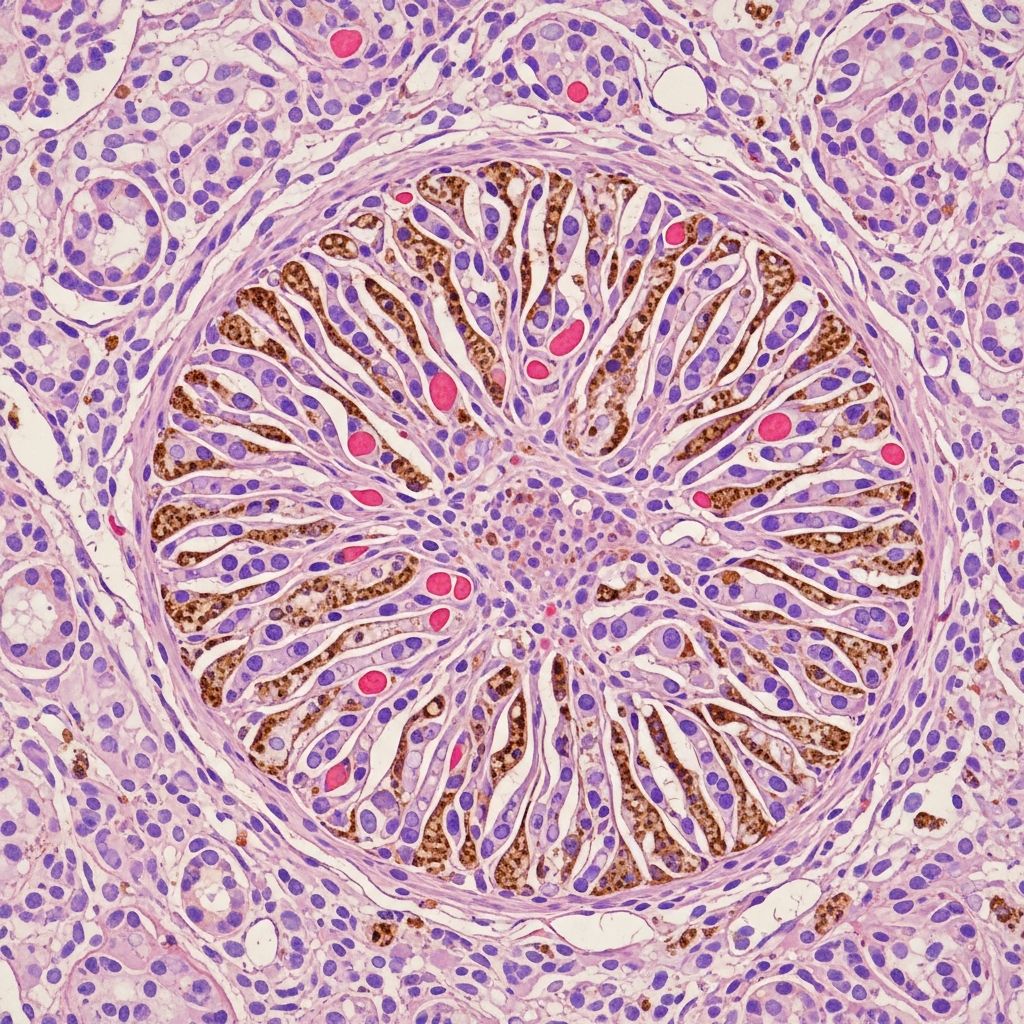
Kaposi sarcoma is classified among vascular tumours exhibiting variable malignant behaviour, with highly distinctive histological features that evolve across its clinical stages.
Authoritative facts about the skin from DermNet New Zealand
This article provides an in-depth examination of the histopathological characteristics of Kaposi sarcoma (KS), a multifocal angioproliferative disorder strongly associated with human herpesvirus 8 (HHV-8) infection. KS manifests in four epidemiological forms: classic, endemic, HIV/AIDS-associated, and iatrogenic, each with varying aggressiveness. The pathology is pivotal for definitive diagnosis, as clinical appearances can mimic other vascular lesions or malignancies. Understanding the progression from patch to plaque to nodular phases is crucial for pathologists and clinicians managing this condition, particularly in immunocompromised patients where it can disseminate widely.
What is Kaposi sarcoma?
Kaposi sarcoma originates from endothelial cells, primarily lymphatic in nature, forming spindle-shaped proliferations within the dermis. It is universally linked to HHV-8 (also known as Kaposi sarcoma-associated herpesvirus or KSHV), though additional cofactors like immunosuppression are required for tumour development. The tumour progresses through three main clinical and histological stages: patch (early macules), plaque (indurated patches), and nodular (tumour masses). Low-power microscopy reveals a cellular dermal nodule with variable epidermal changes, including hyperkeratosis, acanthosis, or ulceration.
The dermal component consists of spindle cells forming sinuous vascular spaces that infiltrate collagen bundles, creating slit-like neovascular channels containing erythrocytes. This architecture is hallmark, with the promontory sign—where new vessels project into pre-existing dilated spaces—being a classic but non-specific feature. Inflammatory infiltrates include lymphocytes and plasma cells, while hyaline (PAS-positive) globules, thought to be degenerated erythrocytes, appear in plaque and nodular stages.
Histopathology of Kaposi sarcoma
The histology of KS is characteristically distinctive and correlates with clinical evolution. In the patch stage, subtle irregular vascular channels dissect collagen fibres in the superficial dermis, with minimal spindle cell proliferation, scattered erythrocytes, hemosiderin-laden macrophages, and perivascular lymphoplasmacytic infiltrates. Nuclear atypia and mitoses are rare.
Progressing to the plaque stage, fusiform endothelial cells form intersecting fascicles resembling ‘schools of fish,’ with more prominent slit-like spaces, extravasated red blood cells, and hyaline globules. The proliferation extends deeper into the dermis.
In the nodular stage, dense spindle cell nodules dominate, with glomerular-like structures, significant mitotic activity, and nuclear atypia in aggressive cases. Large cavernous vessels may appear at the periphery, and anaplastic variants show marked pleomorphism.
- Key low-power features: Cellular dermal nodule with epidermal alterations (hyperkeratosis to ulceration).
- Spindle cell proliferation: Slit-like vascular spaces dissecting collagen, promontory sign.
- Associated elements: Erythrocytes, hyaline globules (PAS+), lymphoplasmacytic infiltrate.
- Advanced changes: Fascicular growth, mitoses, atypia in nodular/anaplastic forms.
Pathological variants
Several histological variants of KS have been described, often intuitive based on dominant patterns or associated features:
- Bullous variant: Vesiculobullous changes due to subepidermal oedema.
- Anaplastic variant: Marked nuclear atypia, high mitotic rate, sarcomatous appearance.
- Lymphangiomatous variant: Prominent lymphatic-like channels.
- Myxoid variant: Abundant mucin deposition within stroma.
- Pyculoid variant: Hyperkeratotic, granulomatous inflammation.
- Eccrine differentiation variant: Ductal structures within tumour.
- Pagetoid variant: Intraepidermal spindle cells mimicking Paget disease.
- Angiosarcoma-like variant: Highly atypical, dissecting growth resembling angiosarcoma.
These variants do not alter management but highlight KS’s morphological diversity, necessitating immunohistochemistry for confirmation.
Immunohistochemistry
Lesional spindle cells express pan-endothelial markers CD31 and CD34, lymphatic markers D2-40 (podoplanin) and LYVE-1, and HHV-8 latent nuclear antigen-1 (LANA-1), which shows characteristic nuclear dot-like positivity and is pathognomonic. Other positives include factor VIII, CD34, VEGFR-3, and BCL-2. HHV-8 staining has revolutionised diagnosis, especially in early patches or unusual presentations.
Related Stories



| Marker | Expression in KS | Specificity |
|---|---|---|
| CD31/CD34 | Positive (endothelial) | Non-specific |
| D2-40/podoplanin | Positive (lymphatic) | Supportive |
| HHV-8 LANA-1 | Strong nuclear positivity | Highly specific |
| Factor VIII | Focal positive | Supportive |
Differential diagnosis
KS mimics include benign and malignant vascular proliferations. Key discriminators are clinical context, promontory sign, plasma cells, hyaline globules, and HHV-8 positivity.
- Microvenular haemangioma: Superficial wedge-shaped, less formed vessels, no HHV-8.
- Tufted angioma: Cannonball lobules, lacks slits/interlacing.
- Progressive enzootic haemangioma: Well-formed vessels, no atypia.
- Spindle cell haemangioma: Cavernous areas, phleboliths.
- Atypical vascular lesion (post-radiation): Superficial, D2-40 negative.
- Dabska/Retiform haemangioendothelioma: Hobnail cells, retiform pattern.
- Kaposi-like infantile haemangioendothelioma: Pediatric, no HHV-8.
- Acroangiodermatitis: Superficial, pseudo-Kaposi.
- Angiosarcoma: Marked atypia, dissects extensively, HHV-8 negative.
- Spindle cell melanoma/squamous cell carcinoma: Keratins/S100 positive.
HHV-8 immunohistochemistry is definitive in equivocal cases.
Frequently Asked Questions
What are the hallmark histological features of Kaposi sarcoma?
Spindle cell proliferation forming slit-like vascular spaces with erythrocytes, promontory sign, hyaline globules, and lymphoplasmacytic infiltrate.
How does patch-stage KS differ from nodular stage?
Patch: Subtle dermal vascular dissection; Nodular: Dense fascicles, mitoses, atypia.
What is the role of HHV-8 in diagnosis?
LANA-1 nuclear staining confirms HHV-8 infection, diagnostic in 100% of cases.
Which immunohistochemical markers support KS?
CD31, CD34, D2-40 positive; HHV-8 LANA-1 highly specific.
What are common mimics of early KS?
Microvenular haemangioma, tufted angioma; distinguished by IHC and architecture.
Clinical Relevance and Staging
KS staging integrates tumour extent (T), immune status (I), and systemic involvement (S). Patch lesions are indolent; nodular forms aggressive, especially in AIDS patients with CD4 <200/mm³. Biopsy is essential, as lesions ulcerate, cause lymphedema, or involve viscera (lungs, GI).
Treatment varies: local (cryotherapy, radiation) for limited disease; systemic (chemotherapy, sirolimus) for advanced. HAART controls HIV-associated KS.
References
- Kaposi Sarcoma Pathology — DermNet New Zealand. 2023-10-15. https://dermnetnz.org/topics/kaposi-sarcoma-pathology
- Kaposi Sarcoma — StatPearls, NCBI Bookshelf. 2023-08-08. https://www.ncbi.nlm.nih.gov/books/NBK534839/
- Kaposi Sarcoma — DermNet New Zealand. 2024-02-20. https://dermnetnz.org/topics/kaposi-sarcoma
Similar Articles








Read full bio of Sneha Tete