Kasabach-Merritt Syndrome: Diagnosis, Symptoms, and Treatment
Understanding Kasabach-Merritt syndrome: causes, clinical presentation, diagnosis, and management strategies.
Kasabach-Merritt Syndrome: Overview and Clinical Significance
Kasabach-Merritt syndrome (KMS), also known as Kasabach-Merritt phenomenon (KMP), is a rare but potentially life-threatening coagulopathy that typically presents in infants and young children. This disorder is characterized by a severe clotting disturbance that develops in association with specific types of vascular tumors, most commonly kaposiform hemangioendothelioma (KHE) or tufted angioma (TA). The syndrome was first described in 1940 and remains a significant clinical concern due to its association with serious hemorrhagic complications and organ dysfunction.
KMS is fundamentally a blood-clotting disorder that develops secondary to the trapping and consumption of platelets and other clotting factors within abnormal blood vessel growths. The condition affects males and females equally and occurs much more frequently during infancy than in older children. Understanding this syndrome is essential for healthcare professionals involved in pediatric care, as early recognition and appropriate management can significantly improve patient outcomes and prevent life-threatening complications.
What Causes Kasabach-Merritt Syndrome?
Kasabach-Merritt syndrome develops as a direct consequence of the growth and behavior of rare vascular tumors, primarily kaposiform hemangioendothelioma and tufted angioma. These are not typical hemangiomas, despite superficial similarities, and the distinction is clinically important because infantile hemangiomas do not lead to KMS.
Kaposiform Hemangioendothelioma (KHE) typically appears as a firm, indurated lesion that resembles a birthmark and usually develops in the soft tissues of the head, neck, limbs, or retroperitoneum. KHE tumors are usually solitary and typically present in infants under 2 years of age, though adult cases have been documented. These benign tumors are closely associated with KMS and only rarely develop without causing the phenomenon. The pathophysiology involves the tumor trapping and activating platelets and other coagulation factors within its vascular network, leading to their consumption and resultant deficiency.
Tufted Angioma (TA) is another vascular tumor that can trigger KMS, though the association is less consistent than with KHE. TA tumors typically develop before 5 years of age and may initially appear as a small bruise-like area that continues to grow without improvement over time. While some cases of TA are associated with KMS, others may develop without causing the syndrome, a phenomenon whose underlying mechanism remains incompletely understood.
The key pathophysiologic mechanism involves the vascular tumors trapping and consuming platelets and fibrinogen, resulting in profound thrombocytopenia, hypofibrinogenemia, and consumptive coagulopathy. This process is exacerbated by trauma, infection, or medical interventions, which can cause bleeding within or around the tumor and worsen the clinical presentation.
Clinical Presentation and Symptoms
The clinical manifestations of Kasabach-Merritt syndrome are predominantly related to the severe bleeding tendency resulting from low platelet counts and deficient clotting factors. Healthcare providers should maintain a high index of suspicion when encountering infants with characteristic vascular lesions combined with signs of bleeding or bruising abnormalities.
Characteristic Skin Findings:
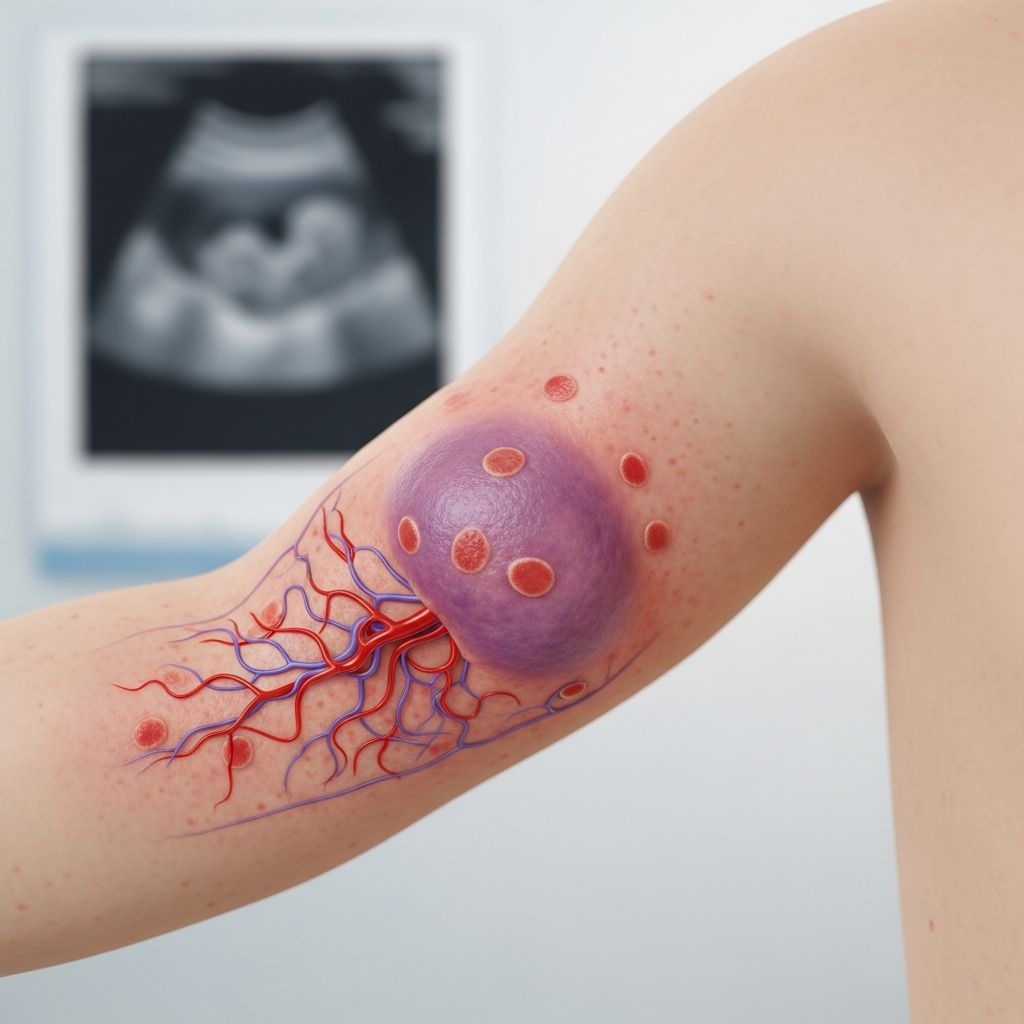
- A raised vascular lesion on the skin, which may initially be without discoloration or present with red or purple coloration
- The lesion typically enlarges suddenly and becomes dark purple due to bleeding into soft tissues
- Firm, indurated appearance that may resemble a birthmark
- Tiny red pinprick bruises under the skin called petechiae, which may develop around the lesion or on other body areas
- Spontaneous bruising and easy bruisability from minor trauma
Related Stories



Systemic Manifestations:
- Enlarged abdomen (hepatomegaly or organomegaly)
- Enlarged liver (hepatomegaly)
- Anemia from chronic bleeding or hemolysis
- Painful lesions, particularly if they are internal
- Spontaneous bleeding from mucous membranes
When the vascular tumors are internal, located in the chest or abdomen, the condition becomes particularly serious as these lesions can cause significant illness and potentially life-threatening hemorrhage. Internal lesions may also take considerably longer to diagnose, as external signs may be minimal.
Most infants with KMS present within the first three months of life, though some cases appear later during infancy. The timing and severity of symptoms can vary considerably, from mild bruising to severe life-threatening hemorrhage, depending on the size and location of the tumor and the degree of platelet consumption.
Diagnostic Approach
Accurate diagnosis of Kasabach-Merritt syndrome requires a combination of clinical assessment, laboratory studies, and imaging evaluation. Diagnosis is typically established when a healthcare provider observes a characteristic vascular lesion in an infant along with laboratory evidence of coagulopathy and thrombocytopenia.
Clinical Suspicion:
KMS should be suspected in any infant presenting with a specific type of vascular growth in combination with signs of easy bleeding or bruising. The presence of petechiae or spontaneous bleeding in association with a vascular lesion should immediately prompt further investigation.
Laboratory Evaluation:
- Complete blood count (CBC) with differential and platelet count—reveals profound thrombocytopenia
- Peripheral blood film—demonstrates microangiopathic hemolytic anemia
- Fibrinogen level and fibrin degradation products—shows low fibrinogen (hypofibrinogenemia)
- Prothrombin time (PT) and partial thromboplastin time (PTT)—assesses clotting factor function
- D-dimer levels—elevated in cases of consumptive coagulopathy
- Full blood panel—comprehensive assessment of hematologic status
Imaging Studies:
Magnetic resonance imaging (MRI) with contrast is considered the best imaging modality to assess the extent, characteristics, and location of the vascular lesion. Ultrasound can reveal an infiltrative high-flow lesion and may be particularly useful in the initial assessment of infants. Angiography may be performed to define vascular anatomy when clinically indicated and depending on the infant’s clinical stability. These imaging studies help determine the aggressiveness, size, and precise location of the tumor, which influences treatment decisions.
Tissue Diagnosis:
A biopsy, in which tissue is collected for microscopic examination in the laboratory, provides definitive confirmation of the diagnosis. This is particularly important when the clinical and laboratory findings suggest KMS but are not entirely characteristic, or when the lesion’s nature remains uncertain.
Differential Diagnosis
Several conditions may present with similar symptoms to Kasabach-Merritt syndrome and must be considered during diagnostic evaluation. Vascular malformations, particularly large venous or venous-lymphatic lesions and multiple venous malformations, can cause coagulopathies with low platelet counts and low coagulation proteins. However, the coagulopathy associated with these lesions results from protein deficiency rather than from platelet trapping, distinguishing them pathophysiologically from true KMS. Careful imaging and biopsy findings help differentiate these conditions.
Management and Treatment Options
The approach to managing Kasabach-Merritt syndrome depends on the severity of clinical presentation, location of the tumor, and extent of coagulopathy. Treatment strategies range from conservative monitoring to aggressive therapeutic intervention.
Watchful Waiting and Monitoring:
Infants with only mild symptoms and minimal bleeding tendency may not require active treatment. In such cases, regular clinical and laboratory monitoring allows healthcare providers to detect any progression early and initiate intervention if the condition worsens. Close follow-up ensures that any development of more severe platelet or clotting abnormalities is identified promptly.
Active Treatment:
When infants present with more severe platelet and clotting problems or evidence of significant bleeding, active treatment becomes necessary. Treatment typically focuses on addressing the underlying vascular tumor, as resolving the tumor’s growth and activity helps normalize platelet consumption and restore normal hemostasis. Various therapeutic modalities may be employed, either alone or in combination, depending on clinical circumstances:
- Pharmacologic therapy targeting tumor growth and platelet consumption
- Surgical intervention when feasible and when the tumor’s location permits safe removal
- Interventional radiologic procedures for internal lesions
- Supportive care including platelet transfusions for severe thrombocytopenia
- Management of hemorrhagic complications
The selection of specific therapeutic approaches should be individualized based on tumor characteristics, clinical stability, and institutional expertise.
When to Seek Medical Attention
Parents and caregivers should seek immediate medical evaluation if an infant develops:
- Unexplained bruising or petechiae, especially in combination with a vascular lesion
- Spontaneous bleeding from any site
- Unusual lethargy or irritability
- Pallor suggesting anemia
- Abdominal swelling or distension
- Any vascular lesion that changes in size, color, or appearance
Frequently Asked Questions
Q: How common is Kasabach-Merritt syndrome?
A: Kasabach-Merritt syndrome is a rare disorder that affects males and females equally. While exact prevalence data are limited, it typically develops in infants less than 6 months of age, with most cases diagnosed during infancy. The phenomenon occurs much less frequently in older children.
Q: Can Kasabach-Merritt syndrome develop in adults?
A: While extremely rare, cases of kaposiform hemangioendothelioma have been reported in adults. However, KMS typically occurs in infants and young children, and the phenomenon is unusual in older pediatric patients and adults.
Q: Is Kasabach-Merritt syndrome inherited or genetic?
A: There is no established hereditary pattern for Kasabach-Merritt syndrome. The condition develops sporadically due to the growth of vascular tumors, and most cases appear to be acquired rather than genetically inherited.
Q: What is the difference between Kasabach-Merritt syndrome and infantile hemangioma?
A: This is an important clinical distinction. Infantile hemangiomas never lead to Kasabach-Merritt syndrome. KMS specifically occurs with kaposiform hemangioendothelioma and tufted angioma, which are different types of vascular lesions from typical infantile hemangiomas.
Q: What is the prognosis for infants with Kasabach-Merritt syndrome?
A: The prognosis depends on the location, size, and aggressiveness of the tumor, as well as the degree of coagulopathy. Early diagnosis and appropriate treatment significantly improve outcomes. Internal tumors, particularly those in the chest or abdomen, carry greater risk of serious complications.
Q: Can Kasabach-Merritt syndrome be prevented?
A: Since KMS results from spontaneous development of vascular tumors rather than inherited factors or preventable causes, the syndrome cannot be prevented. However, early recognition and prompt treatment can prevent serious complications.
References
- Kasabach-Merritt Syndrome — Medical News Today. 2024. https://www.medicalnewstoday.com/articles/kasabach-merritt-syndrome
- Kasabach-Merritt Phenomenon – Symptoms, Causes, Treatment — National Organization for Rare Disorders (NORD). 2024. https://rarediseases.org/rare-diseases/kasabach-merritt-phenomenon/
- Kasabach-Merritt Phenomenon — Great Ormond Street Hospital NHS Trust. 2024. https://www.gosh.nhs.uk/conditions-and-treatments/conditions-we-treat/kasabach-merritt-phenomenon/
- Hemangioendothelioma and Kasabach-Merritt Syndrome Treatment — Mount Sinai Health System. 2024. https://www.mountsinai.org/locations/cerebrovascular-center/conditions/tumors/hemangioendothelioma
- Kasabach-Merritt Syndrome — DermNet. 2024. https://dermnetnz.org/topics/kasabach-merritt-syndrome
- Kasabach-Merritt Syndrome — StatPearls, National Center for Biotechnology Information (NCBI). 2024. https://www.ncbi.nlm.nih.gov/books/NBK519053/
- Kasabach-Merritt Phenomenon — Orphanet, European Organization for Rare Diseases. 2024. https://www.orpha.net/en/disease/detail/2330
Similar Articles








Read full bio of Sneha Tete