Exfoliative Keratolysis: Symptoms, Causes, And Treatment Guide
Understanding the causes, symptoms, diagnosis, and effective management of recurrent palmar peeling skin condition.
Keratolysis exfoliativa is a common, benign skin condition characterized by recurrent, superficial peeling of the palms and sometimes soles, often triggered by heat, sweat, or irritants.
What is keratolysis exfoliativa?
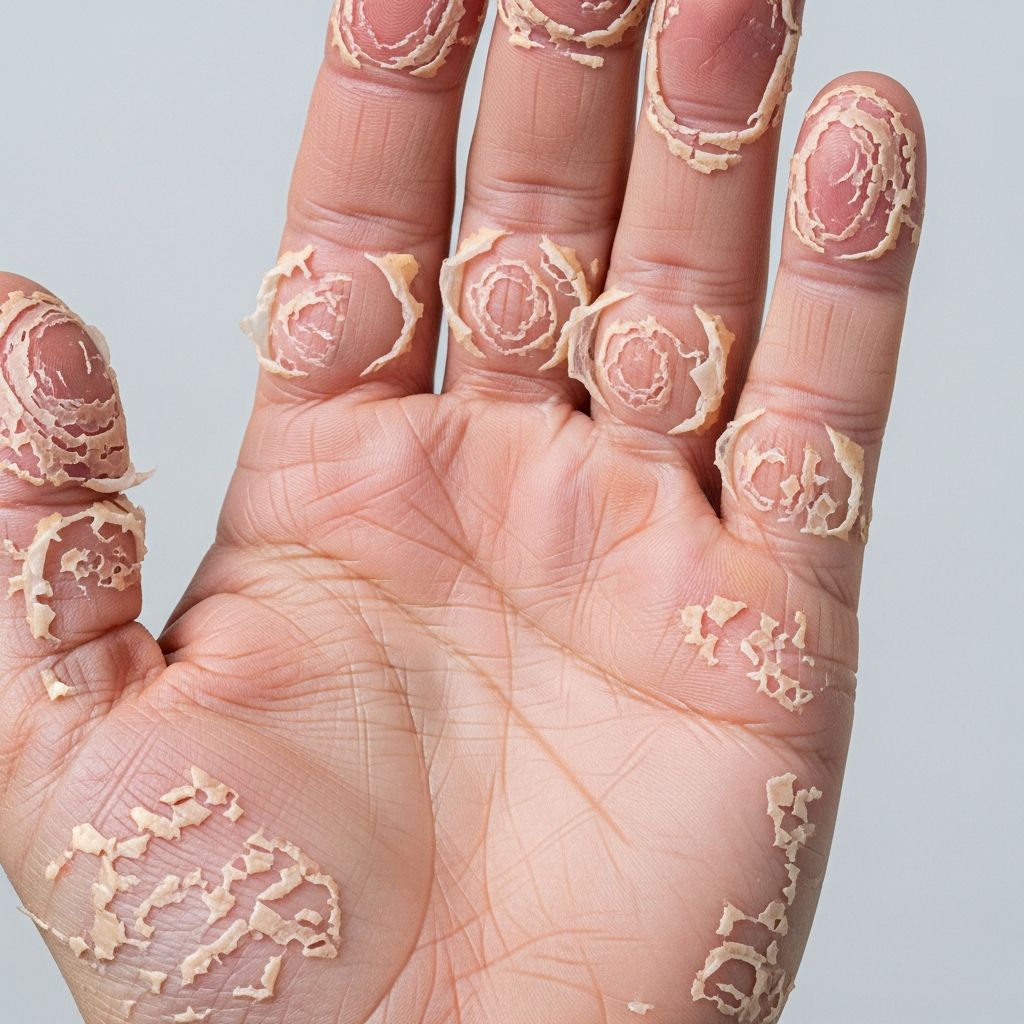
Keratolysis exfoliativa, also known as exfoliative keratolysis or recurrent focal palmar peeling, involves the spontaneous peeling of the outermost layer of skin (stratum corneum) on the palms and fingers. It presents as superficial, air-filled blisters that rupture and peel, leaving behind circular or oval collarettes of scale without significant inflammation or itching. This condition is typically asymptomatic but can lead to dryness, cracking, and mild tenderness in affected areas.
The peeling is due to premature desquamation within the stratum corneum, where desmosomes—protein connectors between corneocytes—break down abnormally. This delamination is often accelerated by external factors, resulting in superficial separation of skin layers. Unlike more serious dermatoses, it lacks systemic implications and resolves with skin regeneration, though recurrences are common.
Who gets keratolysis exfoliativa?
This condition predominantly affects young adults, particularly those who are active and sweat profusely. It is more prevalent in individuals with hyperhidrosis (excessive palm sweating) and shows a seasonal pattern, worsening in warm, humid summer months in about 50% of cases.
- Demographics: Young, active adults; no strong gender preference reported.
- Risk factors: Localized hyperhidrosis, exposure to water, soaps, detergents, solvents, or friction (e.g., from athletic shoes or manual labor like fishing).
- Associations: May coexist with atopic dermatitis, asthma, or allergies, though not directly causative.
Patients with frequent hand washing or chemical exposure, such as healthcare workers or cleaners, report higher incidence. Genetic predisposition may play a role in some cases.
What causes keratolysis exfoliativa?
The exact etiology remains unknown, but environmental triggers are key. Heat and sweating promote maceration of the stratum corneum, leading to desmosomal breakdown. Irritants like soaps, detergents, solvents, and friction exacerbate the process by damaging the skin barrier.
- Primary triggers: Hyperhidrosis, warm weather, moisture occlusion.
- Irritants: Water immersion, soaps, detergents, chemicals; salt water exposure in fishermen.
- Pathophysiology: Low-grade physical/chemical damage causes superficial cleavage in the horny layer without epidermal involvement.
No infectious, autoimmune, or genetic mutations are confirmed, distinguishing it from pitted keratolysis (bacterial) or peeling skin syndromes.
What are the clinical features of keratolysis exfoliativa?
Initial lesions appear as 1–3 mm superficial, air-filled blisters on palms, fingers, or soles. These burst easily, forming expanding annular or oval peeling patches with trailing edges of scale (collarettes). Erythema is minimal or absent; itching is rare, though mild tenderness or dryness may occur.
- Distribution: Central palms, thenar/hypothenar eminences, interdigital spaces; soles less common.
- Course: Cyclic, lasting weeks; recurs seasonally. Skin regenerates but barrier function is temporarily impaired, risking cracks.
- Symptoms: Asymptomatic peeling; occasional dryness, fissuring.
Related Stories



In severe cases, confluent peeling exposes tender dermis, worsened by irritants.
Diagnosis
Diagnosis is clinical, based on characteristic superficial peeling without vesicles, pustules, or inflammation. History of summer exacerbation and hyperhidrosis supports it. No biopsy needed routinely, but histology shows compact orthokeratosis with superficial splitting.
Differential diagnosis
| Condition | Key Differentiators |
|---|---|
| Pompholyx/dyshidrotic eczema | Pruritic, deep vesicles, chronic, lichenified |
| Palmoplantar pustulosis/psoriasis | Pustules, plaques, nail changes, chronic |
| Allergic contact dermatitis | Pruritic, erythematous, steroid-responsive, exposure history |
| Tinea manuum | Nail changes, scaling, KOH+, antifungal response |
| Pitted keratolysis | Pits, odor, bacterial (Corynebacteria) |
Rule out with exam, history, or scrapings if atypical.
What is the treatment for keratolysis exfoliativa?
Treatment is supportive, focusing on irritant avoidance and barrier repair. No cure exists, but symptoms improve with conservative measures.
- First-line: Avoid triggers—wear gloves for wet work, limit soap/detergent exposure. Aggressive emollients (petrolatum, silicone-based) daily.
- Keratolytics: Urea (20–40%), lactic acid (12%), ammonium lactate (12%), salicylic acid (6%) creams BID to aid peeling and hydrate.
- Hyperhidrosis: Topical aluminum chloride (Drysol), oral glycopyrrolate (1mg 2–3x/day).
- Topicals: Potent steroids (e.g., clobetasol 0.05%) short-term (≤2 weeks) if inflamed; often ineffective.
- Advanced: Hand/foot PUVA phototherapy for refractory cases.
Emphasize benign nature; many need no treatment.
Clinical images
Images typically show superficial peeling on palms with white annular scales and minimal erythema. Blisters are translucent and rupture to form collarettes (descriptive based on standard dermatology references).
Frequently asked questions (FAQs)
Q: Is keratolysis exfoliativa contagious?
A: No, it is not infectious or contagious; it results from environmental triggers and skin barrier issues.
Q: Does it go away on its own?
A: Yes, peeling resolves spontaneously with skin regeneration, though recurrences are common in summer.
Q: Can it affect toenails or soles?
A: Primarily palms/fingers; soles less often. No nail involvement.
Q: Is it related to eczema or psoriasis?
A: Mimics but differs; lacks pruritus, chronicity, or plaques. May coexist with atopy.
Q: What home remedies work best?
A: Moisturize frequently with urea/lactic acid creams, avoid irritants, use cotton gloves overnight.
References
- Keratolysis exfoliativa – one of the possible causes of skin peeling — iDerma.lt. 2023. https://iderma.lt/en/skin-diseases/keratolysis-exfoliativa-one-of-the-possible-causes-of-skin-peeling/
- Keratolysis exfoliativa (Lamellar dyshidrosis, Recurrent focal palmar peeling) — Dermatology Advisor. 2024-01-15. https://www.dermatologyadvisor.com/home/decision-support-in-medicine/dermatology/keratolysis-exfoliativa-lamellar-dyshidrosis-recurrent-focal-palmar-peeling-recurrent-palmar-peeling/
- Keratolysis exfoliativa — Wikipedia (informed primary sources). 2024. https://en.wikipedia.org/wiki/Keratolysis_exfoliativa
- Dealing with Peeling Skin: Keratolysis Exfoliativa — The Chelsea Clinic. 2023-06-12. https://thechelseaclinic.uk/dealing-with-peeling-skin-keratolysis-exfoliativa/
- Exfoliative keratolysis (keratolysis exfoliativa, focal palmar peeling) — DermNet NZ. 2024. https://dermnetnz.org/topics/keratolysis-exfoliativa
- Skin Peeling on Hands: Causes and Treatment — Healthline. 2023-11-08. https://www.healthline.com/health/skin-peeling-on-hands
- Peeling skin conditions — Primary Care Dermatology Society (PCDS). 2024. https://www.pcds.org.uk/clinical-guidance/peeling-skin-syndromes1
Similar Articles








Read full bio of Sneha Tete