Knee Ligament Injuries: Causes, Symptoms, and Treatment
Complete guide to understanding knee ligament injuries, from ACL tears to sprains.
Understanding Knee Ligament Injuries
The knee is one of the most complex joints in the human body, comprising multiple structures that work together to provide stability, mobility, and support during movement. Knee ligament injuries represent a significant portion of orthopedic injuries, affecting athletes, active individuals, and people of all ages. Unlike some injuries such as runner’s knee or jumper’s knee that develop gradually over time, knee ligament injuries typically occur suddenly due to a specific traumatic event or unusual movement. These injuries are often referred to as strains, sprains, or tears, and while they may sound alarming, the good news is that most knee ligament injuries are treatable—often without surgery—and individuals can successfully return to their normal activities.
The Four Main Knee Ligaments
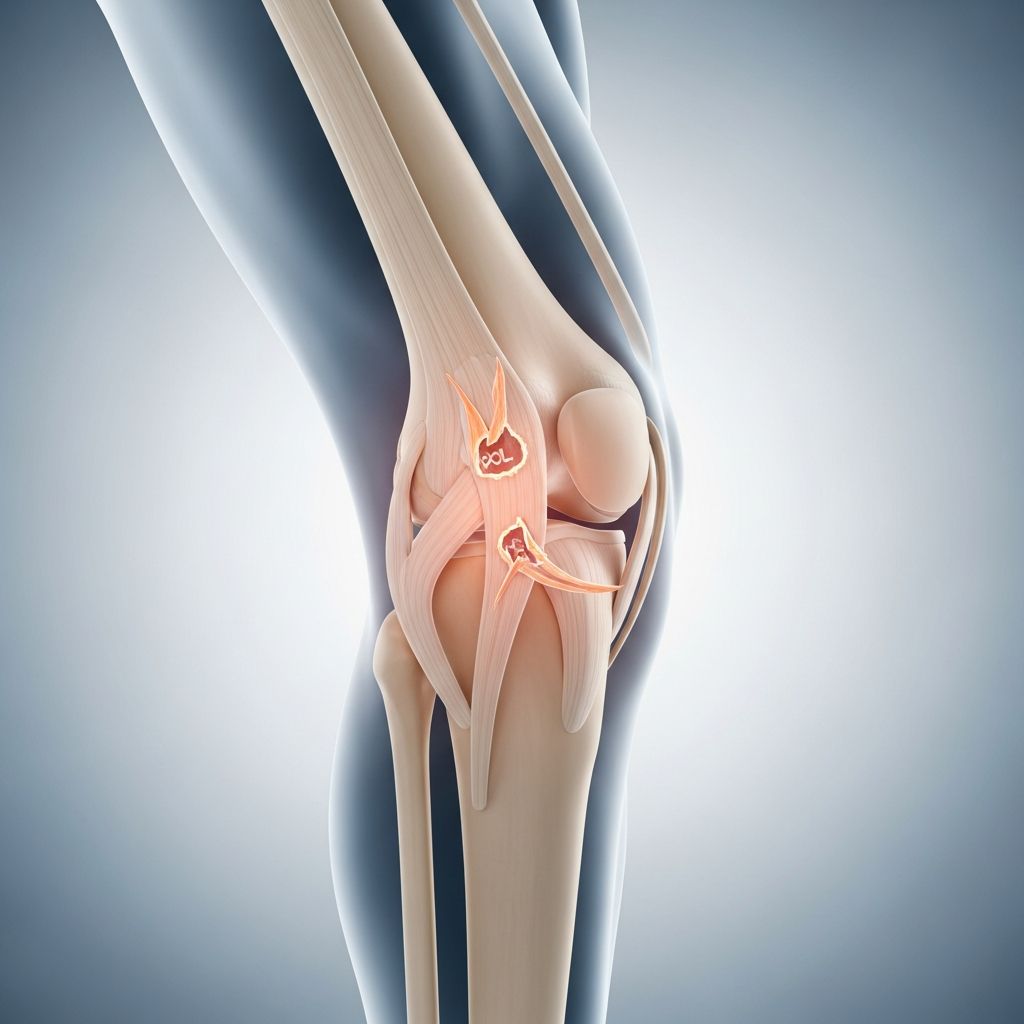
To understand knee ligament injuries, it is essential to first understand the anatomy of the knee and the role each ligament plays. The knee contains four major ligaments that work in concert to stabilize the joint and maintain proper alignment during movement.
Anterior Cruciate Ligament (ACL)
The anterior cruciate ligament, commonly referred to as the ACL, is the most frequently injured knee ligament. This ligament connects the thigh bone to the shin bone and plays a critical role in controlling rotation of the knee. The ACL specifically prevents the tibia (shin bone) from moving too far forward relative to the femur (thigh bone). ACL injuries are particularly common in sports that involve rapid directional changes, jumping, or sudden stops, such as basketball, soccer, and football.
Posterior Cruciate Ligament (PCL)
The posterior cruciate ligament functions as a counterpart to the ACL, preventing the tibia from moving too far backward. While PCL injuries are less common than ACL injuries, they can occur during sports participation or as a result of motor vehicle accidents. PCL injuries often require careful evaluation and typically respond well to nonoperative treatment initially.
Medial Collateral Ligament (MCL)
The medial collateral ligament, located on the inner side of the knee, prevents excessive inward movement of the knee joint. The MCL is particularly vulnerable to injury from direct impact to the outer knee or from sudden twisting movements.
Lateral Collateral Ligament (LCL)
The lateral collateral ligament, positioned on the outer side of the knee, prevents the knee from moving too far outward. Together with the other three major ligaments, the LCL contributes to the overall stability of the knee joint during activities such as running, jumping, and pivoting.
Symptoms of Knee Ligament Injuries
Recognizing the symptoms of a knee ligament injury is crucial for prompt diagnosis and treatment. While the specific symptoms can vary depending on which ligament is injured and the severity of the injury, several common indicators suggest a ligament injury has occurred.
Acute Symptoms
Immediately following a knee ligament injury, individuals typically experience sharp pain at the moment of injury. This acute pain is often accompanied by a distinctive popping or snapping sound at the time of injury, which many people report hearing or feeling. Swelling typically develops within the first few hours following the injury as the body’s inflammatory response is triggered.
Related Stories



Functional Limitations
Beyond the immediate pain and swelling, knee ligament injuries often result in significant functional limitations. Individuals may experience stiffness and a marked loss of range of motion in the affected knee. Many people find it difficult to walk or bear weight on the injured leg, and some report a sense of instability or looseness in the knee joint. In severe cases, the knee may actually give out or feel as though it is about to collapse.
Location-Specific Symptoms
Depending on which ligament is injured, pain and soreness may be localized to different areas of the knee. PCL injuries typically cause pain or soreness at the back of the knee, while MCL injuries produce discomfort on the inside of the knee, and LCL injuries result in pain on the outside of the knee.
Common Causes of Knee Ligament Injuries
Knee ligament injuries can result from a variety of mechanisms, ranging from direct trauma to seemingly minor incidents. Understanding the common causes can help individuals recognize situations in which they are at higher risk for injury.
Direct Impact
Being struck directly in the knee area, such as during contact sports like football, soccer, or hockey, can cause significant ligament injuries. Direct impact can also occur during motor vehicle accidents, leading to various types of knee ligament damage.
Minor Trauma
Even relatively minor traumatic events can result in knee ligament injuries. Falling on the knee, stepping off a curb and landing awkwardly, slipping on a wet surface, or stopping abruptly can all cause ligament sprains or tears. These types of injuries demonstrate that significant force is not always necessary to damage knee ligaments.
Unexpected Movements
One of the most common scenarios for knee ligament injuries involves unexpected movements or situations that do not allow the body adequate time to stabilize itself. Stumbling on an uneven surface while hiking, making a rapid change in direction, or awkwardly twisting the leg can all lead to ligament injuries. These situations are particularly problematic because they occur quickly, and the muscles surrounding the knee cannot provide protective support.
Muscle Weakness and Lack of Support
When an acute strain or force exceeds what the surrounding muscles can protect against, or when muscles are not actively providing support, the knee ligaments become vulnerable to injury. This highlights the important protective role that strong knee and leg muscles play in preventing ligament damage.
Gender and Age Differences in Knee Injuries
Recent research from Johns Hopkins Hospital involving analysis of over 13,500 knee MRI examinations has revealed interesting differences in knee injury patterns between men and women based on age. The study analyzed injuries to the ACL, PCL, MCL, LCL, and menisci in patients presenting with knee pain.
In younger patients, meniscal and medial collateral ligament tears were observed more frequently in men under 40 years of age. Conversely, among older women, these same types of injuries occurred more frequently than in older men, suggesting that older women may be at increased risk for injuries that can lead to joint degeneration over time. While ACL injuries were traditionally thought to be more common in younger women, the research suggests this pattern may not hold true universally.
These findings have important implications for injury prevention and clinical assessment. The research suggests that both men and women should take precautions to avoid high-impact injuries during sports or physical activity, while women over 40 should pay particular attention to joint health and consider incorporating dedicated strength training to help protect their knees as they age.
Treatment Options for Knee Ligament Injuries
The encouraging news for individuals with knee ligament injuries is that most can be effectively treated without surgery. Conservative treatment approaches have been shown to be highly effective in restoring function and returning individuals to their desired activities.
Physical Therapy
Physical therapy represents a research-backed, evidence-based treatment approach for knee ligament injuries. A qualified physical therapist uses targeted exercises and techniques to help rebuild strength and function in the muscles surrounding the knee. Additionally, physical therapists may employ neuromuscular stimulation, which uses low-level electrical impulses to cause muscles to contract and strengthen. Physical therapy can be accessed either through in-person visits or via telehealth video consultations, making it accessible to more individuals.
The P.E.A.C.E and L.O.V.E Protocol
Modern approaches to knee ligament injury management have evolved beyond the traditional R.I.C.E. (rest, ice, compression, elevation) model. The newer P.E.A.C.E and L.O.V.E. protocol represents a more comprehensive self-care approach that prioritizes movement and exercise over prolonged rest. This updated framework recognizes that appropriate activity and exercise are essential components of recovery and can improve circulation, reduce pain, and prevent excess pressure from building up within the knee joint.
Role of Movement and Exercise
Regular movement and appropriate exercise play a vital role in knee ligament injury recovery. Movement ensures good circulation, allowing fluid to move in and out of the knee joint, which helps prevent excess pressure and associated discomfort. Exercise also strengthens the muscles surrounding the knee, reducing stress on the healing ligaments and promoting faster, more complete recovery.
Surgical Treatment Considerations
While most knee ligament injuries respond well to conservative treatment, certain situations may warrant surgical intervention. Posterior cruciate ligament injuries, for example, typically respond to nonoperative treatment initially, involving splinting in extension followed by range-of-motion and strengthening exercises. However, surgical treatment may be reserved for acute bone avulsions or symptomatic chronic high-grade PCL tears. When a PCL injury occurs in combination with other ligament injuries, most patients will require surgical treatment. Recovery of quadriceps strength is necessary following injury to compensate for posterior tibial movement and facilitate return to preinjury activity levels.
Return to Activity and Sport
One of the primary goals following knee ligament reconstruction is to return the individual to their previous level of function as quickly and safely as possible. The appropriate level of aggressiveness in returning to sport remains somewhat controversial among sports medicine professionals, but established principles guide rehabilitation decisions.
The basic concepts that apply to ACL-reconstructed athletes can be generalized to injuries treated nonoperatively as well. Rehabilitation must progress systematically, with careful attention to objective measures of strength, stability, and functional capacity before advancing to higher levels of activity. Professional guidance from a physical therapist or sports medicine physician is essential to ensure safe return to sport and minimize the risk of reinjury.
Prevention Strategies
While not all knee ligament injuries can be prevented, several strategies can reduce the risk of injury. Maintaining strong muscles around the knee through regular strength training provides protection for ligaments. Proper warm-up before physical activity prepares the muscles for the demands that will be placed on them. Using appropriate footwear and ensuring that exercise surfaces are safe can also reduce injury risk. Additionally, learning proper techniques for sports and movements can decrease the likelihood of traumatic injury.
Frequently Asked Questions
Q: What is the difference between a knee ligament strain and a sprain?
A: A strain refers to overstretching or tearing of muscle fibers or tendons, while a sprain specifically involves overstretching or tearing of ligaments. Both are types of knee injuries but affect different structures.
Q: How long does it take to recover from a knee ligament injury?
A: Recovery time varies depending on the severity of the injury and the specific ligament affected. Mild sprains may resolve in a few weeks, while more severe injuries may require several months of rehabilitation.
Q: Do all knee ligament injuries require surgery?
A: No. The vast majority of knee ligament injuries respond well to conservative treatment including physical therapy, appropriate movement, and gradual return to activity.
Q: Can I return to sports after a knee ligament injury?
A: Yes. With appropriate rehabilitation and following evidence-based return-to-sport protocols, most individuals can successfully return to their previous level of athletic activity.
Q: What should I do immediately after a knee ligament injury?
A: Seek medical evaluation to confirm the diagnosis. Follow the P.E.A.C.E protocol (protection, elevation, avoiding excessive compression, education) and begin gentle movement as tolerated while working with a healthcare provider.
References
- Knee Ligament Injuries: Causes, Treatment, Prevention Tips — Hinge Health. 2025. https://www.hingehealth.com/resources/articles/knee-ligament-injuries/
- Posterior cruciate ligament injuries: evaluation and management — Johns Hopkins University. The Journal of the American Academy of Orthopaedic Surgeons, Vol. 9, Issue 5, 2001. https://pure.johnshopkins.edu/en/publications/posterior-cruciate-ligament-injuries-evaluation-and-management-4
- Study finds surprising differences in knee injuries between men and women — Johns Hopkins Hospital, Radiological Society of North America. 2025-12-01. https://www.news-medical.net/news/20251201/Study-finds-surprising-differences-in-knee-injuries-between-men-and-women.aspx
- Return to play after anterior cruciate ligament reconstruction — National Center for Biotechnology Information, PubMed. https://pubmed.ncbi.nlm.nih.gov/15262378/
Similar Articles








Read full bio of medha deb