Knee Ligaments: Structure, Function & Injury
Comprehensive guide to knee ligament anatomy, types, and common injuries.
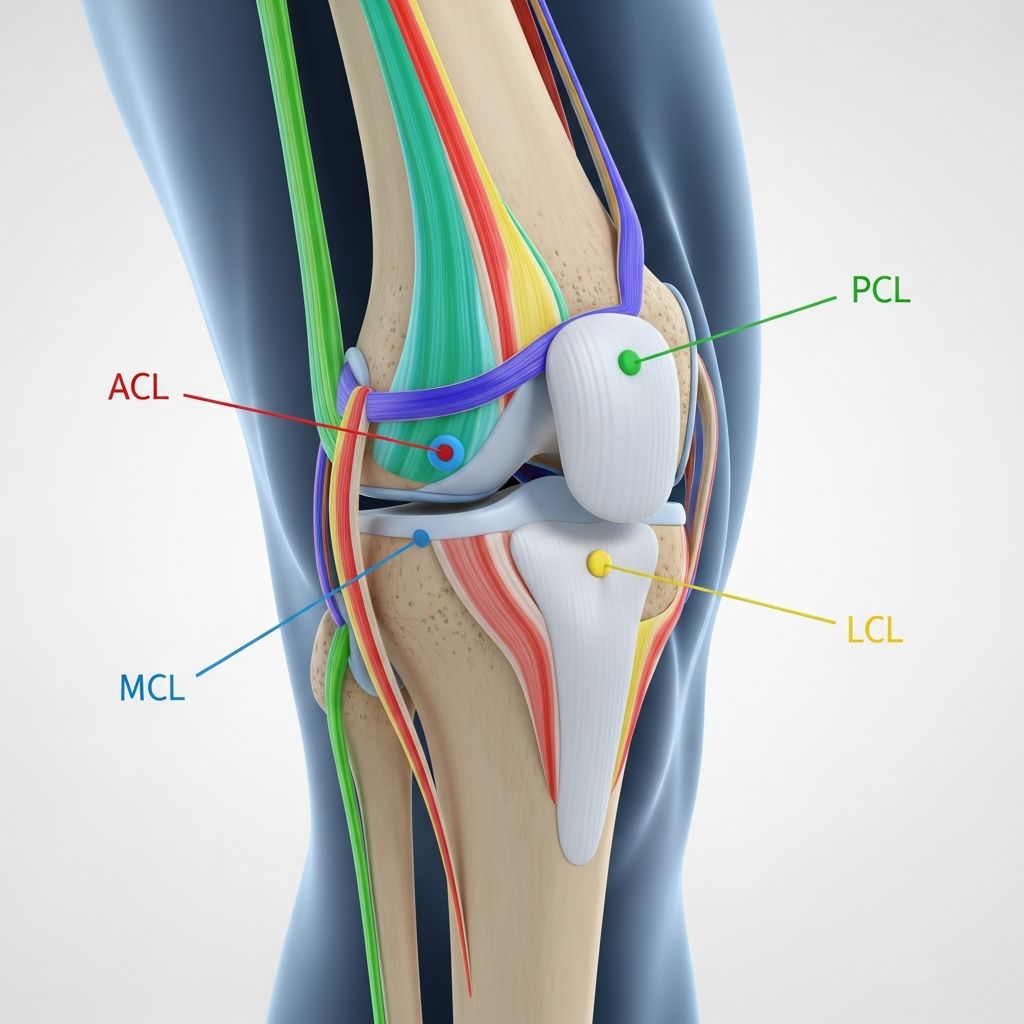
Understanding Knee Ligaments: A Comprehensive Anatomical Guide
The knee is the largest joint in your body, and its stability depends significantly on a complex system of ligaments. These tough, fibrous bands of connective tissue play a critical role in holding your knee together and preventing excessive movement. Whether you’re an athlete, active individual, or simply interested in understanding your body’s mechanics, knowing about knee ligaments is essential for maintaining joint health and preventing injuries.
What Are Knee Ligaments?
Knee ligaments are bands of tissue composed primarily of collagen and elastin fibers that connect your thigh bone (femur) to your lower leg bones (tibia and fibula). These specialized connective tissues function as structural reinforcements that hold the bones of the knee joint in proper alignment. Unlike tendons, which connect muscles to bones, ligaments exclusively connect bone to bone and provide essential stability to the joint.
Your body contains over 900 ligaments throughout its skeletal system, with many concentrated in your joints and limbs. The knee ligaments specifically work in concert with cartilage, muscles, and other supporting structures to create a stable yet mobile joint that can withstand tremendous forces during everyday activities and sports.
Anatomy and Structure of Knee Ligaments
Knee ligaments vary in their physical characteristics. Most appear as rope-like or cord-like structures, while others form wider bands or even arch-shaped formations. They can range from thin, string-like tissues to thicker, more substantial bands. These variations in structure directly relate to their specific functions and the stresses they must endure.
Types of Knee Ligaments
There are two primary types of ligaments in the knee: cruciate ligaments and collateral ligaments. Understanding each type is crucial for comprehending how the knee maintains stability.
Cruciate Ligaments
The cruciate ligaments are located deep within the knee joint and form an X-shaped pattern when viewed from certain angles. They consist of:
Anterior Cruciate Ligament (ACL): The ACL prevents your shinbone from sliding forward in front of your thighbone. This ligament is particularly important during activities that involve cutting, pivoting, or sudden directional changes. ACL injuries are among the most common knee ligament injuries, especially in sports.
Posterior Cruciate Ligament (PCL): The PCL works opposite to the ACL by preventing your shinbone from sliding backward beneath your thighbone. While PCL injuries are less common than ACL injuries, they can still significantly impact knee function and stability.
Collateral Ligaments
The collateral ligaments are positioned on the sides of the knee and provide medial and lateral stability:
Medial Collateral Ligament (MCL): Located on the inner side of your knee, the MCL prevents excessive inward movement and provides stability against valgus stress. The MCL is often injured during activities that involve sudden stops or lateral impacts.
Lateral Collateral Ligament (LCL): Positioned on the outer side of your knee, the LCL prevents excessive outward movement and resists varus stress. LCL injuries are relatively less common but can occur during certain types of trauma or sports activities.
Primary Functions of Knee Ligaments
Knee ligaments serve several critical functions that are essential for proper joint function and overall leg mobility:
Stabilization and Support
The primary function of knee ligaments is to provide stability to the knee joint by holding bones in proper alignment. This stabilization is dynamic, meaning the ligaments adjust constantly to accommodate movement and changing forces. Without adequate ligament function, the knee would lack the structural integrity needed for basic activities like walking or standing.
Movement Restriction
Ligaments hold bones and other body parts together in a way that allows for limited, controlled movement. They prevent bones from moving too far or moving in directions for which they’re not designed. This protective mechanism prevents hyperextension, excessive rotation, and other potentially damaging movements.
Protection
By maintaining proper joint alignment and limiting aberrant movement, ligaments protect the knee from injury and degenerative changes. They work synergistically with cartilage and other joint structures to distribute forces evenly across the joint surfaces.
Common Knee Ligament Injuries
Ligament Sprains
A sprain occurs when you overstretch or tear a ligament. Sprains often happen during a sudden fall, twist, or impact. Most ligament injuries are accidental in nature, though certain activities increase injury risk. Sprains are classified by severity:
Grade 1 (Mild): Minimal ligament fiber damage with slight stretching. Typically involves minimal pain and functional loss.
Grade 2 (Moderate): Partial tearing of ligament fibers. Results in moderate pain, swelling, and some loss of joint stability.
Grade 3 (Severe): Complete ligament tearing. Causes significant pain, swelling, instability, and often requires surgical intervention.
Common Injury Scenarios
ACL Injuries: Often occur during sports involving cutting, jumping, or sudden deceleration. Non-contact mechanisms (such as planting and pivoting) are particularly common in football, basketball, and skiing.
MCL Injuries: Frequently result from direct blows to the outside of the knee or valgus (inward bending) stress during activities like skiing or football.
PCL Injuries: Less common but can occur from direct trauma to the front of the knee or dashboard injuries in motor vehicle accidents.
LCL Injuries: May result from varus (outward bending) stress or lateral impacts to the knee.
Maintaining Healthy Knee Ligaments
Exercise and Strengthening
Exercise plays a vital role in keeping ligaments strong and less prone to injury. Strengthening the muscles around the knee, particularly the quadriceps and hamstrings, provides dynamic support that complements ligament function. Regular, moderate-intensity exercise improves ligament resilience and proprioception.
Proper Technique and Form
Using correct form during athletic activities reduces unnecessary stress on ligaments. This includes proper landing mechanics, appropriate footwear, and gradual progression in training intensity.
Flexibility and Mobility
Maintaining adequate flexibility in the muscles around the knee reduces compensatory stress on ligaments. Regular stretching and mobility work help maintain balanced joint mechanics.
Injury Prevention Strategies
– Warm up adequately before physical activity
– Wear appropriate protective equipment when engaging in contact sports
– Avoid sudden increases in training intensity or volume
– Use proper technique and form during all activities
– Maintain overall fitness and leg strength
– Listen to your body and address minor pain before it becomes severe
Ligament Composition and Structure
Knee ligaments are composed primarily of collagen and elastin fibers. Collagen provides tensile strength and rigidity, while elastin allows for flexibility. This composition makes ligaments strong yet flexible enough to accommodate the range of motion required for normal knee function. The arrangement of these fibers in specific patterns gives each ligament its unique mechanical properties and functional characteristics.
The Role of Ligaments in Knee Stability
Ligament stability is fundamental to preventing excessive or abnormal knee movement. The four main knee ligaments work together as an integrated system. The cruciate ligaments provide anterior-posterior stability, preventing forward and backward sliding of the tibia relative to the femur. The collateral ligaments provide medial-lateral stability, preventing inward and outward bending of the joint. This multi-directional stabilization system allows the knee to function reliably during diverse activities.
How Ligaments Differ from Other Knee Structures
While ligaments are crucial for knee stability, they work alongside other important structures. Cartilage acts as a shock absorber and enables smooth joint movement. Muscles provide dynamic stability and produce movement. Tendons connect muscles to bones and transmit forces. The menisci spread the weight of the upper body across the whole surface of the tibial plateau and provide additional stability. Together, these structures create a comprehensive support system for the knee.
Frequently Asked Questions About Knee Ligaments
Q: Can a ligament heal on its own?
A: Minor ligament sprains (Grade 1) often heal with conservative treatment including rest, ice, compression, and elevation (RICE protocol). However, more severe sprains and complete tears may require surgical intervention and rehabilitation. The healing timeline varies depending on injury severity and individual factors.
Q: How long does a ligament injury take to heal?
A: Grade 1 sprains may heal within 2-4 weeks with proper treatment. Grade 2 sprains typically require 4-12 weeks. Grade 3 injuries and surgical repairs may require several months to over a year for full recovery, including rehabilitation.
Q: What are the symptoms of a ligament injury?
A: Common symptoms include sudden pain, swelling, bruising, instability or “giving way” sensation, limited range of motion, and difficulty bearing weight. The severity of symptoms correlates with injury severity.
Q: Can I prevent ligament injuries?
A: While you cannot completely eliminate injury risk, you can significantly reduce it through proper conditioning, correct technique, appropriate warm-up, and gradual training progressions. Maintaining strength and flexibility in leg muscles provides dynamic support for ligaments.
Q: When should I see a doctor for a knee ligament injury?
A: Seek medical attention if you experience immediate severe pain, significant swelling, inability to bear weight, or a sensation of instability. Even if symptoms seem mild, it’s wise to have any knee injury evaluated to rule out serious damage.
Q: Are all knee ligament injuries surgical?
A: No, many ligament injuries can be managed conservatively with physical therapy, bracing, and rehabilitation. However, complete tears, particularly of the ACL, often require surgical reconstruction for individuals wanting to return to high-level activities.
Conclusion
Knee ligaments are essential structures that provide stability, control movement, and protect the knee joint during daily activities and athletic pursuits. Understanding their anatomy, function, and vulnerability to injury empowers you to take proactive steps in maintaining knee health. Whether through proper conditioning, correct technique, or prompt treatment of injuries, protecting your knee ligaments is an investment in long-term mobility and quality of life.
References
- Knee Joint: Function & Anatomy — Cleveland Clinic. 2024. https://my.clevelandclinic.org/health/body/24777-knee-joint
- Ligament: What It Is, Anatomy & Function — Cleveland Clinic. 2024. https://my.clevelandclinic.org/health/body/21604-ligament
- Human Anatomy and Physiology — National Institutes of Health. 2023. https://www.ncbi.nlm.nih.gov
- Knee Ligament Injury and Repair — American Academy of Orthopaedic Surgeons. 2023. https://www.aaos.org
- Ligament Anatomy and Biomechanics — Journal of Orthopaedic Research. 2023. https://pubmed.ncbi.nlm.nih.gov
Similar Articles








Read full bio of Sneha Tete