Labor Induction: Reasons, Methods, Risks & Recovery
Complete guide to labor induction: understand why it's recommended, methods used, potential risks, and what to expect during recovery.
What Is Labor Induction?
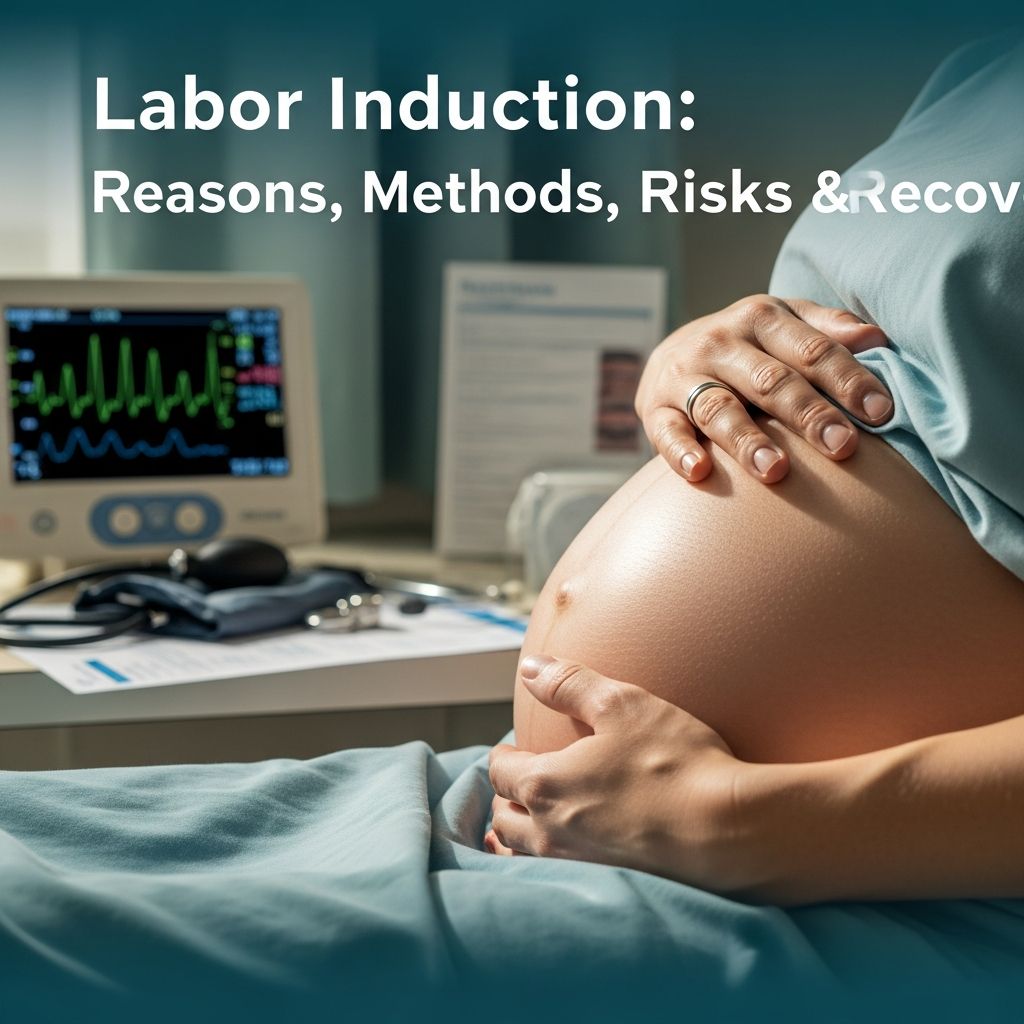
Labor induction refers to a medical intervention where a pregnancy care provider initiates or advances labor before it begins naturally to facilitate vaginal delivery. This procedure involves using medications, mechanical devices, or other techniques to stimulate uterine contractions and progress labor. Your healthcare provider will carefully examine your cervix and assess your medical history before recommending induction, weighing the potential benefits against possible risks for both you and your baby.
Why Is Labor Induction Recommended?
Labor induction becomes necessary for various medical reasons. Your provider may recommend induction if you are past your due date, typically after 41 weeks of gestation. Other common reasons include pregnancy complications such as gestational diabetes, preeclampsia, or intrauterine growth restriction. Induction may also be recommended if your water breaks before labor begins, if there are concerns about fetal well-being, or if you have certain maternal health conditions that make continuing pregnancy risky.
Additionally, induction might be considered if there is placental insufficiency, maternal infection, or if the pregnancy poses risks to your health. Your healthcare team will discuss whether the benefits of induction outweigh the risks specific to your situation.
Contraindications to Labor Induction
Labor induction is not appropriate for all pregnancies. Certain conditions prevent safe induction, including active genital herpes infection, which could be transmitted to your baby during delivery. Previous uterine surgery also affects induction eligibility. Specifically, if you have had a classical (vertical) cesarean incision or transfundal uterine surgery such as myomectomy involving entry into the uterine cavity, induction may not be safe due to the increased risk of uterine rupture.
Abnormal fetal presentations also contraindicate induction. These include transverse lie (when the baby is positioned horizontally), umbilical cord presentation, or severe fetopelvic disproportion. Multiple prior uterine scars combined with breech presentation are considered relative contraindications, meaning your provider will need careful consideration before proceeding.
Pre-Induction Evaluation
Before your labor induction, your healthcare provider will conduct a thorough evaluation. This includes examining your cervix to determine its condition, which is categorized as favorable or unfavorable. A favorable cervix is soft, thin, and partially dilated or effaced, making it more likely to respond to induction methods. An unfavorable cervix is hard, closed, and thick, requiring cervical ripening before active labor induction.
Your provider will also monitor your baby’s heart rate and may perform other assessments to ensure both you and your baby are healthy enough to proceed with induction. This pre-induction assessment is crucial for determining which induction method will be most effective for your specific situation.
Methods for Cervical Ripening
If your cervix is hard and closed, the first step in labor induction is cervical ripening. This process softens and prepares your cervix for labor. Several methods can achieve cervical ripening:
Medication-Based Methods
Misoprostol is a commonly used medication that helps ripen the cervix. It can be administered vaginally in 25-microgram doses every 2 to 4 hours, or orally in 25 to 50-microgram doses every 2 hours. Misoprostol stimulates uterine contractions and softens cervical tissue, making it an effective ripening agent.
Related Stories



Dinoprostone is another medication that may be used for cervical ripening. It works similarly to misoprostol by promoting cervical softening and uterine activity.
Mechanical Methods
Foley Balloon Catheter is a mechanical device that provides an alternative to medications. Your provider inserts a small catheter through your cervix and inflates a balloon with saline solution. The inflated balloon applies gentle, consistent pressure to your cervix, encouraging dilation. This method can take up to 12 hours for effective cervical dilation, and the balloon typically falls out once your cervix dilates to about 3 centimeters.
Laminaria and Transcervical Balloons are other mechanical options that may be useful when other methods are ineffective or contraindications exist. These devices gradually dilate the cervix through mechanical pressure rather than medication.
Combined Approaches often prove most effective. Many providers use a Foley catheter in combination with misoprostol or oxytocin to optimize cervical ripening and labor progression.
Methods to Induce Active Labor
Once your cervix is favorable—soft, thin, and beginning to dilate—your provider may proceed with methods to induce active labor and increase the intensity of uterine contractions.
Oxytocin (Pitocin)
Oxytocin is the most commonly used method for inducing active labor, delivered through a constant intravenous infusion. This approach is safe and cost-effective. Low-dose oxytocin begins at 0.5 to 2 milliunits per minute and increases by 1 to 2 milliunits per minute, typically every 15 to 60 minutes. High-dose oxytocin starts at 6 milliunits per minute and increases by 1 to 6 milliunits per minute every 15 to 40 minutes, up to a maximum of 40 milliunits per minute. Your provider adjusts the dose based on your uterine response and contractions.
Artificial Rupture of Membranes
Amniotomy, or breaking your water artificially, can help stimulate labor. Your provider uses a small instrument to create a small opening in the amniotic sac, releasing the fluid. This procedure may be combined with oxytocin or used independently, depending on your situation.
Natural Methods and Complementary Approaches
While medical interventions are the primary methods for labor induction, some natural techniques may support the process. Research indicates that nipple stimulation is the only non-medical method with substantial scientific evidence supporting its effectiveness. Studies show that women who engaged in nipple stimulation were more likely to be in labor after three days compared to those who did not, without increasing cesarean delivery rates or adverse outcomes.
Risks and Complications of Labor Induction
While labor induction is generally safe, it does carry potential risks that you should understand before proceeding. Hyperstimulation of the uterus, characterized by overly frequent or intense contractions, can occur and may reduce blood flow to the placenta, potentially affecting fetal oxygen supply.
Uterine rupture is a rare but serious complication, particularly in women with prior uterine surgery. Maternal infection and postpartum hemorrhage are additional risks. Some women may experience failed induction, meaning labor does not progress despite induction attempts, potentially leading to cesarean delivery.
Fetal complications can include heart rate abnormalities, cord prolapse if membranes rupture, or infection if labor is prolonged. Your healthcare provider will monitor you and your baby closely throughout the induction process to minimize these risks.
What to Expect During Labor Induction
The timeline for labor induction varies considerably. The procedure itself typically takes less than 10 minutes, but the overall process from induction start to delivery can take hours to days. Many women experience their first induction taking longer than 24 hours.
Upon arrival at the hospital, a monitor will be placed on your abdomen to check your baby’s heart rate and evaluate uterine contractions. Your cervix will be examined periodically to assess dilation and effacement. Depending on your provider’s assessment and the induction method chosen, you may be able to go home and wait for labor to progress, or you may need to remain hospitalized.
Throughout induction, you’ll experience cramping and contractions that gradually increase in intensity. Your provider will adjust medications as needed and continue monitoring both you and your baby to ensure labor is progressing appropriately.
Success Rates and Outcomes
The success rate of labor induction varies depending on the method used and individual factors. For example, Foley balloon induction has a success rate of approximately 70%. Multiple factors influence success, including your cervical condition, whether you’ve given birth before, your age, and your overall health.
Many inductions result in successful vaginal delivery, though some may progress to cesarean delivery if labor doesn’t advance adequately. Your provider will discuss what constitutes adequate progress and when alternative delivery methods might be necessary.
When Induction Is Not Recommended
According to Cleveland Clinic guidelines, if your pregnancy is healthy and uncomplicated, it is best to let labor begin on its own. The clinic recommends against induction of labor prior to 41 weeks of gestation for healthy pregnancies. This recommendation aligns with American College of Obstetricians and Gynecologists (ACOG) national guidelines, emphasizing that spontaneous labor between 37 and 41 weeks is preferable for uncomplicated pregnancies.
Recovery After Labor Induction
In most cases, recovery from labor induction is similar to recovery from labor that began spontaneously. If you delivered vaginally, your recovery involves the standard postpartum period with vaginal soreness, lochia (postpartum bleeding), and gradual restoration of normal body functions. Your healthcare provider will monitor you for complications such as infection or excessive bleeding.
If labor induction resulted in cesarean delivery, your recovery will involve surgical healing along with postpartum recovery. Your provider will give you specific instructions regarding activity restrictions, wound care, and when you can resume normal activities.
Frequently Asked Questions About Labor Induction
Q: Can I be induced as an outpatient?
A: Some induction methods, like Foley balloon placement, can be performed as an outpatient procedure. However, labor can progress quickly for some people, so your provider will determine whether you can go home to wait for labor to start or if you need to remain hospitalized for monitoring.
Q: How long does labor induction usually take?
A: The procedure itself typically takes less than 10 minutes, but the entire induction process from start to delivery can take hours to days. First-time inductions often take longer than 24 hours.
Q: Does labor induction increase my risk of cesarean delivery?
A: While failed induction can lead to cesarean delivery, induction itself does not automatically increase cesarean rates. Your provider will monitor labor progression and discuss options if induction is not progressing adequately.
Q: What is the difference between favorable and unfavorable cervix?
A: A favorable cervix is soft, thin, and partially dilated or effaced, making it more likely to respond to labor induction. An unfavorable cervix is hard, closed, and thick, requiring cervical ripening before active labor induction can be attempted.
Q: Are there any natural ways to prepare for labor induction?
A: While nipple stimulation has scientific evidence supporting its effectiveness in promoting labor onset, most medical inductions rely on medications and mechanical methods. Discuss with your provider what complementary approaches may be appropriate for your situation.
Q: What happens if labor induction doesn’t work?
A: If your cervix doesn’t dilate or labor contractions don’t begin despite induction, your provider will remove any devices used and discuss alternative delivery methods, which may include cesarean delivery.
References
- Induction of Labor — Merck Manuals Professional Edition. Accessed 2025-12-01. https://www.merckmanuals.com/professional/gynecology-and-obstetrics/labor-and-delivery/induction-of-labor
- Foley Bulb Induction: What To Expect & Success Rate — Cleveland Clinic. Accessed 2025-12-01. https://my.clevelandclinic.org/health/treatments/23925-foley-bulb-induction
- Induced Labor: Reasons, Procedure, Risks & Results — Cleveland Clinic. Accessed 2025-12-01. https://my.clevelandclinic.org/health/treatments/17698-labor-induction
- Cervical Ripening: Overview, Methods, Benefits & Risks — Cleveland Clinic. Accessed 2025-12-01. https://my.clevelandclinic.org/health/procedures/22165-cervical-ripening
- Is There Any Guaranteed Way To Induce Labor? — Cleveland Clinic Health. Accessed 2025-12-01. https://health.clevelandclinic.org/what-natural-ways-to-induce-labor-actually-work
Similar Articles








Read full bio of medha deb