Lacrimal Apparatus: Anatomy, Function & Eye Health
Understanding the tear production system: anatomy, function, and importance to eye health.
Understanding the Lacrimal Apparatus: The Eye’s Natural Protection System
The lacrimal apparatus is a sophisticated biological system responsible for the continuous production, distribution, and drainage of tears that maintain eye health and protect against environmental threats. This intricate network of glands, ducts, and tissues works seamlessly to keep your eyes moist, clean, and functioning optimally. The lacrimal apparatus performs essential functions including lubrication of the eye surface, removal of debris, and protection against infections through specialized immune components in tears.
What Is the Lacrimal Apparatus?
The lacrimal apparatus is a complete functional system comprising both secretory and excretory components. The secretory system produces tears through specialized glands, while the excretory system channels these tears across the eye surface and drains them through the nasal cavity. This dual-system approach ensures continuous eye lubrication and waste removal. Understanding how this apparatus functions helps explain common eye conditions and the importance of tear production for overall vision health.
Anatomy of the Lacrimal Apparatus
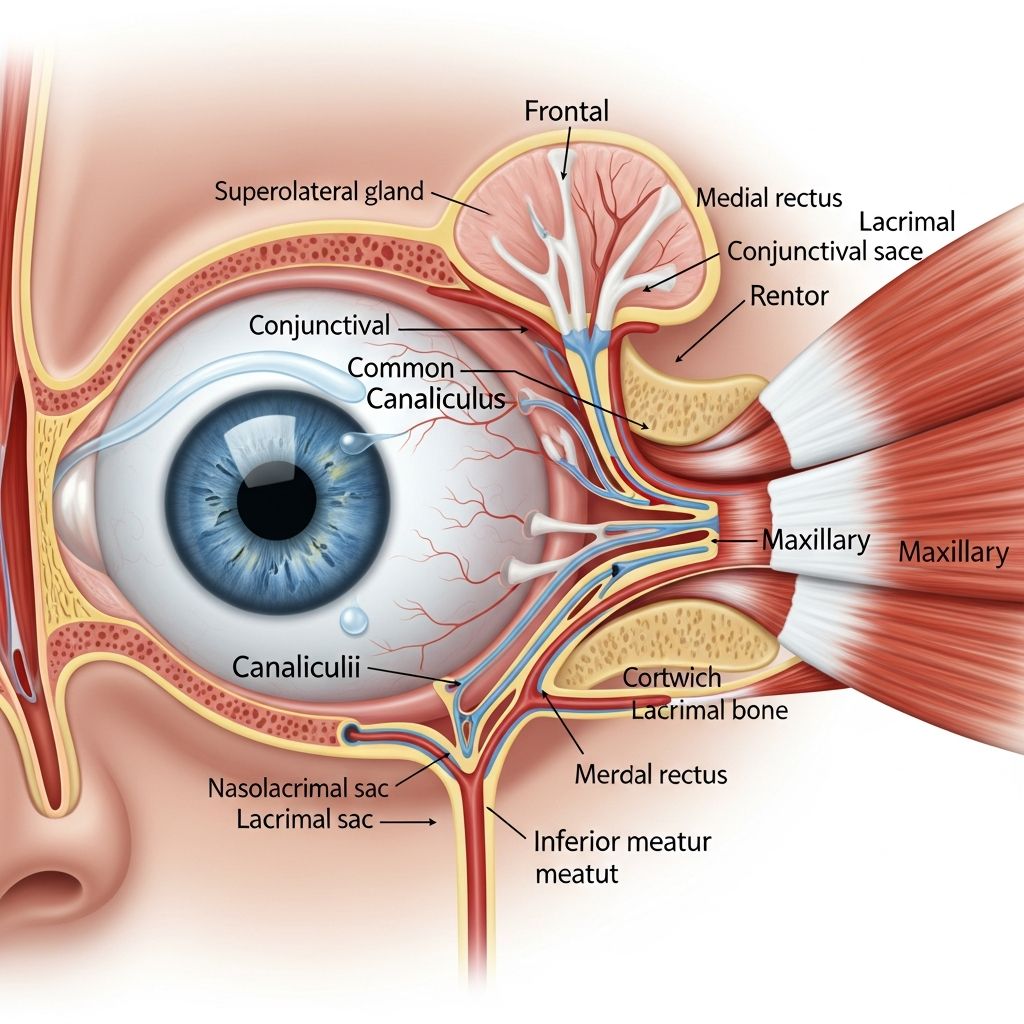
The lacrimal apparatus consists of several distinct anatomical structures, each playing a vital role in tear production and drainage:
The Lacrimal Gland
The lacrimal gland is the primary tear-producing organ, located in the superior and lateral portion of each orbit just beneath the orbital rim. This J-shaped serous gland sits within the lacrimal fossa, an indentation on the orbital roof. The gland is anatomically divided into two distinct sections that work together to produce tears continuously. The smaller palpebral portion lies closer to the eye, while the larger orbital portion extends deeper into the orbit. These two portions are continuous with each other around the lateral margin of the levator palpebrae superioris muscle.
The lacrimal gland comprises specialized cells that produce proteins and electrolytes, which cause water to follow by osmosis, creating the aqueous component of tears. The gland produces approximately one milliliter of lacrimal fluid per day, with about half evaporating between blinks and the remaining half draining into the nasal cavity.
Lacrimal Ducts
Tears exit the lacrimal gland through multiple small ducts. Approximately 6 to 12 excretory ducts emerge from the gland—roughly 4 to 5 from the orbital portion and 6 to 8 from the palpebral portion. These ducts converge and open into the superior conjunctival fornix, the flexible region connecting the eyelid to the eyeball. This strategic opening allows tears to be distributed evenly across the eye surface during blinking.
The Conjunctiva
The conjunctiva is a transparent mucous membrane that plays a crucial role in tear distribution. This tissue has three distinct regions: the palpebral conjunctiva, which lines the internal surface of the eyelids; the bulbar conjunctiva, which covers the eyeball surface; and the fornix, the flexible connecting region that permits eye movement. Specialized goblet cells within the conjunctiva secrete mucins that contribute to the tear film composition.
Lacrimal Puncta and Canaliculi
The lacrimal puncta are small openings located at the medial end of both upper and lower eyelids, serving as entry points for tear drainage. These tiny orifices lead to the lacrimal canaliculi, small channels that transport tears from the eye surface toward the nasal cavity. Each canaliculus consists of a vertical portion near the punctum and a horizontal portion that extends medially. The canaliculi are lined with stratified squamous epithelium, specialized tissue that can withstand the constant flow of tears.
Related Stories



The Lacrimal Sac and Nasolacrimal Duct
Tears from both upper and lower canaliculi converge into the lacrimal sac, the upper dilated portion of the nasolacrimal duct. The lacrimal sac cells are lined with stratified columnar epithelium containing goblet cells that secrete mucus. From the lacrimal sac, tears flow through the nasolacrimal duct, which transports them into the nasal cavity, emptying anteroinferiorly near the inferior nasal conchae. This drainage pathway explains why your nose runs when you cry—tears and nasal secretions are physiologically connected.
Meibomian Glands
Located in the eyelids are approximately 50 meibomian (tarsal) glands in the upper lid and 25 in the lower lid. These specialized sebaceous glands secrete lipids called meibum, which form a crucial component of the tear film. When you blink, these glands are squeezed, releasing their oily secretion that prevents tear spillage onto the cheek and maintains tears between the oiled edge of the eyelid and the eyeball.
The Tear Film: Structure and Composition
Tears are not simple water but a complex fluid with multiple layers, each serving specific protective functions:
The Lipid Layer
The outermost layer of the tear film consists of lipids secreted by meibomian glands, forming a hydrophobic barrier that reduces tear evaporation. This oily layer is composed primarily of nonpolar lipids, but the inner lipids contain both hydrophobic and hydrophilic components, allowing them to form an interface with the underlying aqueous layer.
The Aqueous Layer
Beneath the lipid layer lies the aqueous layer, the main component produced by the lacrimal gland. This layer contains electrolytes, proteins, and antibacterial enzymes that protect the eye from infection and foreign material. The aqueous layer also contains IgA antibodies, providing active immune defense against pathogens attempting to colonize the ocular surface.
The Mucin Layer
The innermost layer directly contacts the eye surface and comprises mucins secreted by goblet cells in the conjunctiva. This layer helps the tear film adhere to the cornea and conjunctiva, ensuring even distribution across the entire eye surface.
Innervation and Neural Control
The lacrimal apparatus functions under precise neural control through multiple cranial nerves. The ophthalmic branch of the trigeminal nerve (cranial nerve V) supplies sensation to the eye, detecting foreign particles and triggering reflex tearing. When debris touches the eye, this sensory input triggers an involuntary eyelid closure via the facial nerve (cranial nerve VII), causing the orbicularis oculi muscle to contract.
Parasympathetic innervation originates from the lacrimatory nucleus of the facial nerve in the pons. These fibers exit the skull via the foramen lacerum with the greater petrosal nerve, eventually reaching the eye after synapsing in the pterygopalatine ganglion. Sympathetic innervation arises from the superior cervical ganglion, forming the deep petrosal nerve that merges with the greater petrosal nerve to provide additional neural regulation of tear production.
Blood Supply and Vascular System
The lacrimal gland receives its arterial blood supply from the lacrimal artery, a branch of the ophthalmic artery. Venous drainage occurs through the superior ophthalmic vein, which returns deoxygenated blood to systemic circulation. This rich vascular supply ensures the lacrimal gland has adequate nutrients and oxygen to maintain continuous tear production throughout the day.
Functions of the Lacrimal Apparatus
The lacrimal apparatus serves multiple critical functions for eye health and vision:
- Lubrication: Tears reduce friction between the eyelid and eyeball during blinking, preventing discomfort and allowing smooth eye movement.
- Optical clarity: The tear film maintains a smooth optical surface over the cornea, essential for clear vision and proper light refraction.
- Debris removal: Tears flush away dust, pollen, and other foreign particles that could scratch or damage the cornea.
- Immune protection: Antibodies and antimicrobial enzymes in tears defend against bacterial and viral infections.
- Nutrition: Tears deliver oxygen and nutrients to the cornea, which lacks blood vessels.
- Waste removal: Tears remove metabolic waste products from the ocular surface.
Types of Tears
The lacrimal apparatus produces different types of tears based on various stimuli and needs. Basal tears are continuously produced in small quantities to maintain baseline eye lubrication. Reflex tears are produced in response to irritation, such as foreign particles or chemical exposure, causing the lacrimal gland to dramatically increase tear production. Emotional tears are triggered by feelings and contain higher concentrations of stress hormones. All three types flow through the same drainage system, though emotional tears often exceed the drainage capacity, causing tears to overflow onto the cheeks.
Clinical Significance and Common Conditions
Dysfunction of the lacrimal apparatus leads to various eye conditions affecting comfort and vision. Dry eye syndrome occurs when tear production is insufficient or tears evaporate too quickly, resulting in irritation and potential corneal damage. Excessive tearing, or epiphora, may result from blocked tear ducts or reflex tearing in response to dry eyes. Dacryocystitis involves inflammation or infection of the lacrimal sac, usually from duct obstruction. Understanding lacrimal apparatus anatomy helps ophthalmologists diagnose and treat these conditions effectively.
Age-Related Changes
The lacrimal apparatus undergoes changes with aging. Tear production typically decreases after age 65, particularly in women post-menopause due to hormonal changes. The tear film composition may also shift, with altered lipid and mucin ratios affecting tear quality. These changes contribute to the higher prevalence of dry eye syndrome in older adults, requiring management strategies such as artificial tears or punctal plugs.
Frequently Asked Questions
Q: How much tear fluid does the lacrimal apparatus produce daily?
A: The lacrimal gland produces approximately one milliliter of tear fluid per day. About half evaporates between blinks, while the remaining half drains through the lacrimal drainage system into the nasal cavity.
Q: Why does my nose run when I cry?
A: Tears drain through the lacrimal puncta into the lacrimal canaliculi, then through the nasolacrimal duct directly into the nasal cavity. When tear production exceeds drainage capacity during emotional crying, excess tears overflow onto your cheeks while tears drain into your nose.
Q: What causes dry eye syndrome?
A: Dry eye syndrome results from insufficient tear production, excessive tear evaporation, or altered tear composition. Contributing factors include aging, hormonal changes, environmental conditions, medication side effects, and certain medical conditions like Sjögren’s syndrome.
Q: Can a blocked tear duct heal on its own?
A: Some mild blockages may resolve spontaneously, but persistent blocked tear ducts often require medical intervention. Treatment options include warm compresses, massage, topical antibiotics, or in some cases, surgical correction.
Q: How do the eyelids help distribute tears?
A: During blinking, the orbicularis oculi muscle contracts, causing the eyelid to sweep across the eye surface. This action distributes tears evenly across the cornea and conjunctiva while simultaneously squeezing meibomian glands to add lipids to the tear film.
Q: What is the difference between basal tears and reflex tears?
A: Basal tears are continuously produced in small amounts to maintain basic eye lubrication. Reflex tears are produced in larger quantities in response to irritation, foreign objects, or emotional triggers, representing the body’s protective response to perceived threats.
References
- Lacrimal apparatus: Anatomy, parts & function — Kenhub. 2024. https://www.kenhub.com/en/library/anatomy/lacrimal-apparatus
- Anatomy of lacrimal apparatus Animation – USMLE Step 1 — YouTube Educational Content. 2024. https://www.youtube.com/watch?v=ZCHQZBtkoM4
- Lacrimal apparatus — Wikipedia. 2024. https://en.wikipedia.org/wiki/Lacrimal_apparatus
- Anatomy, Head and Neck: Eye Lacrimal Duct — StatPearls, National Center for Biotechnology Information (NCBI), National Institutes of Health (NIH). 2024. https://www.ncbi.nlm.nih.gov/books/NBK531487/
- Lacrimal Glands and Apparatus – Vasculature — TeachMeAnatomy. 2024. https://teachmeanatomy.info/head/organs/eye/lacrimal-gland/
- Lacrimal gland anatomy — MedlinePlus Medical Encyclopedia, National Library of Medicine. 2024. https://medlineplus.gov/ency/imagepages/8829.htm
Similar Articles








Read full bio of Sneha Tete