Langerhans Cell Histiocytosis: Signs, Diagnosis, Treatment
Comprehensive guide to Langerhans cell histiocytosis: symptoms, diagnosis, treatment, and prognosis of this rare histiocytic disorder.
Langerhans Cell Histiocytosis
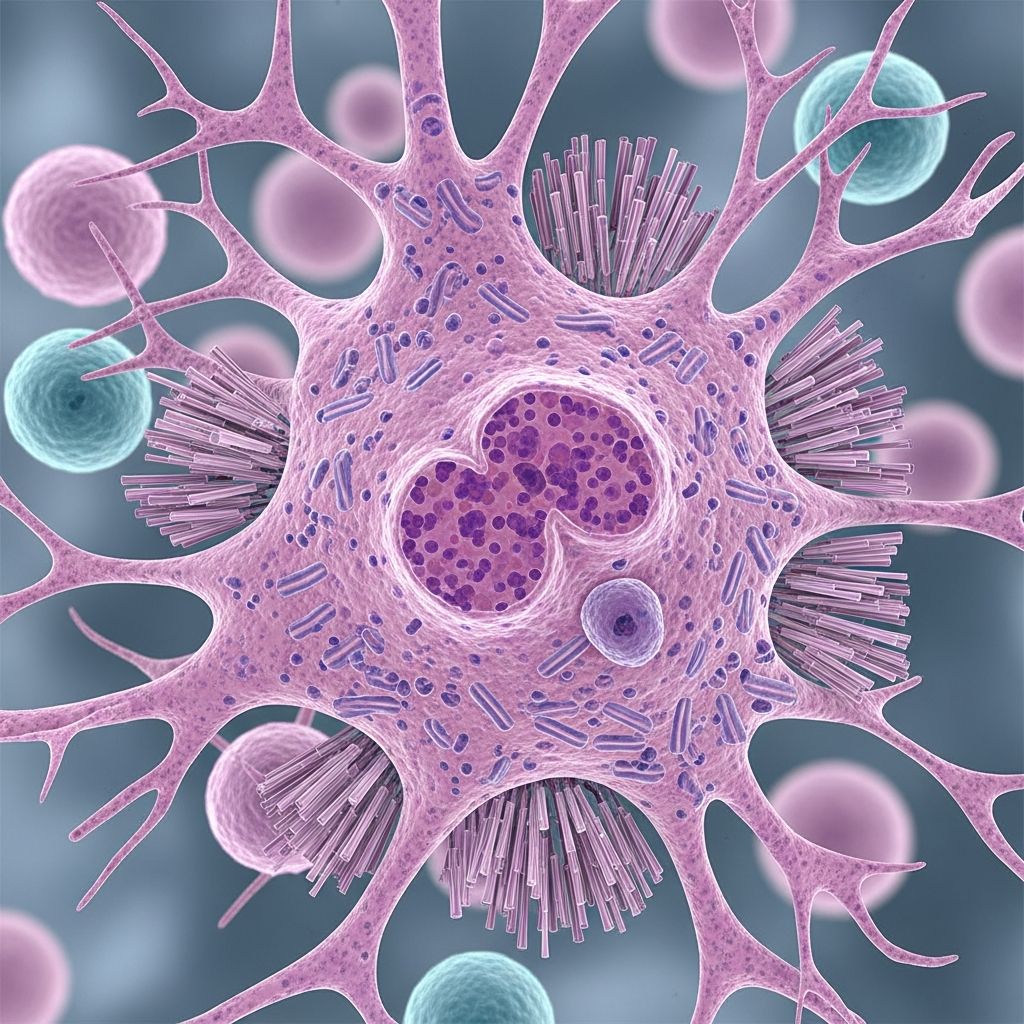
Langerhans cell histiocytosis (LCH) is a rare disorder characterized by the clonal proliferation and infiltration of Langerhans-like dendritic cells into various tissues, leading to a wide spectrum of clinical manifestations from isolated bone lesions to life-threatening multisystem disease.
What is Langerhans cell histiocytosis?
LCH was previously classified as a group of histiocytic disorders but is now recognized as a neoplastic process driven by activating mutations in the MAPK/ERK pathway, most commonly in the BRAF V600E gene. These mutations lead to uncontrolled proliferation of pathological Langerhans cells, which recruit inflammatory cells and cause tissue damage. The disease predominantly affects children under 10 years but can occur at any age, with an annual incidence of approximately 5-8 cases per million children.
Pathological Langerhans cells in LCH express typical markers such as CD1a, langerin (CD207), and S100 protein, distinguishing them from normal epidermal Langerhans cells. The clinical behavior varies widely: some cases regress spontaneously, while others progress to organ failure.
Who gets Langerhans cell histiocytosis?
- Children: Peak incidence between 1-3 years of age; 80% of cases diagnosed before age 10.
- Adults: Rarer, often presenting with pulmonary or multisystem disease, particularly in smokers.
- Male predominance: Slight male-to-female ratio of 1.5-2:1.
- Risk factors include tobacco smoking for adult pulmonary LCH and genetic predisposition in familial cases (rare).
What causes Langerhans cell histiocytosis?
LCH results from somatically acquired mutations in hematopoietic stem cells, leading to clonal expansion of dendritic cells. Key genetic findings include:
- BRAF V600E mutation in 50-60% of cases.
- MAPK pathway mutations (MAP2K1, ARAF) in 20-25%.
- Other rare mutations in ERK pathway genes.
These mutations cause constitutive activation of cell signaling, promoting survival and migration of pathological cells. Environmental triggers like smoking may contribute in adult-onset pulmonary LCH.
What are the clinical features of Langerhans cell histiocytosis?
LCH manifestations depend on involved organs. The disease is classified as single-system (SS-LCH) or multisystem (MS-LCH), with risk organ involvement (liver, spleen, bone marrow) determining prognosis.
Bone involvement (most common, 80% of cases)
Lytic “punched-out” lesions, often painful and affecting skull, spine, pelvis, or long bones. May cause pathological fractures or vertebral collapse. Skull lesions can erode to skin or mastoid causing ear discharge.
Skin involvement
- Infants: Seborrhoeic dermatitis-like scalp crusting (“cradle cap”), intertriginous papules/ulcers (nappy rash).
- Older children/adults: Red-brown papules, vesicles, petechiae, or purpuric macules on trunk, scalp, or flexures. Pruritic or asymptomatic.
Pulmonary involvement
Common in adult smokers: nodular/cystic changes leading to pneumothorax, dyspnea, dry cough, or hemoptysis. Chest imaging shows upper lobe predominant cysts/nodules.
Endocrine involvement (25-50%)
- Diabetes insipidus (central): Polyuria, polydipsia due to posterior pituitary infiltration (most common presenting feature in some series).
- Growth hormone deficiency, precocious puberty, or hypogonadism.
Hematological involvement
Bone marrow infiltration causes cytopenias: anemia (fatigue, pallor), thrombocytopenia (bruising, bleeding), neutropenia (infections).
Gastrointestinal/Abdominal
- Liver/spleen enlargement (organomegaly), jaundice, ascites, hypoalbuminemia.
- Abdominal pain, diarrhea, vomiting.
Central Nervous System
- Mass lesions: ataxia, seizures, diabetes insipidus.
- Neurodegenerative LCH: late-onset ataxia, dysarthria, cognitive decline (years after treatment).
Other features
- Lymphadenopathy: Cervical, axillary, inguinal nodes.
- Oral: Gingival swelling, tooth loosening, ulcers.
- Ear: Chronic otitis media, otorrhea, hearing loss.
- Eye: Proptosis, visual loss.
Diagnosis of Langerhans cell histiocytosis
Diagnosis requires histopathological confirmation with characteristic CD1a+ langerin+ Birbeck granules on electron microscopy (if needed). Key steps:
- Biopsy of accessible lesion (skin, bone, lymph node).
- Imaging: Skeletal survey, PET-CT (preferred for staging), MRI brain/pituitary, chest HRCT.
- Laboratory: CBC, LFTs, ferritin, coagulation, water deprivation test (DI).
- Molecular testing: BRAF/MAPK mutation analysis guides targeted therapy.
Staging assesses extent: SS-LCH (favorable) vs MS-LCH with/without risk organ dysfunction.
Treatment of Langerhans cell histiocytosis
Treatment is risk-adapted. SS-LCH may need only local therapy; MS-LCH requires systemic chemotherapy.
Single-system LCH
- Bone lesions: Surgical curettage, low-dose radiotherapy, or intralesional steroids.
- Skin: Topical nitrogen mustard, phototherapy.
Multisystem LCH
- Induction chemotherapy: Vinblastine + steroids (prednisolone).
- Maintenance: Mercaptopurine, methotrexate (12-24 months).
- Refractory/relapsed: BRAF inhibitors (vemurafenib) if BRAF+, cladribine, cytarabine.
Organ-specific
| Organ | Treatment |
|---|---|
| Pulmonary | Smoking cessation, lung transplant (end-stage). |
| Diabetes insipidus | Desmopressin replacement. |
| Liver failure | Transplant evaluation. |
Complications of Langerhans cell histiocytosis
- Acute: Cytopenias, infections, organ failure (liver/spleen/pulmonary).
- Long-term: Growth impairment, infertility, secondary cancers, neurodegenerative disease, diabetes insipidus (permanent in 50%).
- Pulmonary fibrosis, scoliosis from vertebral lesions, hearing/vision loss.
Prognosis of Langerhans cell histiocytosis
Outcomes vary:
- SS-LCH: >95% cure rate.
- MS-LCH without risk organs: 80-90% 5-year survival.
- MS-LCH with risk organs: 50-70% survival; poor if non-responsive to initial therapy.
Reactivations occur in 20-30%; late effects affect 40% of survivors.
Frequently Asked Questions
What is the most common symptom of LCH?
Painful bone lesions, especially skull “punched-out” lytic areas, occur in 80% of cases.
Is LCH cancer?
LCH is a neoplastic disorder due to clonal dendritic cell proliferation with driver mutations, classified as a blood cancer by WHO.
Can LCH be cured?
Single-system LCH has excellent cure rates (>95%); multisystem disease cure depends on early response (50-90% survival).
How is LCH diagnosed?
Tissue biopsy showing CD1a+ CD207+ cells with Birbeck granules; staging with PET-CT and labs.
What is the treatment for LCH?
Risk-adapted chemotherapy (vinblastine/steroids), targeted BRAF inhibitors for mutated cases, supportive care.
References
- Langerhans Cell Histiocytosis (LCH) Diagnosis & Treatment — Columbia University Irving Medical Center. 2024. https://www.cancer.columbia.edu/cancer-types-care/types/rare-blood-disorders/conditions/langerhans-cell-histiocytosis-lch
- Langerhans Cell Histiocytosis – Diagnosis & Disease Information — Cancer Therapy Advisor. 2024. https://www.cancertherapyadvisor.com/ddi/langerhans-cell-histiocytosis/
- Langerhans cell Histiocytosis in Adults — Histiocytosis Association. 2024. https://histio.org/langerhans-cell-histiocytosis-in-adults/
- Langerhans Cell Histiocytosis — NORD (National Organization for Rare Disorders). 2023-10-27. https://rarediseases.org/rare-diseases/langerhans-cell-histiocytosis/
- Langerhans Cell Histiocytosis — Vanderbilt-Ingram Cancer Center. 2024. https://vicc.org/cancer-info/childhood-langerhans-cell-histiocytosis
- Langerhans Cell Histiocytosis Treatment — St. Jude Children’s Research Hospital. 2024. https://www.stjude.org/care-treatment/treatment/immune-disorders/histiocytosis/langerhans-cell-histiocytosis.html
- Langerhans’ cell histiocytosis — Great Ormond Street Hospital. 2024. https://www.gosh.nhs.uk/conditions-and-treatments/conditions-we-treat/langerhans-cell-histiocytosis/
Similar Articles



Read full bio of medha deb