Lax Beetle Images and Blister Dermatitis
Visual guide to lax beetle blisters and blister beetle dermatitis symptoms.
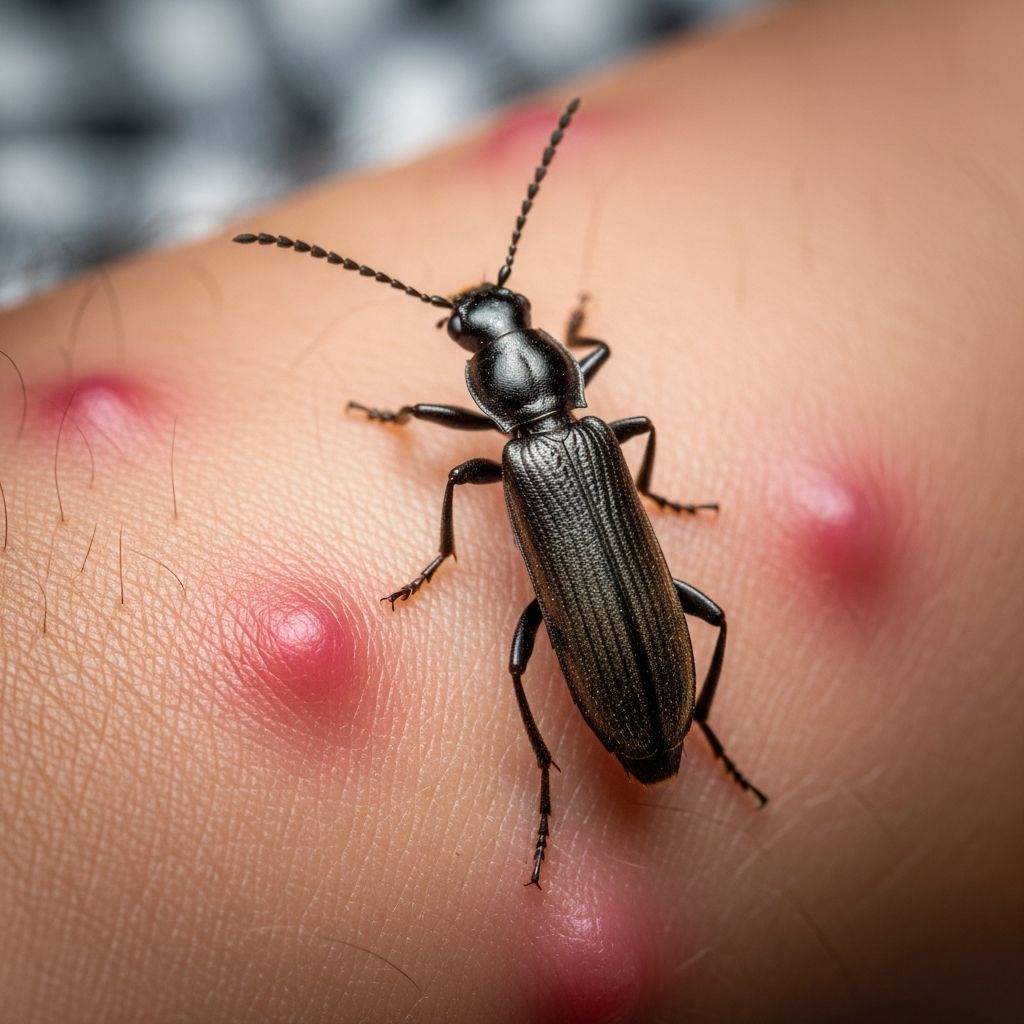
Lax beetle dermatitis is a painful skin condition resulting from contact with the lax beetle, scientifically known as Thelyphassa lineata. This irritant contact dermatitis occurs when the beetle is accidentally crushed against the skin, releasing hemolymph containing potent blistering toxins. Understanding the visual presentation of lax beetle blisters is essential for accurate diagnosis and prompt treatment of this condition.
Understanding Lax Beetle Dermatitis
Lax beetle dermatitis, also referred to as blister beetle dermatitis or dermatitis linearis, is characterized by the sudden onset of painful fluid-filled blisters that appear on exposed areas of the skin. The condition occurs when the beetle’s protective hemolymph, containing the toxic compound paederin, comes into direct contact with human skin. Unlike some other beetle-induced dermatitis conditions, lax beetle reactions are primarily mechanical in nature, triggered by the accidental crushing of the insect against the body.
The lax beetle is a small insect measuring approximately 0.5 to 1.5 centimeters in length. These beetles are characterized by their distinctive appearance, featuring a shiny black head and thorax with blue or black elytra (forewings) and a contrasting orange-red abdomen. This striking coloration pattern makes them relatively easy to identify once encountered.
Timeline of Blister Development
The progression of lax beetle blisters follows a predictable timeline that helps differentiate this condition from other skin disorders:
- Initial contact: When the beetle is crushed against the skin, the toxin is immediately released but initial symptoms may not appear immediately
- 24-48 hours: A localized streaky or linear erythema (redness) appears on the affected area, marking the beginning of visible symptoms
- 2-4 days: The affected area progresses from simple redness to vesicles and pustules, which are characteristic fluid-filled lesions
- 1-2 weeks: The blisters gradually begin to dry and crust over as the skin begins its healing process
- Several weeks to months: Complete resolution occurs, though postinflammatory pigmentation changes may persist for an extended period
Visual Characteristics of Lax Beetle Blisters
The visual presentation of lax beetle-induced blisters is distinctive and recognizable to trained healthcare providers. The characteristic appearance includes:
- Linear arrangement: Blisters typically appear in a linear or whiplash-like pattern, following the path where the beetle contacted or was dragged across the skin
- Erythematous base: The affected areas display intense reddish-pink coloration surrounding the actual blisters
- Fluid-filled lesions: Clear to yellowish fluid fills the blisters, which may appear as rounded or oval structures under magnification
- Perifollicular involvement: Blisters often concentrate around hair follicles, creating a characteristic dotted or globular appearance
- Progressive inflammation: Early lesions show more intense inflammation with white and gray structures visible on examination, while later lesions appear more muted in coloration
Dermoscopic Features
Dermoscopy, a non-invasive examination technique using magnified visualization, reveals specific patterns in lax beetle dermatitis that aid in diagnosis:
| Stage of Lesion | Dermoscopic Findings | Histopathological Correlation |
|---|---|---|
| Early lesions | Yellowish-white structures, roundish white globules, gray structures on intense reddish-pink background | Intra-epidermal vesicles with serum and erythrocytes |
| Mid-stage lesions | Brown dots and areas, scales, pinkish-white zones | Dried serum and necrotic keratinocytes with melanin retention |
| Late lesions | Dotted and globular vessels, reduced gray structures, vascular elements | Vasodilation and superficial perivascular infiltration |
| Healing lesions | Pink background with prominent vascular patterns | Hyperkeratosis and persistent vasodilation |
Distinguishing Features from Other Conditions
Lax beetle dermatitis can be confused with several other skin conditions, particularly herpes zoster (shingles), which also presents with blisters in a linear distribution. However, specific features help differentiate lax beetle dermatitis:
- Absence of systemic symptoms: Lax beetle dermatitis typically does not cause fever, malaise, or lymphadenopathy as seen in herpes zoster
- Whiplash pattern: The linear arrangement follows the direction of beetle contact rather than dermatomal distribution
- History of beetle exposure: Patients can usually recall contact with an insect, whereas herpes zoster has no clear insect exposure history
- Kissing lesions: When opposing skin surfaces touch during contact, mirror-image blisters appear on both surfaces, a feature characteristic of beetle contact dermatitis
- Dermoscopic patterns: The specific arrangement of white globules with brown dots in the center is characteristic of perifollicular micropustules seen in beetle dermatitis, distinguishing it from the vesicular patterns of herpes zoster
Locations of Involvement
Lax beetle blisters predominantly appear on exposed areas of the body where contact with the insect is most likely. Common sites include:
- Face and neck
- Arms and forearms
- Legs and shins
- Hands and fingers
- Chest (in cases where beetles enter clothing)
Occasionally, the blisters may appear on opposing skin surfaces, such as both sides of the neck or both arms if the beetle was crushed between skin surfaces, creating distinctive symmetrical lesions.
Clinical Diagnosis
Diagnosis of lax beetle dermatitis is primarily clinical, based on the characteristic appearance, distribution pattern, timeline of symptoms, and history of beetle contact. A healthcare provider will examine the blisters and may ask about recent exposure to insects. In ambiguous cases, dermoscopic examination can confirm the diagnosis by revealing the distinctive patterns associated with beetle dermatitis.
Skin biopsy, while not routinely necessary, shows intra-epidermal blister formation with preserved epidermal architecture, distinguishing it histologically from pemphigus or other blistering disorders. The presence of perifollicular micropustules is particularly characteristic.
Associated Pain and Complications
The primary concern with lax beetle dermatitis is the significant pain associated with the blisters. This discomfort can persist throughout the healing process. Secondary complications may include:
- Bacterial superinfection: If blisters are scratched or not kept clean, secondary bacterial infection can develop
- Postinflammatory hyperpigmentation: After the blisters heal, darkening of the affected skin may persist for several months
- Postinflammatory hypopigmentation: Less commonly, some patients experience temporary lightening of the skin
- Scarring: Though rare with appropriate care, severe cases may result in subtle scarring
Treatment Approach
Once lax beetle blisters appear, management focuses on minimizing discomfort and preventing complications:
- Immediate cleaning: Wash the affected area thoroughly with soap and clean water to remove any remaining toxin from the beetle’s hemolymph
- Cold compress: Apply a cold wet compress to reduce inflammation and pain
- Topical steroids: A topical corticosteroid cream or ointment helps reduce inflammation and itching
- Pain management: Oral analgesics may be necessary to manage the discomfort associated with the blisters
- Infection prevention: Keep the area clean and covered to prevent bacterial superinfection
- Avoid scratching: Protect the blisters from further trauma, as this can lead to infection and increased scarring risk
Recovery and Long-term Outcomes
Lax beetle dermatitis is self-limited, meaning it resolves on its own with time. However, complete recovery requires patience:
- Most acute symptoms resolve within 1-2 weeks
- Full healing of the skin typically takes several weeks
- Postinflammatory pigmentation changes may persist for several months after the blisters have healed
- With appropriate care, scarring is minimal to absent
Prevention Strategies
While lax beetles cannot be completely avoided in their natural habitats, several strategies can reduce the risk of contact:
- Protective clothing: Wear long sleeves and pants in areas where lax beetles are prevalent
- Avoid crushing: If a beetle lands on the skin, gently brush it away rather than crushing it
- Light management: Avoid outdoor activities around sources of ultraviolet radiation or bright lights that attract beetles during their active seasons
- Environmental awareness: Be aware of seasonal beetle activity in your region and take appropriate precautions during peak seasons
- Inspection: Check bedding and clothing in areas with known beetle populations
Frequently Asked Questions
Q: How quickly should I seek medical attention if I suspect lax beetle contact?
A: While lax beetle dermatitis is not life-threatening, seeking prompt medical attention within the first 24-48 hours of symptom onset allows for early treatment with topical steroids, which can help minimize pain and inflammation.
Q: Can lax beetle dermatitis be treated with home remedies?
A: Initial home care includes washing the area with soap and water and applying cold compresses. However, professional medical evaluation and topical steroid treatment are recommended for optimal pain management and faster healing.
Q: Is lax beetle dermatitis contagious?
A: No, lax beetle dermatitis is not contagious. It results from direct contact with the beetle and its toxic hemolymph, not from any infectious agent. The blisters cannot spread the condition to other people.
Q: Will the blisters leave permanent scars?
A: With appropriate care and avoiding scratching, lax beetle dermatitis typically heals without significant scarring. However, postinflammatory pigmentation changes may persist for several months.
Q: What is the difference between lax beetle and paederus beetle dermatitis?
A: Both are types of beetle dermatitis caused by different beetle species. The lax beetle (Thelyphassa lineata) causes blister beetle dermatitis, while paederus beetles cause paederus dermatitis. While the clinical presentation is similar, they are distinct conditions caused by different insect species and different toxins in their hemolymph.
Q: How long does it take for lax beetle blisters to completely heal?
A: While the acute blistering phase typically resolves within 1-2 weeks, complete healing of the skin can take several weeks. Postinflammatory changes may persist for several months, but the condition is self-limited and will eventually resolve completely.
References
- Paederus Dermatitis — DermNet New Zealand. 2024. https://dermnetnz.org/topics/paederus-dermatitis
- Dermoscopic Differentiation of Blister Beetle Dermatitis and Herpes Zoster — PubMed Central. 2022. https://pmc.ncbi.nlm.nih.gov/articles/PMC9681307/
- Blistering Skin Conditions — DermNet New Zealand. 2024. https://dermnetnz.org/topics/blistering-skin-conditions
- Cantharidin: Uses and Precautions — DermNet New Zealand. 2003. https://dermnetnz.org/topics/cantharidin
- Arthropods, Helminths and Other Bugs — DermNet New Zealand. 2024. https://dermnetnz.org/topics/bugs
Similar Articles





Read full bio of Sneha Tete