Leg Muscles: Anatomy, Function & Common Issues
Complete guide to leg muscle anatomy, function, and health maintenance for optimal mobility.
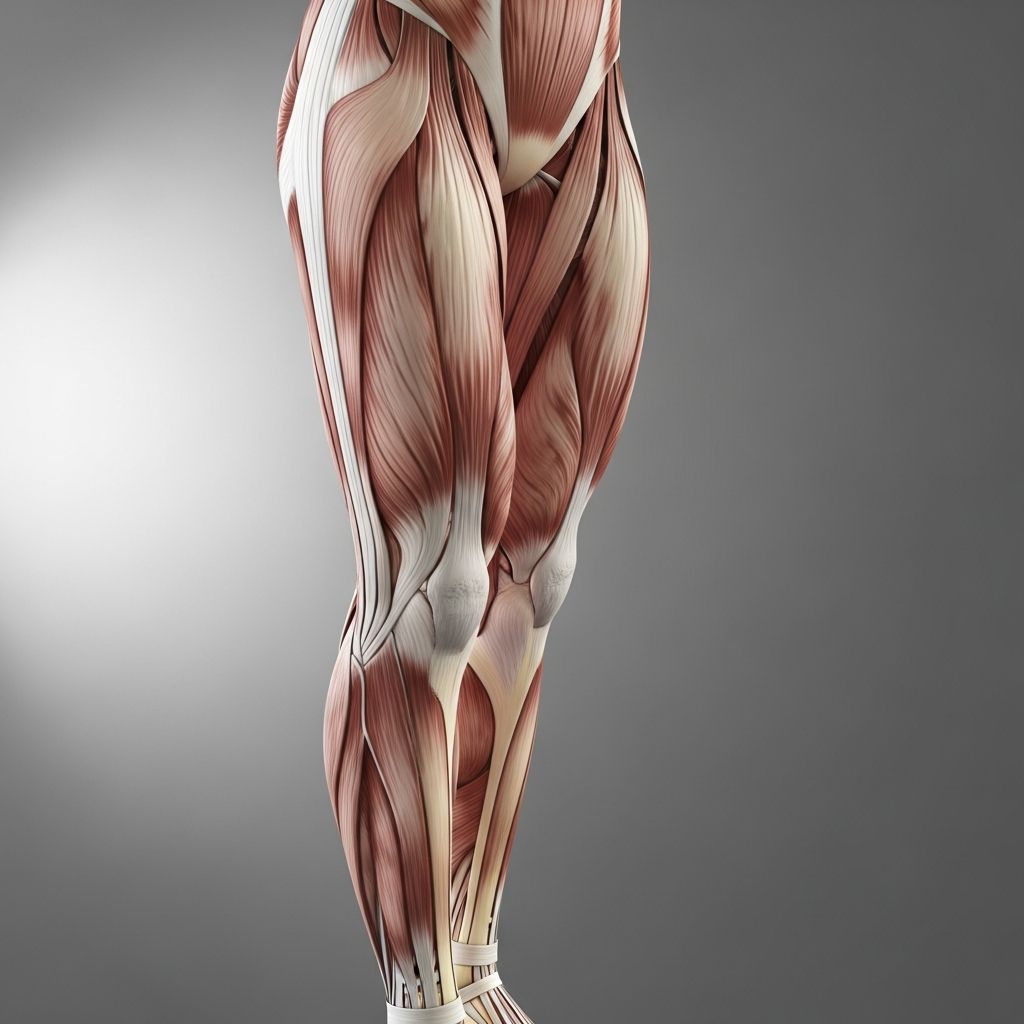
Your leg muscles are essential for movement, stability, and daily activities. They work together to help you walk, run, jump, and maintain proper posture. Understanding the anatomy and function of your leg muscles can help you appreciate how your body moves and recognize when something isn’t working as it should.
What Are Leg Muscles?
Leg muscles are skeletal muscles that attach to your bones through tendons and work with your ligaments to support your weight and enable movement. Your legs contain multiple muscle groups that work in coordination to perform complex movements. These muscles range from your hip down to your ankle, covering a large area of your body and serving various functions from propulsion to stabilization.
Muscles work by contracting and relaxing in response to electrical signals from your nerves. When a nerve impulse reaches a muscle fiber, it triggers the release of a neurotransmitter called acetylcholine, which causes the muscle to contract. This process happens thousands of times throughout the day as you move, stand, and perform everyday activities.
Major Leg Muscle Groups
Quadriceps (Front Thigh)
The quadriceps muscle group is located on the front of your thigh and consists of four muscles that work together to extend your knee and flex your hip. These powerful muscles are responsible for straightening your leg and lifting your thigh. The quadriceps are among the strongest muscles in your body and are essential for activities like climbing stairs, jumping, and kicking.
The quadriceps attach to your pelvis and femur (thighbone) and extend down to your knee. They help you perform everyday tasks that require knee extension, such as standing up from a seated position or pushing off when running.
Hamstrings (Back Thigh)
The hamstring muscle group consists of three muscles located on the back of your thigh: the semitendinosus, semimembranosus, and biceps femoris. These muscles run down the back of your thigh from your hip to just below your knee. The hamstrings are responsible for bending your knee and extending your hip, movements that are critical for running, walking, and jumping.
Hamstring injuries are common, especially among athletes, because these muscles must work powerfully during high-speed movements. Strains occur when the muscle fibers are overstretched or torn, causing pain and limited mobility.
Calf Muscles (Back Lower Leg)
Your calf muscle is located in the back of your lower leg, behind your shin bone (tibia). The calf actually consists of three different muscles: the gastrocnemius, soleus, and plantaris. Together, these muscles help you walk, run, jump, stand on your toes, and flex your foot.
The gastrocnemius muscle is just under your skin at the back of your lower leg. Because it’s close to the skin’s surface, you can often see its outline. It forms the bulk of your calf muscle and has two heads that start on the inside and outside of your thighbone. The gastrocnemius is a powerful plantarflexor, meaning it points your toes downward.
Related Stories



The soleus muscle is wide and flat and sits slightly deeper than the gastrocnemius. It starts just below your knee and connects to the Achilles tendon above your heel. While soleus injuries are less common than gastrocnemius injuries, this muscle is crucial for sustained plantarflexion and helps maintain your posture when standing.
The plantaris muscle is small and assists weakly in plantarflexion and knee flexion. Both the gastrocnemius and soleus come together above your heel to form the Achilles tendon, which is one of the strongest tendons in your body.
Anterior Leg Muscles (Front Lower Leg)
The anterior compartment of your lower leg contains muscles responsible for dorsiflexion (lifting your toes) and toe extension. The tibialis anterior is the primary dorsiflexor and is essential for lifting your foot while walking, preventing you from tripping. The extensor digitorum longus extends toes 2–5, while the extensor hallucis longus extends your great toe.
Lateral Leg Muscles (Outer Lower Leg)
The lateral compartment contains the fibularis longus and fibularis brevis muscles, which are responsible for foot eversion (turning your sole outward) and provide weak plantarflexion. These muscles help stabilize your ankle on uneven terrain.
Deep Posterior Leg Muscles
Deep within the back of your lower leg are muscles including the tibialis posterior, flexor digitorum longus, and flexor hallucis longus. These muscles flex your toes, support your foot’s arch, and provide the push-off power during walking and running.
How Leg Muscles Work
Leg muscles work through a coordinated system of contractions and relaxations. When you decide to move, your brain sends electrical signals through your nervous system to the appropriate muscles. These signals trigger a cascade of chemical and electrical events that cause muscle fibers to shorten and pull on your bones.
Muscles always pull; they never push. This is why many movements require multiple muscles working together. For example, when you bend your knee, your hamstrings contract to pull your lower leg up, while your quadriceps relax and lengthen. When you straighten your leg, the quadriceps contract and the hamstrings relax.
Your leg muscles perform four important functions: bringing about body movement, helping to maintain posture, helping to stabilize joints such as the knee, and protecting your bones. The coordination between these different functions is essential for smooth, efficient movement.
Functions of Your Leg Muscles
Your leg muscles enable you to perform a wide range of activities:
- Walking and Running: Your leg muscles work together to propel you forward, with your calf muscles pushing off the ground and your hip muscles driving your leg forward.
- Jumping: The explosive power needed for jumping comes primarily from your quadriceps and calf muscles working together.
- Standing: Even when standing still, your leg muscles are actively working to maintain your balance and support your body weight against gravity.
- Climbing: Stairs and hills require significant effort from your quadriceps and glute muscles to lift your body weight against gravity.
- Rotating: Some leg muscles assist in rotating your leg inward and outward.
- Maintaining Posture: Your leg muscles help keep your spine aligned and your body upright.
Common Leg Muscle Conditions
Muscle Strains
A muscle strain occurs when muscle fibers are overstretched or partially torn. Strains range from mild stretching of a few fibers to severe complete tears. Common leg muscle strains affect the hamstrings, quadriceps, and calf muscles, often resulting from sudden movements, inadequate warm-up, or overuse.
Muscle Cramps
Muscle cramps are involuntary, painful muscle contractions that can occur in any leg muscle. Cramps are often caused by dehydration, electrolyte imbalances, muscle fatigue, or prolonged muscle contraction. Calf muscles are particularly prone to cramping, especially at night.
Shin Splints
Shin splints refer to pain along the inner edge of your shin bone (tibia), typically caused by inflammation of the muscles and tendons in your anterior leg compartment. This condition is common in runners and is usually caused by overuse, sudden increases in activity, or improper footwear.
Compartment Syndrome
Your leg muscles are organized into compartments separated by tough fibrous tissue called fascia. When pressure within a compartment increases due to swelling or bleeding, it can compromise blood flow and nerve function, causing pain and potential tissue damage.
Muscle Weakness
Leg muscle weakness can result from various causes including nerve damage, disuse, age-related muscle loss (sarcopenia), or underlying medical conditions. Weakness can affect your mobility, balance, and ability to perform daily activities.
Keeping Your Leg Muscles Healthy
Maintaining healthy leg muscles is essential for mobility, independence, and quality of life. Here are key strategies:
- Regular Exercise: Engage in activities that strengthen and stretch your leg muscles, including walking, running, cycling, and strength training exercises.
- Proper Warm-Up: Always warm up before intense activity to increase blood flow and prepare your muscles for work.
- Adequate Hydration: Stay hydrated to prevent muscle cramps and maintain optimal muscle function.
- Balanced Diet: Eat adequate protein and nutrients to support muscle growth and repair.
- Rest and Recovery: Allow your muscles adequate time to recover between intense workouts to prevent overuse injuries.
- Proper Footwear: Wear supportive shoes appropriate for your activities to reduce stress on leg muscles.
- Stretching: Regular stretching improves flexibility and reduces muscle tension and injury risk.
Understanding Muscle Anatomy
Each muscle in your leg has specific anatomical features that determine its function. Muscles attach to bones through tendons, which concentrate the pulling force of the muscle on the bone. Ligaments connect bones to other bones, adding strength to joints and limiting movements in certain directions.
The origin of a muscle is where it attaches to the bone that doesn’t move during contraction, while the insertion is where it attaches to the bone that does move. Understanding these attachments helps explain how each muscle functions and why certain injuries occur.
Lower Leg Compartments Overview
| Compartment | Primary Muscles | Main Actions | Nerve Supply | Example Task |
|---|---|---|---|---|
| Anterior | Tibialis anterior, Extensor digitorum longus, Extensor hallucis longus | Dorsiflexion, toe extension | Deep fibular nerve | Lifting toes while walking |
| Lateral | Fibularis longus, Fibularis brevis | Foot eversion, weak plantarflexion | Superficial fibular nerve | Stabilizing on uneven ground |
| Posterior Superficial | Gastrocnemius, Soleus, Plantaris | Powerful plantarflexion, knee flexion | Tibial nerve | Jumping, sprinting |
| Posterior Deep | Tibialis posterior, Flexor digitorum longus, Flexor hallucis longus | Toe flexion, inversion, arch support | Tibial nerve | Pushing off during stride |
Frequently Asked Questions (FAQs)
Q: What is the strongest muscle in the lower leg?
A: The soleus muscle produces the greatest force for sustained plantarflexion, making it critical for standing and walking.
Q: Which nerve innervates the tibialis anterior?
A: The deep fibular (peroneal) nerve supplies all anterior-compartment muscles.
Q: What should I do if I have a leg muscle strain?
A: Apply ice to reduce swelling, rest the muscle, and avoid activities that cause pain. Compression and elevation can also help. Seek medical attention if pain is severe or doesn’t improve within a few days.
Q: How long does it take to recover from a hamstring strain?
A: Recovery time depends on the severity of the strain. Mild strains may heal in weeks, while more severe strains can take several months. Physical therapy can aid recovery.
Q: Can leg muscle exercises improve my balance?
A: Yes, strengthening your leg muscles, particularly your hip and ankle stabilizers, significantly improves balance and reduces fall risk.
Q: What causes nighttime leg cramps?
A: Nighttime leg cramps can result from dehydration, electrolyte imbalances, prolonged immobility, or certain medications. Stretching before bed and staying hydrated may help prevent them.
References
- Leg Muscle Anatomy Guide: Compartments & Functions — BodySpec. 2024. https://www.bodyspec.com/blog/post/leg_muscle_anatomy_guide
- Calf Muscle: Anatomy, Function & Common Conditions — Cleveland Clinic. 2024. https://my.clevelandclinic.org/health/body/21662-calf-muscle
- The Structure And Function Of A Healthy Spine — Cleveland Clinic Abu Dhabi. 2017. https://www.clevelandclinicabudhabi.ae/en/health-hub/health-resource/diseases-and-conditions/the-structure-and-function-of-a-healthy-spine
- Thigh Muscles: What Are They, Anatomy & Function — Cleveland Clinic. 2024. https://my.clevelandclinic.org/health/body/21936-thigh-muscles
- Muscles | Research Starters – Health and Medicine — EBSCO. 2024. https://www.ebsco.com/research-starters/health-and-medicine/muscles
- Muscles of the Body: Types, Groups, Anatomy & Functions — Cleveland Clinic. 2024. https://my.clevelandclinic.org/health/body/21887-muscle
Similar Articles








Read full bio of medha deb