Lentigo Images: 12 Clinical Photos To Identify Types
Comprehensive visual guide to lentigo types, causes, features, diagnosis, and treatments with high-quality images.
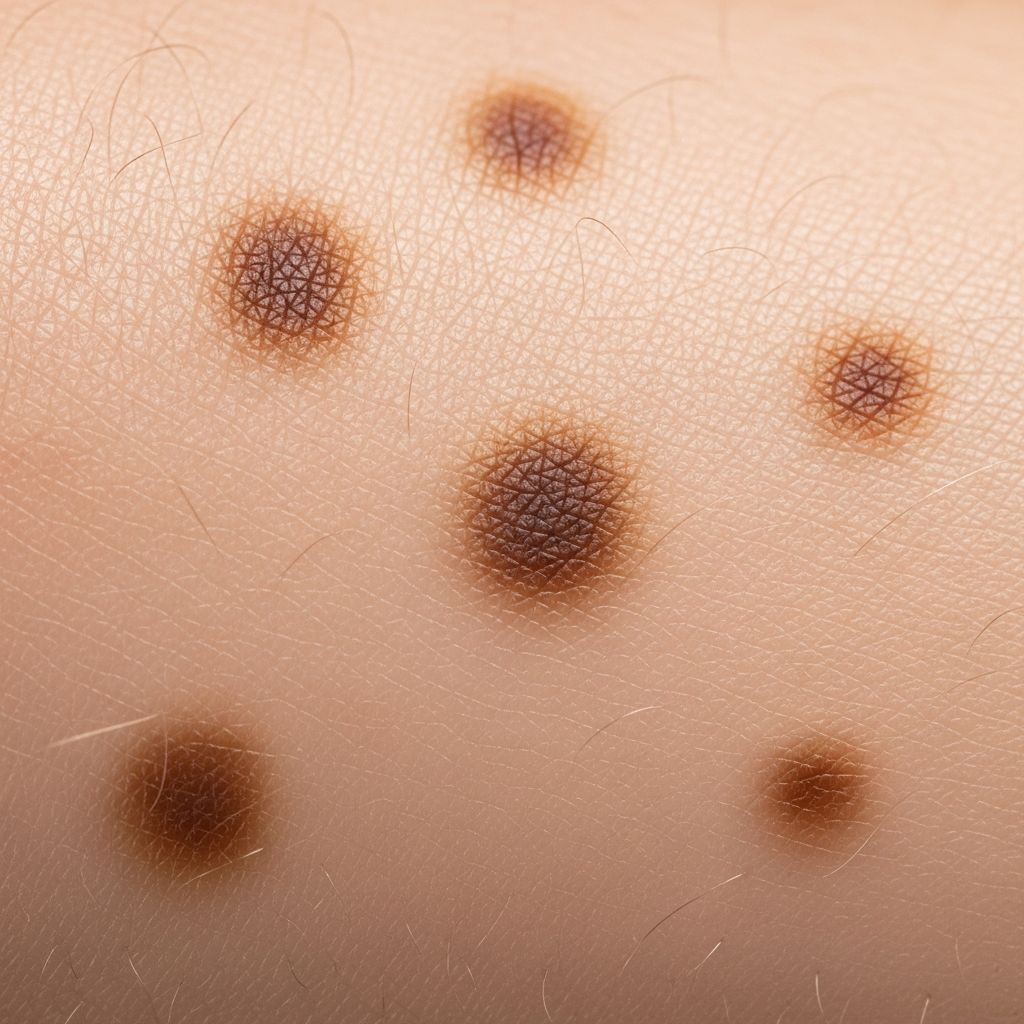
A
lentigo
is a pigmented flat or slightly raised lesion with a clearly defined edge. Unlike anephelis
(freckle), it does not fade in the winter months. There are several kinds of lentigo, distinguished by their appearance, location, cause, and associations. This page provides high-quality clinical images of various lentigo types to aid in identification and understanding.Who gets lentigo?
Lentigines are common in fair-skinned individuals over 40 years old, particularly on sun-exposed areas such as the face, hands, shoulders, and arms. They affect people of all ages but increase with cumulative UV exposure. Rare genetic syndromes cause multiple lentigines in children and young adults. Ionizing radiation from therapy can induce lentigines in treated areas.
Causes of lentigo
Common lentigines result from
ultraviolet radiation
exposure, leading to melanocyte proliferation and hyperpigmentation. Other causes include:- Ionising radiation: From radiation therapy for cancer.
- Genetic syndromes: Mutations in Ras-MAP kinase, mTOR signaling, and PTEN pathways, e.g., Noonan, LEOPARD, Peutz-Jeghers, Bannayan-Riley-Ruvalcaba, and Cowden syndromes.
Solar lentigo, the most prevalent type, develops from chronic sun damage, where UV rays stimulate excess melanin production by melanocytes.
Clinical features of lentigo
Lentigines appear as small, well-circumscribed brown, black, or dark tan macules or patches. They are flat or slightly raised, with sizes ranging from 0.2 to 2 cm. Edges can be regular, irregular, or ‘moth-eaten.’ They persist year-round, unlike freckles. Locations vary by type: sun-exposed sites for solar lentigo, trunk for simplex, or mucosal areas for melanotic macules.
Histology: Lentigines show elongated epidermal rete ridges (clubbed or budded) with increased melanocytes along the basal layer, hyperpigmentation of the basal epidermis, and minimal dermal changes.
Types of lentigo
Lentigines are classified by morphology, location, cause, and associations. Key types include:
- Solar lentigo (lentigo senilis, age spot, liver spot): Most common in adults >40 on sun-exposed areas. Tan to dark brown, 0.5–3 cm, irregular borders.
- Ink-spot lentigo (lentigo nigra): Dark brown-black, small (0.5 cm), on sun-damaged skin post-sunburn, especially fair skin.
- Lentigo simplex: Childhood onset, small brown macules on trunk/legs, may fade.
- PUVA lentigo: After PUVA therapy for psoriasis/eczema.
- Tanning-bed lentigo: Similar to ink-spot, from UV tanning beds.
- Radiation lentigo: In radiotherapy fields.
- Melanotic macule: Benign on lips, genitals, nails.
- LEOPARD syndrome lentigines: Multiple small brown-black macules on face, limbs.
Lentigo images
(Note: This article mirrors DermNet’s image gallery structure. Descriptions accompany representative images sourced from clinical dermatology resources.)
Solar lentigo images
Solar lentigines appear as multiple tan-brown patches on sun-exposed skin. They often coalesce and have irregular, serrated borders.
- Image 1: Multiple solar lentigines on the back of the hand in an elderly patient.
- Image 2: Large solar lentigo on the forehead with moth-eaten edges.
- Image 3: Clustered solar lentigines on the shoulder post-chronic sun exposure.
Ink-spot lentigo images
Ink-spot lentigines are strikingly dark with a pinpoint white center sometimes visible.
- Image 4: Solitary ink-spot lentigo on the lower leg after sunburn.
- Image 5: Multiple ink spots on fair skin of the back.
Related Stories



Lentigo simplex images
Small, round, sharply demarcated brown spots on non-sun-exposed areas.
- Image 6: Scattered lentigo simplex on the abdomen of a child.
PUVA lentigo images
Develop post-PUVA therapy, often on trunk.
- Image 7: Confetti-like PUVA lentigines on the chest.
Radiation lentigo images
Appear in radiation ports, mimicking solar but localized.
- Image 8: Radiation-induced lentigines on breast skin post-radiotherapy.
Syndromic lentigines images
Multiple, widespread lentigines in genetic conditions.
- Image 9: Numerous lentigines on face and neck in LEOPARD syndrome.
- Image 10: Genital lentigines in Bannayan-Riley-Ruvalcaba syndrome.
Melanotic macule images
Smooth, uniform brown macules on mucosa.
- Image 11: Labial melanotic macule.
- Image 12: Nail matrix lentigo.
Diagnosis of lentigo
Diagnosis is clinical based on history, appearance, and persistence. Dermoscopy shows reticular pigment network, dots/globules, or structureless areas. Biopsy if atypical (e.g., asymmetry, irregular borders) to rule out melanoma or lentigo maligna. Histology confirms increased basal melanocytes without atypia.
| Feature | Lentigo | Freckle (Ephelis) | Lentigo Maligna |
|---|---|---|---|
| Pigmentation | Persistent year-round | Fades in winter | Progressive, irregular |
| Histology | Increased melanocytes | Increased melanin only | Atypical melanocytes |
| Border | Defined, may be irregular | Ill-defined | Asymmetric |
| Risk | Benign | Benign | Pre-melanoma |
Treatment of lentigo
Most lentigines require no treatment as they are benign. Cosmetic removal options include:
- Topical agents: Hydroquinone (2-4%), retinoids (tretinoin), azelaic acid, vitamin C, alpha hydroxy acids. Apply 4-8 weeks for fading.
- Chemical peels: TCA or glycolic acid for superficial pigmentation.
- Laser/IPL: Q-switched Nd:YAG, picosecond lasers, IPL target melanocytes effectively with minimal downtime.
- Cryotherapy: Liquid nitrogen for individual lesions.
- Electrosurgery/curettage: For raised lesions.
Recurrence is common without sun protection. Consult dermatologist for personalized plan.
What is the outlook for lentigo?
Lentigines are harmless but indicate photoaging and skin cancer risk. Prevention via broad-spectrum SPF 30+ sunscreen, UPF clothing, and shade reduces new lesions. Regular skin checks recommended.
Frequently Asked Questions (FAQs)
Q: Are lentigines cancerous?
A: No, benign. Monitor for changes (ABCDE rule) to exclude melanoma.
Q: How can I prevent solar lentigines?
A: Daily sunscreen, protective clothing, avoid peak sun hours.
Q: Do home remedies work for lentigines?
A: Limited evidence for lemon, aloe, or tea; professional treatments superior.
Q: Can lentigines be removed permanently?
A: Lasers/cryo offer good results, but sun exposure causes recurrence.
Q: What’s the difference between lentigo and freckle?
A: Lentigo persists, has more melanocytes; freckle fades seasonally.
References
- Lentigo (Liver Spots): Pictures, Causes, Removal & Prevention — Healthline. 2023-10-15. https://www.healthline.com/health/lentigo
- Treating lentigines, brown spots and freckles — ENRICH Clinic. 2024-05-20. https://www.enrichclinic.com.au/treating-lentigines-brown-spots-and-freckles/
- Lentigo: Causes, Features, and Treatment — DermNet NZ. 2016-02-01. https://dermnetnz.org/topics/lentigo
- Lentigo (syn. lentigine) — Primary Care Dermatology Society (PCDS). 2022-04-28. https://www.pcds.org.uk/clinical-guidance/lentigo
- Lentigo/Lentigines — Fairfax Dermatological Consultants. 2023-01-12. https://www.fairfaxderm.com/content/lentigolentigines
Similar Articles








Read full bio of medha deb