Lentigo Maligna and Lentigo Maligna Melanoma
Understanding lentigo maligna: Early melanoma in situ on sun-damaged skin and its progression to invasive cancer.
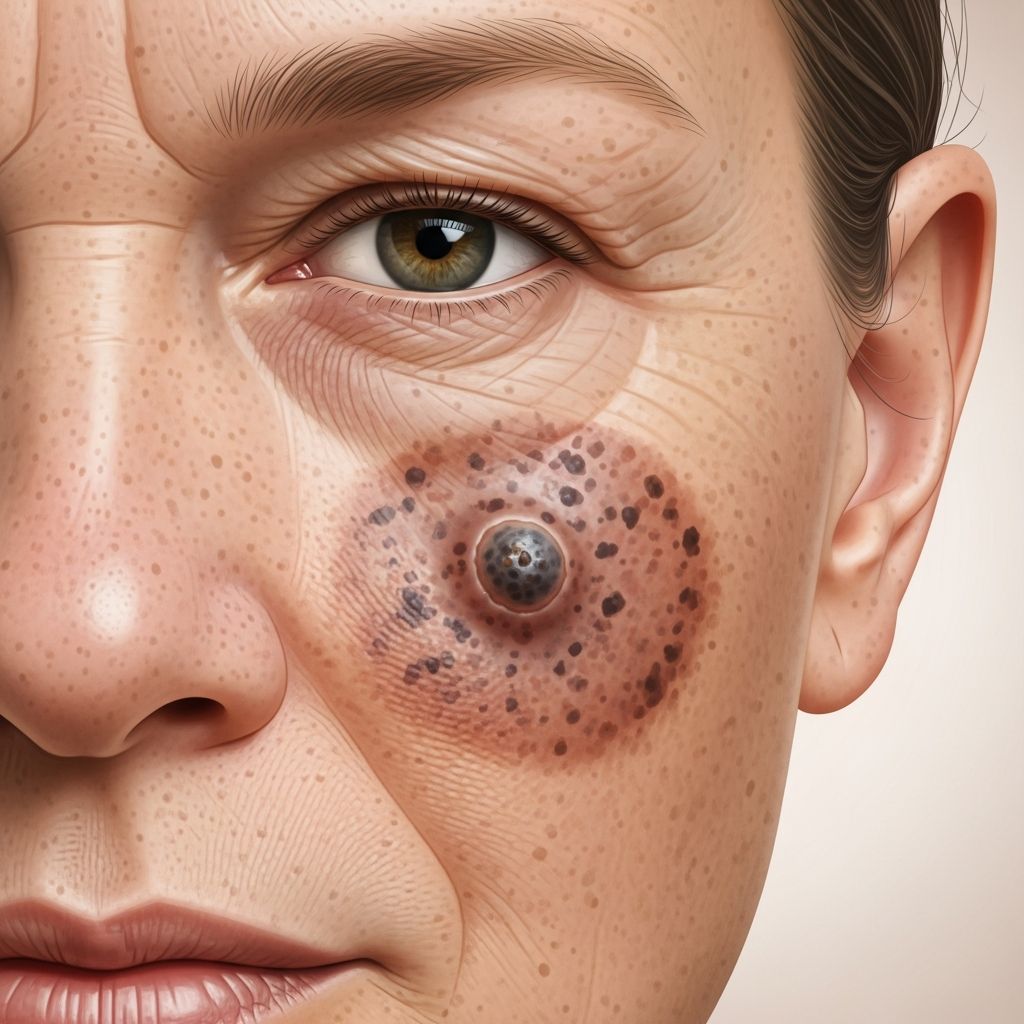
Lentigo maligna represents an early, in situ form of melanoma confined to the epidermis, primarily on sun-damaged facial skin, progressing slowly over years to potentially invasive lentigo maligna melanoma.
What is lentigo maligna?
Lentigo maligna, also known as Hutchinson melanotic freckle, is a type of
melanoma in situ
characterized by malignant melanocytes proliferating along the basal epidermis, often extending into hair follicles. It typically arises on chronically sun-exposed areas like the face, neck, nose, or cheeks in older adults over 40, peaking between 60-80 years, and is more common in males. Unlike superficial spreading melanoma, it bears no relation to the number of moles or atypical nevi. The lesion grows radially over 5-20 years or more, starting as a subtle brown patch resembling freckles or lentigines before developing atypical features.The overall transformation rate to invasive melanoma is low, under 5%, but rises significantly in larger lesions (>4 cm diameter), where up to 50% may harbor invasive foci. This slow progression underscores the importance of monitoring, as invasion occurs when melanocytes penetrate the dermis.
Who gets lentigo maligna?
Primarily affecting fair-skinned individuals with significant UV exposure history, lentigo maligna targets sun-damaged skin. Risk factors include advanced age (majority diagnosed 60-80 years), male gender predominance, and chronic sun exposure leading to solar elastosis. It accounts for about 5% of all melanomas, often in elderly patients on the face. Genetic mutations in melanocyte stem cells may initiate malignancy, though triggers remain unclear.
What does lentigo maligna look like?
Initially, lentigo maligna appears as a flat, slowly enlarging asymmetric patch of varied brown pigmentation, following the
ABCDE rule
: Asymmetry, irregular Borders, Colour variation (shades of brown, black, white, blue), Diameter >6 mm (often several cm over time), and Evolving size/shape. Key characteristics include:- Notched, irregular borders
- Variable colours: tan, brown, black with hypopigmented or grey areas
- Lack of palpable elevation (flat)
- Slow radial growth over years/decades
- Possible central darkening or nodularity signaling invasion
Suspicious features for invasion include focal dark nodules, ulceration, bleeding, or rapid change. These patches can mimic benign lesions but evolve progressively.
Diagnosis
Clinical suspicion arises from history and ABCDE features on sun-damaged skin. Dermoscopy enhances accuracy by revealing specific patterns distinguishing it from mimics. Confirmation requires biopsy: incisional shave for large lesions or excisional for smaller ones, interpreted by dermatopathologists. Challenges include subtle atypia or sampling errors in large lesions.
Dermoscopy of facial lesions
Facial skin lacks typical rete ridges, showing a pseudonetwork—pigmentation around hair follicles. Lentigo maligna displays:
- Atypical rhomboidal network: Irregular, thickened lines forming rhomboids
- Greyish dots/granularity within network
- Irregular structure and colour variation
- Annular-granular pattern in early stages
- Blue-grey veil, polymorphous vessels, or shiny white streaks in advanced/invasive cases
These features differentiate from solar lentigines (uniform network), pigmented actinic keratoses (strawberry pattern), or lichenoid keratoses.
Differential diagnosis
Lentigo maligna mimics several facial pigmented lesions due to pseudonetwork:
| Lesion | Key Features | Malignant Potential |
|---|---|---|
| Solar lentigo / Early seborrheic keratosis | Uniform pigmentation, regular network, no atypia | Benign |
| Lichenoid keratosis | Well-defined, comedo-like openings, grey dots | Benign |
| Pigmented actinic keratosis | Strawberry pattern, diffuse erythema | Premalignant |
| Lentigo maligna | Atypical network, rhomboids, grey dots, asymmetry | Malignant (in situ) |
Biopsy resolves ambiguities, especially with solar elastosis.
Pathology
Histologically, lentigo maligna shows confluent atypical melanocytes along the dermoepidermal junction, extending into adnexa (hair follicles), with prominent solar elastosis. Features include pagetoid spread, nesting, and cytologic atypia. Invasive lentigo maligna melanoma reveals dermal invasion. Immunostains (e.g., Melan-A, SOX10) aid in borderline cases. Pathologic diagnosis can be challenging, with some lesions showing only junctional proliferation.
Related Stories



Staging melanoma
For invasive cases,
Breslow thickness
(mm from granular layer to deepest invasion) predicts prognosis—thinner lesions (<1 mm) have excellent outcomes.Clark level
assesses anatomic invasion:| Level | Characteristics |
|---|---|
| Level 1 | In situ (epidermis only) |
| Level 2 | Papillary dermis invasion |
| Level 3 | Fills papillary dermis |
| Level 4 | Reticular dermis invasion |
| Level 5 | Subcutaneous fat |
TNM staging integrates thickness, ulceration, nodes, and metastasis.
| Stage | Characteristics |
|---|---|
| Stage 0 | Melanoma in situ (lentigo maligna) |
| Stage I | Thin invasive (<2 mm), no nodes |
| Stage II | Thick (>2 mm), no nodes |
| Stage III | Regional lymph nodes involved |
| Stage IV | Distant metastasis |
Treatment of lentigo maligna
Complete excision with 5-10 mm margins is standard, challenging on the face due to recurrence risk (up to 20%). Mohs micrographic surgery (staged excision with margin control) is preferred for large/periorificial lesions, preserving tissue. Alternatives for inoperable cases: imiquimod, radiotherapy. Sentinel lymph node biopsy considered for invasive depth >1 mm or high-risk features.
Outlook
Excellent for in situ lesions if excised fully (near 100% cure). Invasive cases depend on Breslow thickness; thin melanomas (<1 mm) have >95% 5-year survival. Recurrence is common due to subclinical extension; regular follow-up essential. Early detection via self-exam and dermoscopy improves prognosis.
Frequently Asked Questions (FAQs)
Q: How common is progression from lentigo maligna to invasive melanoma?
A: Under 5% overall, but up to 50% in lesions >4 cm.
Q: Can lentigo maligna be treated without surgery?
A: Yes, topical imiquimod or radiotherapy for select cases, though excision is gold standard.
Q: What is the dermoscopic hallmark of lentigo maligna?
A: Atypical rhomboidal network with grey dots.
Q: Is lentigo maligna hereditary?
A: No, primarily UV-induced; not linked to family history or moles.
Q: How often should patients with lentigo maligna be monitored?
A: Lifelong every 3-6 months initially, then annually, focusing on face and sun protection.
References
- Lentigo maligna and lentigo maligna melanoma — DermNet NZ. 2023. https://dermnetnz.org/topics/lentigo-maligna-and-lentigo-maligna-melanoma
- Lentigo maligna and melanoma in situ — ESMS Mohs. 2024. https://esms-mohs.eu/lentigo-maligna-and-melanoma-in-situ/
- Lentigo maligna – Melanoma — Primary Care Dermatology Society (PCDS). 2022-03-21. https://www.pcds.org.uk/clinical-guidance/lentigo-maligna-melanoma-and-lentigo-maligna
- Lentigo Maligna and Lentigo Malignant Melanoma — BC Cancer Agency. 2023. https://www.bccancer.bc.ca/books/skin-cancer-prevention-early-diagnosis-courses/course-readings/skin-cancer-early-diagnosis-readings/lentigo-maligna-and-lentigo-malignant-melanoma
- Types of melanoma — Cancer Research UK. 2024. https://www.cancerresearchuk.org/about-cancer/melanoma/stages-types/types
Similar Articles








Read full bio of Sneha Tete