Lentigo Pathology: Diagnostic Guide For Clinicians
Comprehensive histopathological analysis of lentigo variants, from simplex to solar, with diagnostic challenges and differentials.
A
lentigo
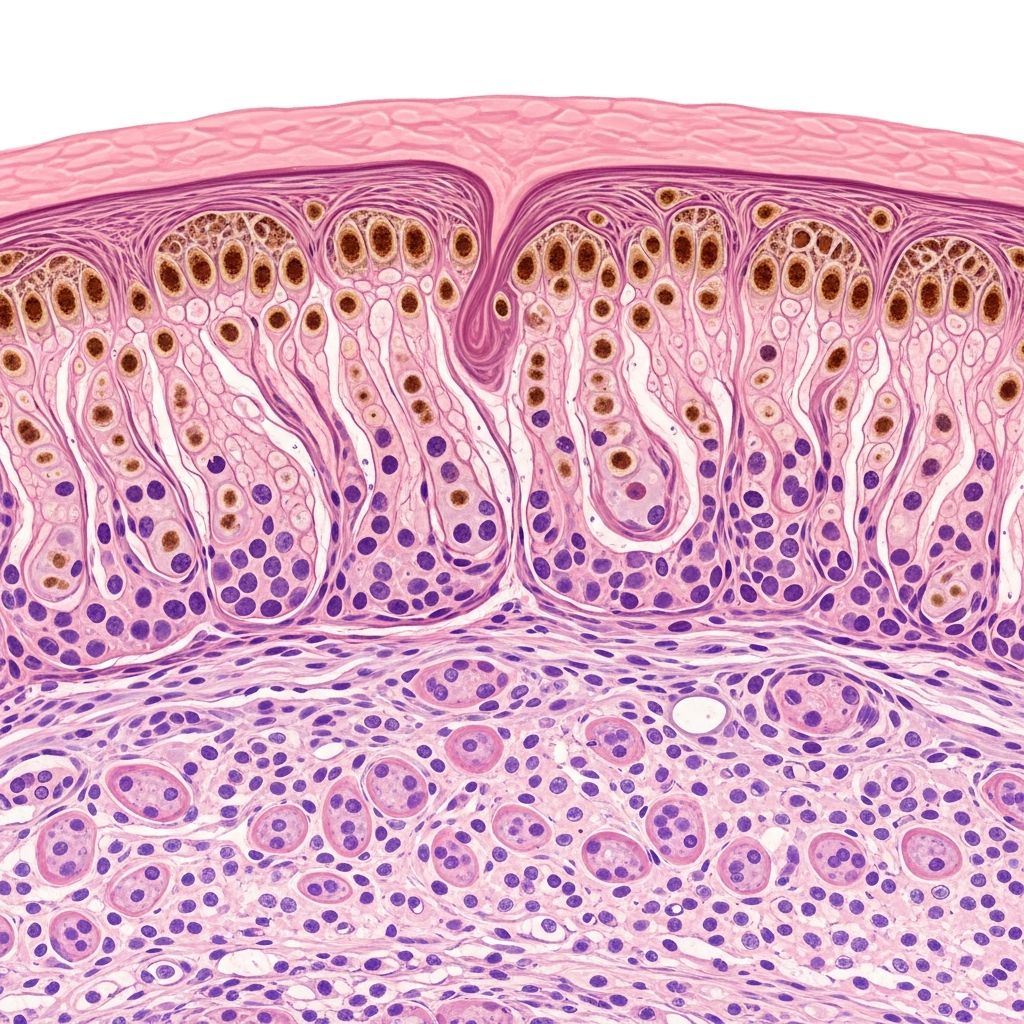
(plural lentigines) is characterised histologically by an increase in basal melanin, often with a mildly increased number of melanocytes in the basal layer of the epidermis and variable elongation of the rete ridges. This hallmark feature distinguishes lentigines from other pigmented lesions like ephelides (freckles), which show only mild basal hypermelanosis without melanocytic hyperplasia.Authoritative Facts
- Core histological hallmark: Increased basal layer melanocytes and melanin, with rete ridge elongation in most forms.
- Solar lentigines often show
bulbous rete ridges
and dermal solar elastosis. - **Lentigo simplex** features uniform melanocytes without atypia and mild acanthosis.
- Mucosal lentigines exhibit
dermal melanophages
as a diagnostic clue. - Differential includes
lentigo maligna
, requiring search for atypia and nesting.
Lentigo Simplex
**Lentigo simplex** is the most common form, often appearing in childhood as small brown macules. Histologically, it demonstrates mild epidermal acanthosis, increased uniformly dispersed single melanocytes without atypia in the basal layer, and variable basal hyperpigmentation. A sparse papillary lymphohistiocytic infiltrate may be present, occasionally with melanophages, which can lead to atypical dermatoscopic features.
Lesions on mucosal sites, such as labial melanotic macules (lips/oral mucosa), vulvar, or penile melanotic macules, mirror cutaneous lentigo simplex but with less prominent acanthosis. Dermal melanophages are nearly always present, serving as a key diagnostic hint, especially in subtle oral lesions. The main differential is postinflammatory pigmentation.
Occasionally, lentigo simplex shows isolated junctional nests of melanocytes. A
lentiginous naevus
(naevoid lentigo or ‘jentigo’) features few junctional nests and peripheral lentiginous hyperplasia, representing a continuum from lentigo simplex to junctional, compound, and intradermal naevi.Solar Lentigo
**Solar lentigo** (also called actinic or senile lentigo) arises from chronic UV exposure, typically on sun-damaged skin of the face, hands, and arms. Histologically, there is conspicuous bulb-like elongation of rete ridges forming a reticular pattern due to interconnections between adjacent strands—a less prominent feature in facial lesions. Basal layer hyperpigmentation is often marked, with a mild increase in melanocytes, especially at rete ridge tips. Dermal solar elastosis is usual.
Facial solar lentigines with significant melanocytic hyperplasia warrant caution, as they may represent early
lentigo maligna
. Prudent evaluation includes searching for junctional nesting, adnexal invasion, and nuclear atypia. Partially sampled lesions should be reported conservatively.Solar lentigines commonly regress via a lichenoid reaction, termed
lichenoid keratosis
orlichen planus-like keratosis
. These mimic superficial basal cell carcinoma or atypical melanocytic lesions clinically/dermatoscopically and are frequently biopsied. Histopathology shows lichenoid infiltrate, distinguishable from lichen planus with clinical correlation.Other Lentigo Variants
Ephelides (Freckles)
Ephelides are easily overlooked histopathologically, showing only mild basal hypermelanosis without melanocytic increase or structural changes. They fade with reduced sun exposure, unlike persistent lentigines.
Related Stories



Nail Matrix Lentigines
Presenting as longitudinal greyish-brown bands (melanonychia) in the nail plate, these may be subtle histologically. Basal hypermelanosis is key; even mild dendritic melanocytic hyperplasia suggests atypical proliferation or nail matrix melanoma.
Ink-Spot Lentigo
A rare variant post-minor trauma (e.g., ink exposure), showing similar features to solar lentigo but often with more pronounced hyperpigmentation and focal trauma-related changes.
Lentigo Maligna and Atypical Forms
**Lentigo maligna** (LM), or Hutchinson melanotic freckle, is an in situ melanoma on sun-damaged skin, primarily facial (nose/cheeks). It features predominantly junctional confluent melanocytic proliferation extending along adnexa (hair follicles), with prominent solar elastosis. Immunostains like MART-1 improve borderline diagnosis.
Progression to
lentigo maligna melanoma
(LMM) occurs when cells invade the dermis (3-10% risk overall, up to 50% in lesions >4 cm). Suspicious features include asymmetry, irregular borders, colour variation, diameter >6 mm, and rapid change.| Level | Characteristics |
|---|---|
| Level 1 | In situ melanoma (epidermis only) |
| Level 2 | Invaded papillary dermis |
| Level 3 | Filled papillary dermis |
| Level 4 | Invaded reticular dermis |
**Atypical solar lentigo** requires clinical, dermatoscopic, and histopathological evaluation. Differentials include solar lentigo, lichenoid keratosis, unstable solar lentigo, atypical lentiginous hyperplasia, atypical naevus, or melanoma in situ. Excisional biopsy with serial sections is recommended if melanocytic proliferation is noted.
**Unstable solar lentigo** shows lentiginous proliferation of single melanocytes (variable density, occasional nests), mild cytological atypia, focal dermal fibrosis, pigment incontinence, and superficial dermal melanocyte aggregates.
Diagnostic Challenges and Differentials
Distinguishing benign lentigines from malignancy is critical. Key pitfalls:
- Missed ephelides: Subtle hypermelanosis only.
- Facial solar lentigo vs. LM: Check for atypia, nesting, adnexal spread.
- Lichenoid regression: Mimics lichen planus or BCC.
- Mucosal lesions: Rely on melanophages.
- Nail bands: Rule out melanoma.
Dermoscopy aids: LM shows irregular pseudonetwork, grey dots, rhomboidal patterns. Pathology reports should detail macro/micro descriptions, atypia, invasion depth (Breslow thickness), Clark level, ulceration, mitoses, and margins.
Frequently Asked Questions (FAQs)
What is the hallmark histology of a lentigo?
Increased basal melanocytes and melanin with rete ridge elongation.
How does solar lentigo differ from lentigo simplex?
Solar shows bulbous interconnected rete ridges and solar elastosis; simplex has mild acanthosis without.
Is lentigo maligna always invasive?
No, it’s in situ; invasion defines lentigo maligna melanoma (3-10% progression).
Can lentigines turn into melanoma?
Benign forms rarely; atypical/large solar lentigines or LM carry risk—biopsy suspicious lesions.
What causes multiple lentigines?
Idiopathic (lentigines profusa) or syndromes like Peutz-Jeghers, LEOPARD.
Clinical Implications and Management
Benign lentigines require no treatment but sun protection prevents solar types. Atypical lesions demand biopsy. LM management involves wide excision; Mohs surgery for facial sites. Regular monitoring for progression is essential.
Solar lentigines may develop seborrhoeic keratoses or inflame into lichenoid keratoses, which self-resolve. Genetic mutations underlie LM, starting in stem cells.
References
- Lentigo pathology — DermNet NZ. 2023-10-15. https://dermnetnz.org/topics/lentigo-pathology
- Lentigo maligna and lentigo maligna melanoma — DermNet NZ. 2024-02-20. https://dermnetnz.org/topics/lentigo-maligna-and-lentigo-maligna-melanoma
- Solar lentigo — DermNet NZ. 2023-11-05. https://dermnetnz.org/topics/solar-lentigo
- Atypical solar lentigo — DermNet NZ. 2024-01-12. https://dermnetnz.org/topics/atypical-solar-lentigo
- Lentigo simplex — DermNet NZ. 2023-09-28. https://dermnetnz.org/topics/lentigo-simplex
- Lentiginous melanoma (lentigo maligna and lentigo maligna melanoma) — Journal of the European Academy of Dermatology and Venereology (Wiley). 2021-06-01. https://onlinelibrary.wiley.com/doi/abs/10.1111/jdv.17135
Similar Articles








Read full bio of Sneha Tete