Leprosy Pathology: Guide To Histology & Classification
Detailed histopathological analysis of leprosy spectrum, from tuberculoid to lepromatous forms and reactional states.
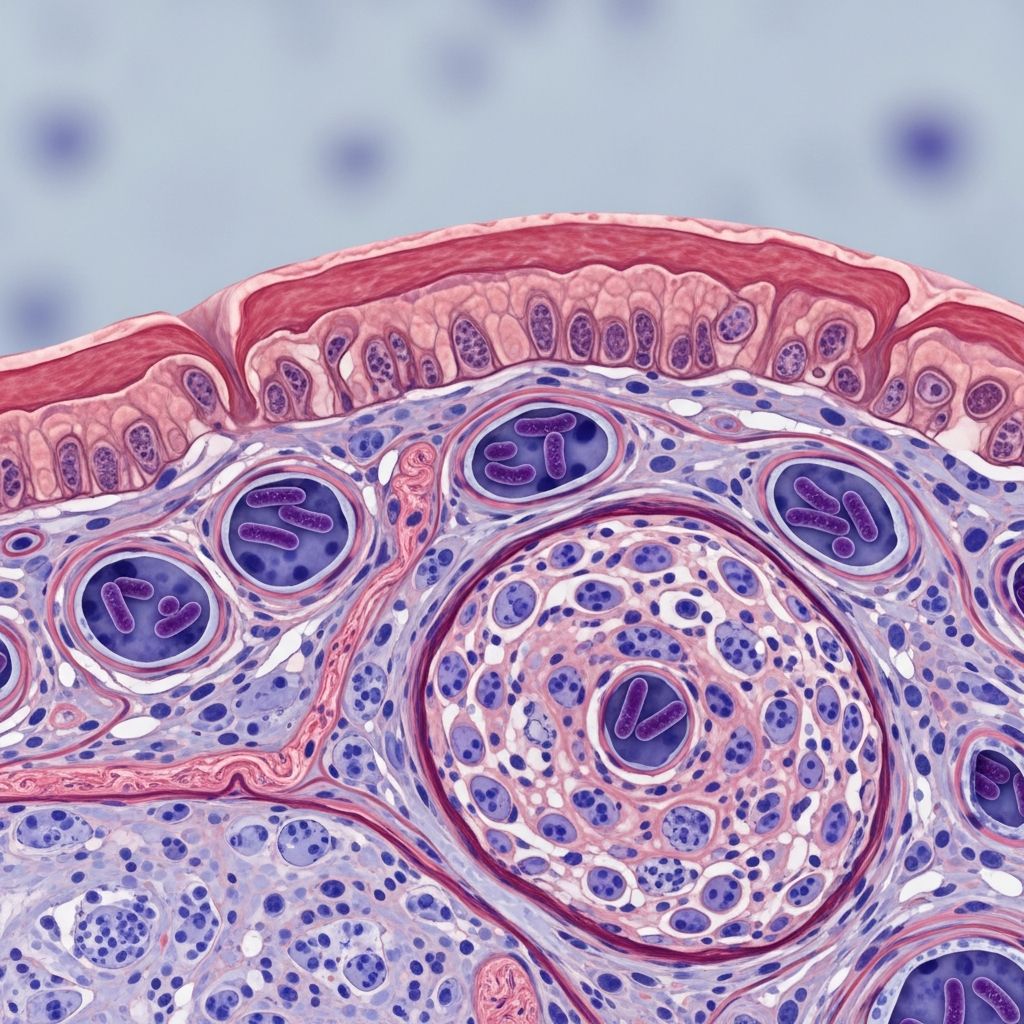
Leprosy, also known as Hansen disease, is a chronic granulomatous infection caused by the obligate intracellular acid-fast bacillus Mycobacterium leprae. This pathogen has a unique tropism for cooler body areas, primarily affecting the skin, mucous membranes, and peripheral nerves. The histopathological features of leprosy form a spectrum that mirrors the clinical classification, ranging from strong cell-mediated immunity in tuberculoid forms to anergy in lepromatous disease. Understanding these microscopic patterns is essential for accurate diagnosis, as clinical features alone can overlap with other dermatoses.
Introduction
Leprosy pathology reflects the host’s immune response to M. leprae, which cannot be cultured in vitro and multiplies slowly (division time of 12-13 days). The disease spectrum includes paucibacillary tuberculoid leprosy (TT), borderline forms (BT, BB, BL), multibacillary lepromatous leprosy (LL), indeterminate leprosy (I), and reactional states like erythema nodosum leprosum (ENL) and reversal reactions. Key pathological hallmarks include granulomatous inflammation, perineural infiltrates, and demonstration of acid-fast bacilli via special stains. Nerve damage, a hallmark complication, results from bacillary invasion of Schwann cells and subsequent demyelination.
Histological examination of skin biopsies from active lesions is the gold standard for confirmation. Punch biopsies (4-6 mm) should include the dermal-subcutis junction and target the edge of lesions where inflammatory activity is maximal. Slit-skin smears complement histology by quantifying bacillary load via the Ridley Bacterial Index.
Clinical Types and Corresponding Histopathology
The Ridley-Jopling classification divides leprosy into immunologically polarized forms, each with distinct microscopic signatures. These correlate with bacillary density: paucibacillary (0-2+ bacilli) in tuberculoid spectrum versus multibacillary (>4+ in lepromatous).
Lepromatous Leprosy (LL)
In lepromatous leprosy, the epidermis appears normal with a characteristic Grenz zone—a thin, uninflamed papillary dermis separating the epidermis from deeper infiltrate. Beneath this lies sheets or globular clusters of foamy macrophages (lepra cells) packed with myriad bacilli, imparting a pale pink to vacuolated cytoplasm on H&E stain. Lymphocytes are sparse, and well-formed granulomas are absent. In chronic lesions, macrophages exhibit bubbly, virchowian transformation due to lipid-laden globi (bacillary fragments). Perineural granulomas are poorly organized, and organisms proliferate extracellularly in foam cells.
- Key features: Virtual sheets of foamy macrophages, Grenz zone, high bacillary load (globi positive on Wade-Fite).
- Nerve involvement: Loose perineural sleeves with oncocytic change in Schwann cells.
- Special stains: Abundant red acid-fast bacilli in clusters (solid and fragmented).
Tuberculoid Leprosy (TT)
Tuberculoid lesions show well-circumscribed sarcoid-like granulomas filling the dermis, composed of epithelioid histiocytes, Langhans giant cells, and cuffing lymphocytes. The infiltrate expands and may ulcerate the epidermis, with flattening of rete ridges. Peripheral nerves are prominently infiltrated and fibrosed (“onion skin” fibrosis), explaining sensory loss. Bacilli are rare or absent (paucibacillary), requiring PCR for detection in some cases.
| Feature | Tuberculoid (TT) | Lepromatous (LL) |
|---|---|---|
| Granuloma type | Well-formed, sarcoidal | Diffuse foamy macrophages |
| Bacillary load | Paucibacillary (<1/10 hpf) | Multibacillary (>1000/10 hpf) |
| Nerve infiltrate | Dense, fibrotic | Sparse, loose |
| Epidermis | Atrophic, ulcerated | Normal + Grenz zone |
Borderline Forms
Related Stories



- Borderline Tuberculoid (BT): Focal granulomas with incomplete borders, moderate lymphocytes, and occasional bacilli. Nerves show mixed fibrosis and edema.
- Borderline Borderline (BB): Poorly formed granulomas with streaming epithelioids (“string of beads”), lymphocytes, and plasma cells. Highest risk of upgrading reactions.
- Borderline Lepromatous (BL): Macrophages with early foamy change, scattered epithelioids, and increasing bacilli. Infiltrate is patchy with subepidermal edema.
Indeterminate Leprosy (I)
Early, unstable lesions feature perivascular/periadnexal lymphocytic infiltrates with focal epithelioid clusters around nerves or vessels. Bacilli are scant and require Wade-Fite stain or PCR. This form may regress spontaneously or progress along the spectrum.
Reactional States
Erythema Nodosum Leprosum (ENL / Type 2 Reaction)
ENL, seen in 10-25% of LL/BL patients, shows panniculitis with dense polymorphous dermal-subcutaneous infiltrates: neutrophils, karyorrhectic debris (LE figures), vasculitis, and foamy macrophages. Edema extends into subcutis around vessels. Bacilli may be fragmented. Systemic ENL involves organs like testes, eyes.
- Histology: Neutrophilic abscesses, endothelial swelling, fibrin thrombi.
- Triggers: MDT initiation, pregnancy, intercurrent infection.
Reversal Reaction (Type 1)
Upgrading reactions in borderline forms feature epithelioid granuloma expansion, edema, and lymphocyte cuffing. Occurs due to increased CMI, mimicking TT histology but on BT/BB background.
Peripheral Nerve Pathology
M. leprae targets Schwann cells via laminin-2 binding, causing segmental demyelination, axonal degeneration, and endoneurial fibrosis. Epineural granulomas predominate in tuberculoid forms, while intraneural bacillary proliferation occurs in lepromatous. Biopsy of involved nerves (e.g., radial, sural) shows perineural thickening, hyalinization, and acid-fast bacilli.
Special Stains and Diagnostic Techniques
Modified Fite-Faraco (Wade-Fite) stain is preferred over Ziehl-Neelsen for its sensitivity in formalin-fixed tissue: bacilli appear red against green counterstain. Globi stain solidly. PCR amplifies M. leprae DNA (RLEP gene) in paucibacillary cases. Immunohistochemistry (anti-PGL-1) highlights bacilli in macrophages.
- Bacterial Index (Ridley): Log scale 0-6+ based on slit-smears.
- Morphology Index: Solid (viable) vs. fragmented (dead) bacilli.
Differential Diagnosis
| Condition | Distinguishing Features |
|---|---|
| Sarcoidosis | Naked granulomas, no bacilli, hilar adenopathy |
| Lupus vulgaris | Caseating granulomas, fewer nerves involved |
| Granuloma annulare | Mucin, palisading, no organisms |
| Leishmaniasis | Intracellular amastigotes, Giemsa positive |
Frequently Asked Questions (FAQs)
Q: What is the hallmark histological feature of lepromatous leprosy?
A: Sheets of foamy macrophages (lepra cells) with a Grenz zone and abundant intracellular acid-fast bacilli on Wade-Fite stain.
Q: How does tuberculoid leprosy differ pathologically from lepromatous?
A: Tuberculoid shows well-formed granulomas with nerve destruction and paucibacillary load, while lepromatous has diffuse foam cells with multibacillary proliferation.
Q: Is PCR useful in leprosy diagnosis?
A: Yes, PCR detects M. leprae DNA in paucibacillary forms where bacilli are scarce on microscopy.
Q: What causes nerve damage in leprosy?
A: Bacillary invasion of Schwann cells leads to demyelination, inflammation, and fibrosis.
Q: How is ENL distinguished histologically?
A: Neutrophilic panniculitis with vasculitis and karyorrhexis, unlike chronic granulomas in non-reactional leprosy.
This article synthesizes over 1400 years of pathological study since Armauer Hansen’s 1873 discovery. Early biopsy guides MDT, preventing disability. Global cases persist at ~200,000 annually despite eliminability.
References
- Leprosy pathology — DermNet NZ. 2023. https://dermnetnz.org/topics/leprosy-pathology
- Leprosy (Hansen disease) — DermNet NZ. 2023. https://dermnetnz.org/topics/leprosy
- Leprosy: an overview of pathophysiology — PubMed / PLoS Curr. 2012-09-27. https://pubmed.ncbi.nlm.nih.gov/22988457/
- Clinical Testing and Diagnosis for Leprosy — Centers for Disease Control and Prevention (CDC). 2024. https://www.cdc.gov/leprosy/hcp/diagnosis-testing/index.html
- Slit Skin smears [Leprosy] — Auckland District Health Board. 2023. https://testguide.adhb.govt.nz/eguidemob/?gm=457&gs=3
Similar Articles








Read full bio of medha deb