Lichen Myxoedematosus: Symptoms, Diagnosis, Treatment Guide
Rare mucin skin disorder with papules, nodules; generalised scleromyxoedema linked to gammopathy, localised forms often benign.
What is lichen myxoedematosus?
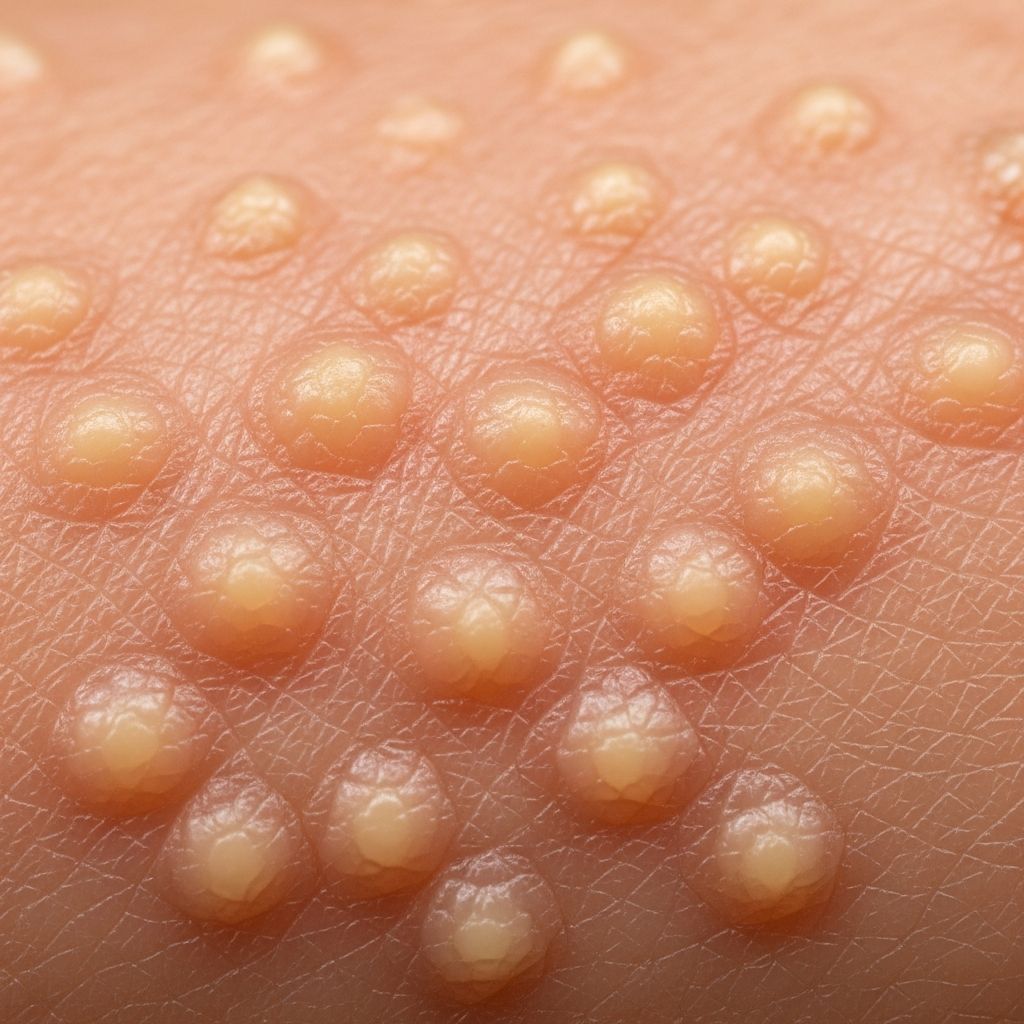
Lichen myxoedematosus, also known as papular mucinosis, is a rare chronic skin disorder characterised by the development of small papules, nodules and plaques due to mucin deposition in the dermis. The mucin gives the lesions a waxy or pearly appearance. Lichen myxoedematosus belongs to the group of cutaneous mucinoses, which are a heterogeneous group of disorders characterised by abnormal mucin deposition in the skin.
The disorder has a generalised papular and sclerodermoid form called scleromyxoedema (previously denoted scleromyxedema), which is associated with monoclonal gammopathy and often systemic manifestations. Localised lichen myxoedematosus refers to several distinctive but rare forms of papular eruption that are not associated with paraproteinaemia.
Who gets lichen myxoedematosus?
Lichen myxoedematosus most commonly affects adults aged 30–80 years, with a mean age of onset around 55–60 years. It is rare in children. There is no sex predilection for localised forms, but scleromyxoedema has a slight female predominance (2:1).
What causes lichen myxoedematosus?
The cause of lichen myxoedematosus is unknown. Abnormal fibroblast stimulation leading to excessive mucin production has been proposed. Mucin is a gel-like substance composed mainly of glycosaminoglycans, particularly hyaluronic acid, deposited in the skin by fibroblasts.
In scleromyxoedema, fibroblast overstimulation by cytokines such as IL-1, TNF-α and TGF-β has been implicated. A monoclonal gammopathy, usually IgG lambda, is present in over 80% of cases and may play a role in pathogenesis.
Localised forms are not associated with gammopathy or systemic disease. Rare associations include HIV infection in discrete papular lichen myxoedematosus.
What are the clinical features of lichen myxoedematosus?
Clinical features vary depending on the subtype.
Scleromyxoedema
Scleromyxoedema is the generalised form, characterised by a generalised eruption of 2–3 mm firm, waxy papules that coalesce into indurated plaques. Lesions have a linear configuration with a tendency to align along skin tension lines, particularly on the trunk, arms and legs. The face has a typical leonine appearance due to thickening and furrowing of the glabella and eyebrows. Eyebrows are often prominent and bushy.
Skin involvement leads to skin tightening and reduced mobility, mimicking scleroderma. A characteristic doughnut sign may be seen on the fingers (central depression surrounded by an elevated rim). Pruritus, pruritus and pain are common.
- Mucocutaneous: Macroglossia, hoarseness, dysphagia
- Neurological: Encephalopathy, peripheral neuropathy
- Rheumatological: Arthralgia/arthritis, carpal tunnel syndrome
- Pulmonary: Interstitial lung disease, restrictive ventilatory defect
- Cardiac: Arrhythmias, myocardial ischaemia, congestive cardiomyopathy
- Gastrointestinal: Oesophageal dysmotility, malabsorption
- Renal: Glomerulosclerosis
Extracutaneous involvement occurs in 70–77% of cases and can be fatal.
Localised lichen myxoedematosus
Localised forms include:
- Self-healing (papular eruption of infancy): Crops of papules on trunk and limbs in children that resolve spontaneously within months.
- Discrete papular lichen myxoedematosus: Scattered skin-coloured papules, often on trunk and extremities. May resolve spontaneously or persist.
- Acral persistent papular mucinosis: Persistent ivory papules on backs of hands in young women.
- Cutaneous (nodular/plaque) mucinosis: Solitary or multiple nodules/plaques, often on head and neck.
Related Stories



Diagnosis of lichen myxoedematosus
Clinical
Diagnosis is based on clinical features, histopathology and laboratory findings.
Histology
Skin biopsy shows mucin deposition in the upper dermis confirmed by alcian blue or colloidal iron stains. There is a proliferation of irregular fibroblasts and increased collagen bundles. In scleromyxoedema, a superficial lymphoplasmacytic infiltrate is often present.
Investigations
- Serum protein electrophoresis and immunofixation for monoclonal gammopathy (present in >80% scleromyxoedema)
- Serum mucin levels (elevated in some)
- ANA, RF, anti-dsDNA (negative)
- Systemic evaluation: ECG, PFTs, oesophageal studies if indicated
The diagnostic criteria for scleromyxoedema require:
- Generalised papular eruption
- Mucin deposition, fibroblast proliferation, fibrosis on histology
- Monoclonal gammopathy without thyroid disease
- No plasma cell dyscrasia or other mucinosis
How is lichen myxoedematosus treated?
Treatment is challenging due to rarity and unclear pathogenesis.
Scleromyxoedema
No standard treatment exists. Options include:
- Intravenous immunoglobulin (IVIG): Most effective; 2 g/kg over 2–5 days monthly. Response in 50–80% cutaneous/extracutaneous symptoms.
- Thalidomide: 100–400 mg/day; effective but neuropathy risk. Lenalidomide safer alternative.
- Chemotherapy: Melphalan, cyclophosphamide (reserved for severe/progressive disease)
- Retinoids: Isotretinoin, acitretin (partial response)
- Corticosteroids, hydroxychloroquine, cyclosporine (variable)
- Stem cell transplant: For refractory cases
Localised lichen myxoedematosus
Often requires no treatment due to benign course. Symptomatic options:
- Topical corticosteroids, tacrolimus, pimecrolimus
- Intralesional steroids
- Laser therapy (CO2, Er:YAG), cryotherapy for cosmetics
- Observation; spontaneous resolution common
In HIV-associated cases, antiretroviral therapy may resolve lesions.
What is the outcome for lichen myxoedematosus?
Localised forms have excellent prognosis; many self-resolve. Scleromyxoedema has high morbidity from extracutaneous involvement; mortality 10–20% from cardiac/pulmonary complications or malignancy.
Differential diagnosis
Condition Key Features Scleroderma Raynaud’s, nailfold changes, no mucin, positive ANA Pretibial myxoedema Associated thyroid disease, pretibial location Ledoid dermopathy Diabetes, pretibial plaques, no gammopathy Mucinous carcinoma Single nodule, malignant Related topics
- Cutaneous mucinoses
- Scleromyxoedema
- Monoclonal gammopathy of undetermined significance
- Nephrogenic systemic fibrosis
Frequently asked questions
What is the difference between lichen myxoedematosus and scleromyxoedema?
Scleromyxoedema is the generalised, systemic form of lichen myxoedematosus associated with monoclonal gammopathy. Localised lichen myxoedematosus lacks gammopathy and systemic involvement.
Is lichen myxoedematosus curable?
No curative treatment exists. Localised forms often resolve spontaneously; scleromyxoedema requires ongoing management.
Does lichen myxoedematosus turn into cancer?
Monoclonal gammopathy may progress to myeloma rarely (<5%). Regular monitoring recommended.
Can lichen myxoedematosus be fatal?
Scleromyxoedema can be fatal due to cardiac, pulmonary or neurological complications in 10–20% cases.
References
- Lichen Myxedematosus — Next Steps in Dermatology. 2023. https://nextstepsinderm.com/jdd-corner/lichen-myxedematosus/
- Lichen myxoedematosus — DermNet NZ. 2024-01-15. https://dermnetnz.org/topics/lichen-myxoedematosus
- Lichen myxedematosus: a rare group of cutaneous mucinosis — PMC (National Library of Medicine). 2020-02-01. https://pmc.ncbi.nlm.nih.gov/articles/PMC7007042/
- Lichen myxedematosus associated with monoclonal gammopathy — Frontiers in Medicine. 2023-05-12. https://www.frontiersin.org/journals/medicine/articles/10.3389/fmed.2023.1118555/full
- Scleromyxedema — National Organization for Rare Disorders. 2024. https://rarediseases.org/mondo-disease/scleromyxedema/
Similar Articles








Read full bio of Sneha Tete