Lichen Striatus: Causes, Symptoms, And Treatment Guide
Uncommon self-limiting skin rash in children forming linear pink papules along Blaschko lines, resolving spontaneously.
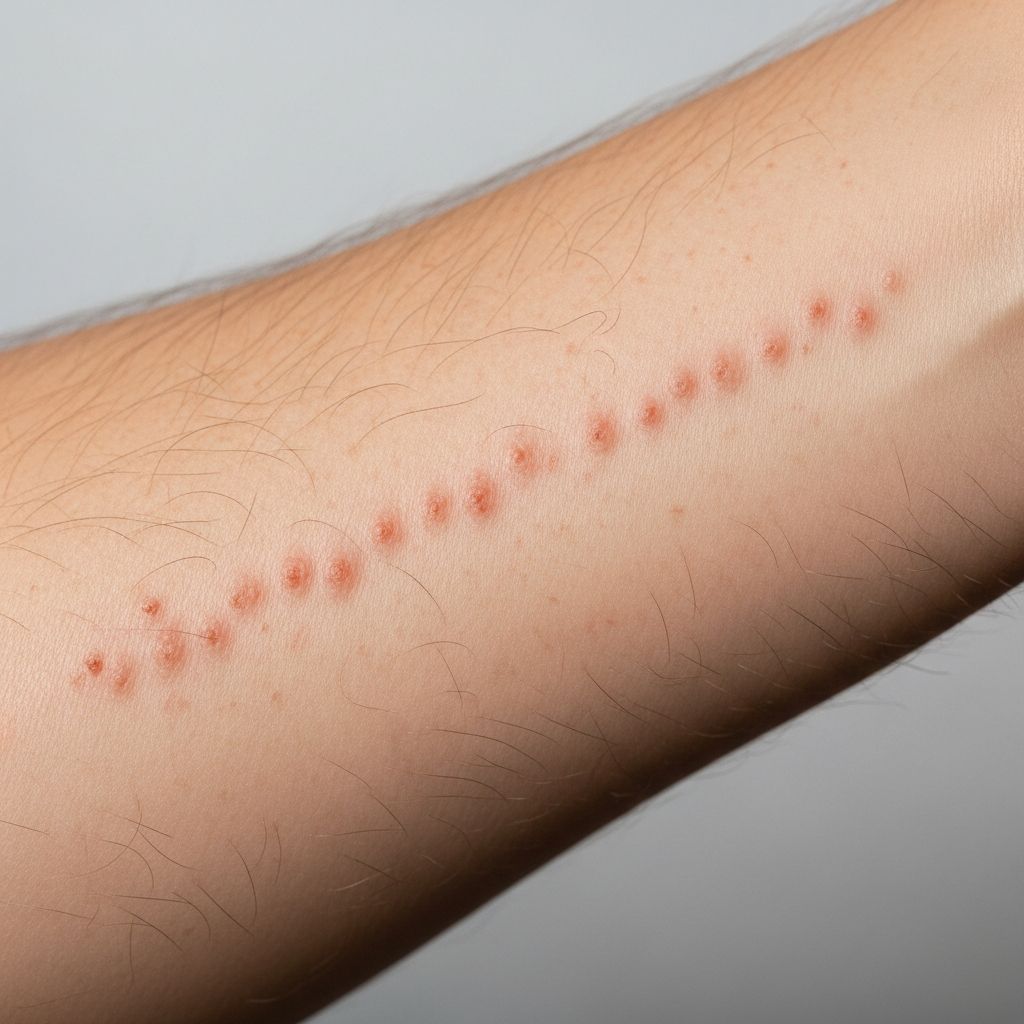
Lichen striatus is an uncommon self-limiting skin rash that occurs mainly in children. It presents as pink raised spots that join together to form one or more dull red slightly scaly linear bands.
Introduction
Lichen striatus, also known as Blaschko linear acquired inflammatory skin eruption, is a rare dermatosis characterized by its distinctive linear arrangement following the lines of Blaschko. These lines represent patterns of embryonic cell development and are not visible on normal skin but become apparent in certain mosaic skin conditions. The condition typically manifests suddenly as a stripe-like rash composed of small papules that coalesce into bands. It is benign, non-contagious, and resolves without scarring, though temporary pigment changes may persist.
Authoritative sources describe it as primarily affecting children under 15 years, with a peak incidence between 1-5 years. It is more common in females, with a ratio of about 2:1 compared to males. The rash follows a self-limited course, lasting from a few weeks to several months, and rarely recurs once resolved.
Demographics
Lichen striatus predominantly affects children, with over 80-90% of cases occurring before age 15. It is rare in adults, though isolated reports exist. There is a slight female predominance. The condition shows no strong racial or geographic predilection, but it has been observed worldwide.
- Age: Most common in children aged 1-5 years; rare in infants under 6 months or adults over 40.
- Sex: Females affected twice as often as males.
- Incidence: Uncommon; exact prevalence unknown but considered rare in pediatric dermatology practices.
Outbreaks have been noted in clusters among unrelated children in the same environment, suggesting possible environmental triggers.
Clinical Features
The hallmark of lichen striatus is its linear configuration along Blaschko lines, which appear as whorled or streaked patterns on the trunk, limbs, neck, or face. The eruption begins abruptly with small, pink to red-brown papules (1-3 mm) that are slightly scaly and may be flat-topped. These papules coalesce to form continuous or interrupted linear bands, typically 2-3 cm wide and up to 10-20 cm long.
Symptoms include:
- Appearance: Pink, flesh-colored, or hypopigmented papules forming linear streaks; may become hypopigmented or hyperpigmented in darker skin types.
- Location: Extremities (arms, legs) most common (over 70% of cases); also trunk, neck, buttocks; unilateral in nearly all cases; rarely involves face, palms, soles, or mucous membranes.
- Symptoms: Usually asymptomatic; mild pruritus (itching) in 20-50% of cases; no pain or systemic symptoms.
- Evolution: Acute onset over days; peaks in 1-2 weeks; active lesions scaly and erythematous; fades over months, leaving temporary hypopigmentation.
Nail involvement occurs in 10-20% of cases, especially if rash is near nails: onycholysis (nail separation), ridging, or dystrophy.

In darker skin, lesions may appear lighter or more hypopigmented from the start.
Diagnosis
Diagnosis is primarily clinical based on the characteristic linear papular eruption along Blaschko lines in a healthy child. No laboratory tests are routinely needed. Dermoscopy may show scaled pink papules in a linear array.
Differential diagnosis includes:
| Condition | Key Distinguishing Features |
|---|---|
| Linear lichen planus | Violaceous, polygonal papules; Wickham striae on dermoscopy; pruritic; adults. |
| Adult Blaschkitis | Similar but in adults; vesicles possible; longer duration. |
| Linear psoriasis | Thicker plaques, silvery scale; positive Auspitz sign; family history. |
| Incontinentia pigmenti | Four stages (vesicular, verrucous, hyperpigmented); X-linked; females. |
| Phytophotodermatitis | History of plant/UV exposure; bizarre shapes; hyperpigmentation. |
| ILVEN (Inflammatory Linear Verrucous Epidermal Naevus) | Present from birth/infancy; pruritic; persists lifelong; verrucous. |
Related Stories



Histopathology, if performed (rarely needed), shows:
- Spongiotic dermatitis with parakeratosis.
- Lymphocytic infiltrate in dermis.
- Melastocyte damage explaining hypopigmentation.
Biopsy is reserved for atypical cases or treatment failures.
Pathophysiology / Cause
The exact etiology is unknown. Current theories include:
- Genetic mosaicism: Postzygotic somatic mutation affecting clones of keratinocytes along Blaschko lines, triggered by environmental factors.
- Immune-mediated: T-cell mediated inflammatory response; elevated IL-1β in lesions.
- Triggers: Viral infections (HHV-6/7, COVID-19, chickenpox), vaccinations (BCG, hepatitis B, COVID), trauma, drugs (adalimumab, etanercept).
- Atopy association: Controversial; some studies show 85% with personal/family atopy (eczema, asthma, rhinitis), others no link.
No infectious agent identified; not contagious.
Treatment
No curative treatment exists; condition is self-limiting, resolving in 3-12 months (average 9 months; up to 3 years). Treatment is symptomatic.
- First-line: Emollients for dryness/itching.
- Mild-moderate itch: Mild-moderate potency topical corticosteroids (e.g., hydrocortisone 1%) for 2-4 weeks.
- Moderate-severe/persistent: Topical calcineurin inhibitors (tacrolimus 0.03-0.1%, pimecrolimus 1%); effective for face/nails.
- Refractory: Short-course oral corticosteroids, acitretin, photodynamic therapy (rare).
Avoid unnecessary biopsies or aggressive therapy. Nail changes improve with topical tacrolimus.
Prognosis and Complications
Excellent prognosis: spontaneous resolution without scarring. Temporary hypopigmentation (most common) or hyperpigmentation lasts 1-3 years in 50% of cases. Nail changes resolve slowly. Recurrence rare (<5%). No systemic associations.
Frequently Asked Questions
Is lichen striatus contagious?
No, it is not infectious or contagious.
How long does lichen striatus last?
Typically 3-12 months; up to 3 years; average 9.5 months.
Does lichen striatus leave scars?
No scarring, but temporary pigment changes may occur.
Can adults get lichen striatus?
Rare; mostly children, but adult-onset (Blaschkitis) reported.
Is treatment always needed?
No; only for symptomatic relief.
Can vaccines trigger lichen striatus?
Possible after BCG, hepatitis B, COVID vaccines.
References
- Lichen Striatus – MD Searchlight — MD Searchlight. 2023. https://mdsearchlight.com/skin-problems-and-treatments/lichen-striatus/
- Lichen Striatus: Causes, Symptoms, and Treatment — WebMD. 2024-01-15. https://www.webmd.com/skin-problems-and-treatments/lichen-striatus
- Lichen striatus – DermNet — DermNet NZ. 2024-06-20. https://dermnetnz.org/topics/lichen-striatus
- Pediatric lichen striatus — Children’s Health. 2023. https://www.childrens.com/specialties-services/conditions/lichen-striatus
- Lichen Striatus | Children’s Wisconsin — Children’s Wisconsin. 2024. https://childrenswi.org/teaching-sheet/dermatology/lichen-striatus
- Lichen Striatus – StatPearls — NCBI Bookshelf. 2023-07-17. https://www.ncbi.nlm.nih.gov/books/NBK507830/
Similar Articles








Read full bio of Sneha Tete