Ligament of Treitz: Anatomy, Function, and Clinical Significance
Understanding the ligament of Treitz: A crucial anatomical landmark connecting the duodenum to the diaphragm.
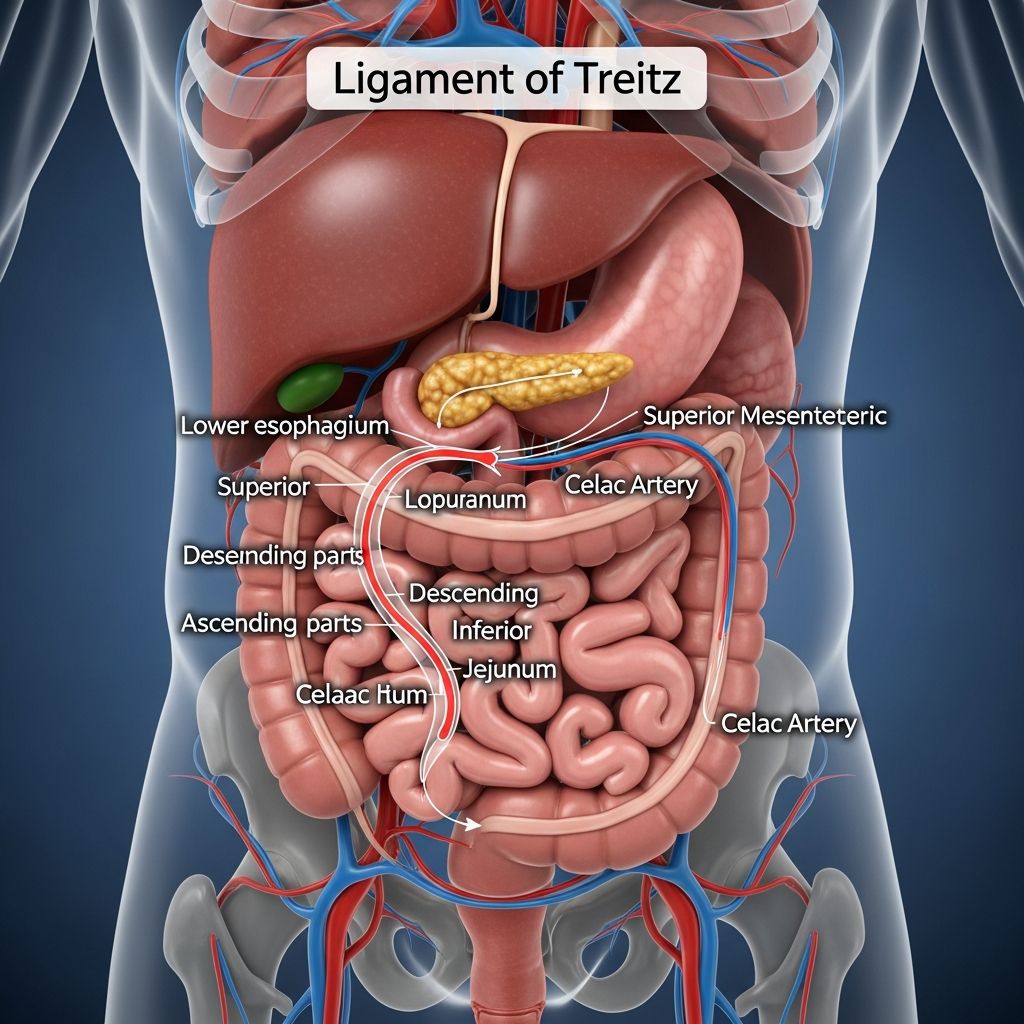
The ligament of Treitz, also known as the suspensory muscle of the duodenum or suspensory ligament of the duodenum, is a thin musculofibrous band that plays a crucial role in abdominal anatomy. Named after the Austrian physician Wenzel Treitz who first described it in 1853, this structure connects the duodenojejunal flexure to supporting tissues in the upper abdomen. While relatively small and often overlooked, the ligament of Treitz carries significant implications in surgical procedures, radiological examinations, and the diagnosis of various gastrointestinal disorders. Understanding this anatomical landmark is essential for healthcare professionals involved in abdominal surgery, gastroenterology, and diagnostic imaging.
What Is the Ligament of Treitz?
The ligament of Treitz is a suspensory structure composed of connective tissue and muscle fibers that support the junction between the duodenum and jejunum, collectively referred to as the duodenojejunal flexure. This anatomical landmark serves as the transition point between the foregut and midgut embryologically, making it important for understanding gastrointestinal anatomy and physiology. The structure is derived from mesoderm during embryological development and maintains its position throughout an individual’s life, providing structural support to the small intestine.
Historically, there has been considerable debate regarding the exact composition of the ligament of Treitz. Dr. Wenzel Treitz originally described two distinct structures comprising this ligament, and subsequent anatomical research has confirmed that the ligament indeed consists of multiple components rather than a single unified structure.
Anatomical Structure and Components
The ligament of Treitz is composed of two main anatomical components that work together to provide support and stability to the duodenum and proximal jejunum.
The Phrenicoceliac Part (Hilfsmuskel)
The phrenicoceliac part, also referred to as the Hilfsmuskel—a German term meaning “accessory muscle”—comprises the superior component of the ligament. This structure originates from the right crus of the diaphragm and loops around the esophageal hiatus before descending to insert at the celiac trunk or celiac artery. Histological examination reveals that this portion contains striated skeletal muscle fibers derived from the diaphragmatic crus, giving it muscular properties in addition to its fibrous components. The phrenicoceliac part forms an elongated triangular shape, widest at its origin near the diaphragm and gradually narrowing as it approaches its insertion at the celiac artery.
The Celiacoduodenal Part
The celiacoduodenal part comprises the inferior component of the ligament of Treitz. This portion originates as a connective tissue band from the paraaortic connective tissue surrounding the celiac artery. It travels in close proximity to the pancreas, splenic vein, and left renal vein, navigating through the complex vascular anatomy of the upper abdomen. The celiacoduodenal part eventually forms a triangular structure that inserts at the left lateral aspect of the fourth segment of the duodenum at the duodenojejunal flexure. This component is primarily composed of dense connective tissue with fewer muscular elements compared to the phrenicoceliac part.
Related Stories



Microscopic Composition
Recent microscopic studies have provided detailed insights into the histological composition of the ligament of Treitz. The structure contains a combination of striated skeletal muscle fibers, particularly in the phrenicoceliac portion, along with irregular connective tissue composed primarily of collagen bundles. The exact ratio of muscular to fibrous components varies, which explains some of the historical disagreement among anatomists regarding the true nature of this structure. Some researchers have identified smooth muscle fibers within the ligament, while others argue that the muscular elements are primarily skeletal in origin.
Anatomical Location and Relationships
Understanding the precise location of the ligament of Treitz is essential for surgeons and diagnosticians. The structure is positioned retroperitoneally and forms a bridge between the diaphragm superiorly and the duodenojejunal junction inferiorly. It passes through a complex region of the upper abdomen occupied by major blood vessels and organs, making its identification important during abdominal surgical procedures.
The ligament maintains important anatomical relationships with several key structures:
– The right crus of the diaphragm at its superior attachment point- The celiac artery and celiac trunk at the junction of its two components- The fourth portion of the duodenum at its inferior insertion- The pancreas, which it passes medially to- Major abdominal blood vessels, including the splenic and left renal veins- The esophageal hiatus, which it loops around
Functions of the Ligament of Treitz
While anatomists initially hypothesized that the ligament of Treitz functioned as a dynamic suspensory muscle capable of preventing displacement of the duodenojejunal flexure, current understanding suggests a more limited but still important role.
Positional Support
One of the primary functions of the ligament of Treitz is to help maintain the normal anatomical position of the duodenum. By providing a point of attachment between the duodenum and the diaphragm, the ligament contributes to keeping the C-shaped duodenum in its characteristic configuration. This positional support facilitates optimal interaction between gastric chyme (partially digested food) and digestive enzymes from the pancreas and gallbladder, promoting efficient digestion and nutrient absorption.
Small Intestine Support
Research suggests that the ligament of Treitz contributes to the support of small intestinal loops through its connections to the mesentery. By sending collagen fibers into the mesenteric scaffold, it potentially increases the structural integrity and support of both the jejunum and ileum, the second and third portions of the small intestine.
Embryological Function
During embryonic development, the ligament of Treitz plays a fundamental role by serving as a point of fixation during rotation of the gut around the superior mesenteric artery. This embryological function helps establish the normal anatomical configuration of the abdominal organs and is critical for proper gastrointestinal development.
Anatomical Landmark Function
Perhaps the most clinically relevant function of the ligament of Treitz is serving as a crucial surgical and diagnostic landmark. It marks the junction between the foregut and midgut, dividing the gastrointestinal tract into functionally and embryologically distinct regions. This anatomical demarcation has significant clinical implications for classifying gastrointestinal bleeding, identifying anatomical abnormalities, and guiding surgical procedures.
Clinical Significance and Medical Applications
The ligament of Treitz holds substantial clinical importance in various medical contexts, from diagnostic imaging to surgical intervention.
Gastrointestinal Bleeding Classification
One of the most important clinical applications of the ligament of Treitz is its use as the anatomical boundary separating upper gastrointestinal bleeding from lower gastrointestinal bleeding. Bleeding that occurs proximal to (above) the ligament of Treitz is classified as upper gastrointestinal bleeding, typically presenting with hematemesis (vomiting blood) or melena (black tarry stools). In contrast, bleeding distal to (below) the ligament is classified as lower gastrointestinal bleeding, often presenting with hematochezia (bright red blood in stools). This distinction is crucial for determining the likely location of the bleeding source and guiding appropriate diagnostic and therapeutic interventions.
Malrotation Syndrome Diagnosis
The ligament of Treitz serves as a key anatomical landmark for diagnosing malrotation of the gut, particularly in pediatric patients. When malrotation is present, the ligament of Treitz is abnormally positioned, which can be detected through radiological imaging. This is especially important in children presenting with recurrent vomiting without obvious cause, as proper visualization of the ligament of Treitz in normal anatomical position helps rule out malrotation syndrome, a condition that can lead to serious complications including bowel obstruction and volvulus.
Surgical Significance
During abdominal surgical procedures, the ligament of Treitz serves multiple important functions. During the Whipple procedure—a complex operation used to treat pancreatic cancer involving removal of the pancreas, duodenum, and part of the jejunum—the ligament of Treitz is carefully separated from the duodenum and preserved. The ligament remains intact while the remaining jejunum is anastomosed (surgically connected) with the stomach’s pylorus, and the jejunum may be passed through the ligament during this reconstruction. Understanding the anatomy of the ligament and its relationships with surrounding structures is essential for surgeons performing this and other complex abdominal procedures.
Superior Mesenteric Artery Syndrome
Although rare, the ligament of Treitz has been implicated as a causative factor in superior mesenteric artery (SMA) syndrome. In this condition, compression of the third part of the duodenum occurs between the superior mesenteric artery and the abdominal aorta, potentially related to anatomical variations of the ligament. This compression can lead to small bowel obstruction characterized by early satiety, vomiting, and obstipation (absence of fecal and gas passage). Recognition of this rare complication is important for proper diagnosis and management of patients presenting with obstructive symptoms.
Embryological Development
The ligament of Treitz is derived from mesoderm during embryological development and plays a critical role in the complex process of gut rotation. During normal embryonic development, the primitive gut undergoes a 270-degree counterclockwise rotation around the superior mesenteric artery. The ligament of Treitz, by providing a point of fixation, facilitates this rotation and helps establish the normal anatomical positions of the small intestine, large intestine, and associated mesenteric attachments. Abnormalities in this developmental process can result in malrotation, which may remain asymptomatic or lead to serious complications throughout life.
Variations and Anatomical Considerations
Anatomical variations in the ligament of Treitz are not uncommon and can have clinical implications. Some individuals may have variations in the thickness, muscular composition, or exact anatomical relationships of the ligament. Additionally, the degree of muscularization can vary between individuals, with some having more prominent muscular components while others have predominantly fibrous tissue. These anatomical variations, along with normal anatomical relationships, must be considered during surgical planning and radiological interpretation.
Imaging and Identification
Identification of the ligament of Treitz on radiological imaging is important for detecting anatomical abnormalities and guiding clinical assessment. The ligament can often be visualized on contrast-enhanced CT scans and fluoroscopic studies as it courses from the right diaphragmatic crus to the duodenojejunal flexure. On upper endoscopy, the duodenojejunal flexure, which marks the insertion point of the ligament, can be identified as a sharp angular turn in the duodenum, often with a characteristic appearance that experienced endoscopists learn to recognize.
Frequently Asked Questions
Q: What exactly is the ligament of Treitz?
A: The ligament of Treitz, also called the suspensory muscle of the duodenum, is a thin musculofibrous band that connects the duodenojejunal flexure (junction between the duodenum and jejunum) to the right crus of the diaphragm. It consists of two anatomical components: the phrenicoceliac part and the celiacoduodenal part.
Q: What is the primary function of the ligament of Treitz?
A: While historically thought to be a dynamic suspensory muscle, the ligament of Treitz primarily functions as an anatomical landmark marking the transition between the foregut and midgut. It helps maintain duodenal positioning and serves as a crucial reference point for surgeons and radiologists in diagnosing and treating various gastrointestinal conditions.
Q: Why is the ligament of Treitz important for gastrointestinal bleeding?
A: The ligament of Treitz serves as the anatomical boundary between upper and lower gastrointestinal bleeding. Bleeding above the ligament is classified as upper GI bleeding, while bleeding below it is classified as lower GI bleeding. This classification helps determine the likely location of the bleeding source and guides appropriate treatment.
Q: How does the ligament of Treitz relate to malrotation syndrome?
A: The ligament of Treitz is an important anatomical landmark for diagnosing malrotation of the gut, particularly in children. When malrotation is present, the ligament is abnormally positioned. Radiological visualization of normal ligament positioning helps rule out malrotation in patients with unexplained recurrent vomiting.
Q: Is the ligament of Treitz actually a muscle or a ligament?
A: The ligament of Treitz is actually a musculofibrous structure containing both muscle fibers (particularly in the phrenicoceliac portion) and connective tissue. The phrenicoceliac part contains striated skeletal muscle fibers, while the celiacoduodenal part is primarily composed of dense connective tissue.
Q: Can the ligament of Treitz cause bowel obstruction?
A: While rare, the ligament of Treitz has been implicated as a causative factor in superior mesenteric artery syndrome, which can result in bowel obstruction. In this condition, anatomical variations or abnormal positioning of the ligament may contribute to compression of the duodenum.
Conclusion
The ligament of Treitz represents a small but anatomically and clinically significant structure within the abdominal cavity. Despite its diminutive size, this musculofibrous band serves multiple important functions: maintaining the normal anatomical position of the duodenum, supporting the small intestine, facilitating embryological gut development, and most importantly, providing a crucial anatomical landmark for surgical and radiological work. Healthcare professionals must understand the anatomy, relationships, and clinical significance of the ligament of Treitz to effectively diagnose gastrointestinal conditions, perform abdominal surgical procedures safely, and interpret radiological findings accurately. As medical knowledge continues to evolve, the ligament of Treitz remains a fundamental reference point in abdominal anatomy and clinical practice.
References
- New look at about nature, structure and function of Trietz ligament — National Center for Biotechnology Information (NCBI/PMC). 2014. https://pmc.ncbi.nlm.nih.gov/articles/PMC3950839/
- Ligament of Treitz: Suspensory ligament of duodenum — Kenhub Anatomy Library. 2024. https://www.kenhub.com/en/library/anatomy/ligaments-of-the-gastrointestinal-tract
- Suspensory muscle of duodenum — Wikimedia Foundation. 2024. https://en.wikipedia.org/wiki/Suspensory_muscle_of_duodenum
- Ligament of Treitz: Anatomy, Relevance of Radiologic Findings, and Clinical Significance — American Journal of Roentgenology (AJR). 2021. https://ajronline.org/doi/full/10.2214/AJR.20.23273
- Suspensory Muscle of Duodenum — Elsevier Complete Anatomy. 2024. https://www.elsevier.com/resources/anatomy/muscular-system/muscles-of-thorax/suspensory-muscle-of-duodenum/20023
Similar Articles








Read full bio of medha deb