Liposarcoma Pathology: 4 Subtypes, Diagnosis, Treatment
Comprehensive guide to liposarcoma pathology, subtypes, diagnosis, and management for clinicians and patients.
Liposarcoma (LPS) represents one of the most prevalent soft tissue sarcomas, comprising a malignant neoplasm exhibiting adipocyte (fat cell) differentiation. It primarily originates in deep soft tissues of the extremities and retroperitoneum, with rarer subcutaneous involvement.
Introduction
Liposarcomas account for 15-20% of all soft tissue sarcomas, displaying significant clinical and pathological heterogeneity that challenges diagnosis and therapy. According to the WHO 2020 classification, liposarcomas are categorized into several subtypes based on histology, molecular profiles, location, and growth patterns, each with distinct behaviors regarding recurrence, metastasis, treatment response, and prognosis. These tumors arise de novo, not from pre-existing lipomas, and unlike many sarcomas, radiation is not implicated in their pathogenesis.
Demographics
Liposarcomas predominantly affect adults, with peak incidence between 50 and 70 years, more common in males. Well-differentiated liposarcoma (WDLPS)/atypical lipomatous tumor (ALT) and dedifferentiated liposarcoma (DDLPS) occur in middle-aged to older adults, often in the limbs or retroperitoneum. Myxoid liposarcoma (MLPS) favors younger adults (30-50 years), primarily in extremities. Pleomorphic liposarcoma (PLPS), the rarest subtype (<10%), impacts those aged 50-70, with rarity in younger patients necessitating differentiation.
Causes
The etiology of liposarcoma remains unclear, with no definitive modifiable risk factors established. Genetic alterations drive pathogenesis: WDLPS/DDLPS feature 12q13-15 amplifications including MDM2 and CDK4 oncogenes; DDLPS adds 6q23 and 1p32 amplifications. MLPS involves t(12;16)(q13;p11) FUS::DDIT3 fusion or rarer t(12;22) EWSR1::DDIT3. PLPS shows complex karyotypes, TP53 mutations (60%), and NF1 alterations (5%), lacking unifying changes. Potential risks include prior radiation, family cancer history, lymph system damage, or vinyl chloride exposure, though unproven.
Clinical Features
Patients typically present with a painless, polypoid mass (1-19.5 cm). Extremity lesions cause limb swelling or pain from neurovascular compression; retroperitoneal tumors lead to abdominal distension, pain, or bloating via organ compression. Subcutaneous involvement usually stems from deep extension. MLPS often arises in thighs; PLPS presents as rapidly growing extremity masses, occasionally superficial.
Complications
Local invasion compresses structures, causing pain, swelling, or dysfunction. Metastasis varies: MLPS spreads to soft tissues, bone, skin; DDLPS/PLPS to lungs/pleura. Retroperitoneal sites hinder complete resection, raising recurrence risk. High-grade MLPS shows necrosis, hemorrhage, mitoses, worsening prognosis.
Diagnosis
Diagnosis integrates clinical, imaging, histopathology, immunohistochemistry (IHC), and genetics.
Histopathology
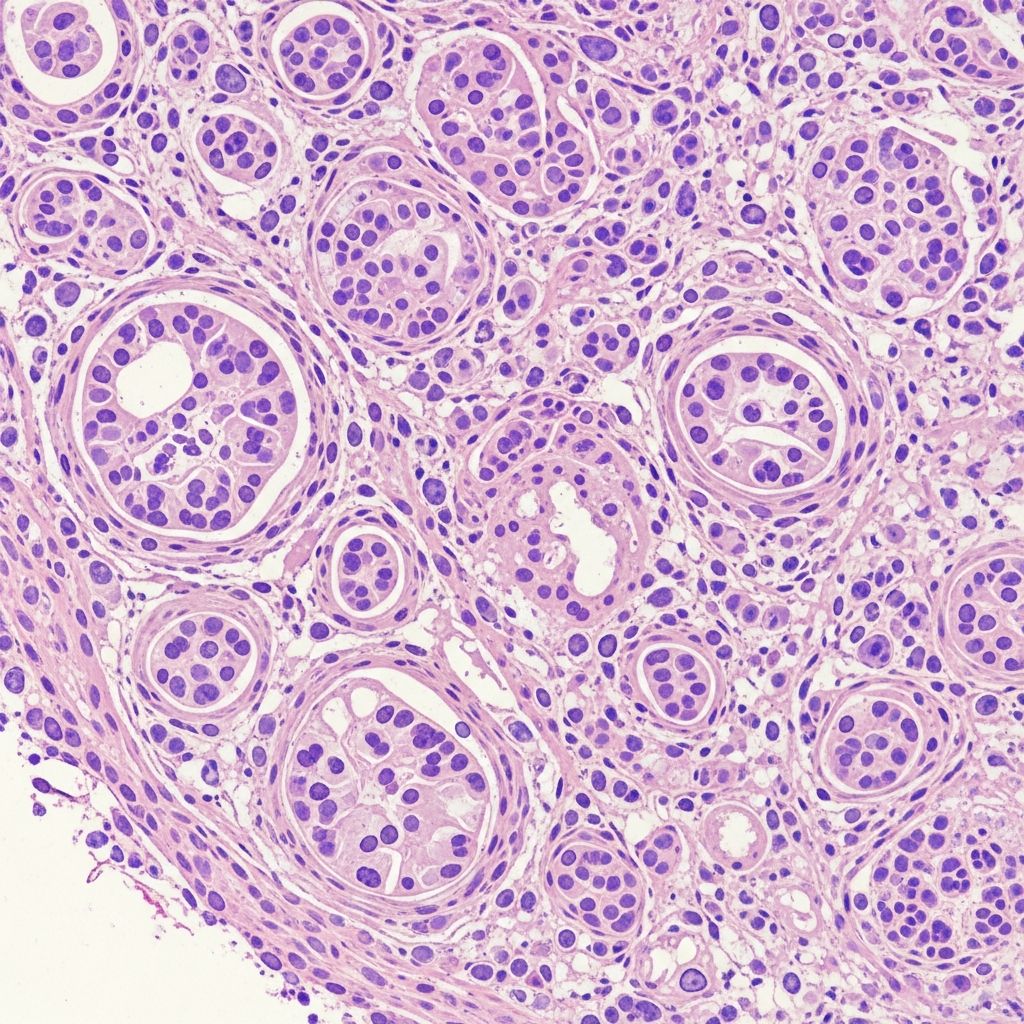
- WDLPS/ALT: Mature adipocytes with atypical stromal cells, lipoblasts; fibrous bands, myxoid change in retroperitoneum.
- DDLPS: Non-lipogenic sarcoma adjacent to WDLPS; spindle/pleomorphic cells.
- MLPS: Gelatinous myxoid stroma, lipoblasts, capillary network; high-grade: necrosis, mitoses.
- PLPS: Pleomorphic cells, bizarre multinucleated giants, pleomorphic lipoblasts.
Immunohistochemistry
MDM2/CDK4 positive in WDLPS/DDLPS; negative in PLPS. PLPS variably expresses SMA, desmin, CD34 focally.
Molecular
MDM2/CDK4 amplification (WDLPS/DDLPS); FUS::DDIT3 (MLPS).
Differential Diagnoses
| Condition | Key Distinguishing Features |
|---|---|
| Lipoma | Benign, uniform adipocytes, no atypia. |
| Atypical Lipomatous Tumor | Synonymous with WDLPS in extremities; MDM2+. |
| Other Sarcomas (e.g., Leiomyosarcoma) | Different IHC, genetics. |
| Myxoid Lipoma | No FUS::DDIT3. |
| Pleomorphic Sarcomas | PLPS molecularly aligns; lacks MDM2. |
Treatment
Surgery is mainstay: wide excision for localized disease. Retroperitoneal/inoperable cases use radiation/chemotherapy. MLPS responds well to neoadjuvant chemo (trabectedin, anthracyclines). Targeted therapies target MDM2/CDK4 amplifications. PLPS: aggressive surgery, poor chemo response.
Prevention
No established prevention due to unknown causes and rarity of modifiable risks.
Outcome
Prognosis varies: WDLPS/ALT favorable (low-grade, local recurrence if incomplete excision); MLPS intermediate (good chemo response, high recurrence); DDLPS worse (dedifferentiation risk); PLPS poorest (30-50% recurrence/metastasis, 60% 5-year survival). Factors: site (extremity better), size, grade, margins.
Related Stories



Frequently Asked Questions (FAQs)
Q: What is the most common liposarcoma subtype?
A: Well-differentiated liposarcoma (WDLPS)/atypical lipomatous tumor, 30-50% of cases, often in thighs/retroperitoneum.
Q: How is liposarcoma diagnosed?
A: Biopsy with histopathology, IHC (MDM2/CDK4), molecular tests (FUS::DDIT3).
Q: Is liposarcoma hereditary?
A: No strong evidence; rare familial cases, but mostly sporadic genetic changes.
Q: Can liposarcoma be cured?
A: Yes, with complete surgical resection in low-grade, localized cases; advanced/retroperitoneal poorer.
Q: What is the prognosis for myxoid liposarcoma?
A: Intermediate; chemo-sensitive, but high recurrence; better than PLPS.
References
- Liposarcoma – DermNet — DermNet NZ. 2023. https://dermnetnz.org/topics/liposarcoma
- Histomorphological and molecular characteristics of liposarcoma — PMC (NCBI). 2024-10-15. https://pmc.ncbi.nlm.nih.gov/articles/PMC12311419/
- Fact Sheet on Liposarcoma — Cancer Association of South Africa (CANSA). 2021-03. https://cansa.org.za/files/2021/03/Fact-Sheet-on-Liposarcoma-NCR-2017-web-March-2021.pdf
- Liposarcoma: Symptoms, Types, Treatment, Prognosis — Healthline. 2023-05-12. https://www.healthline.com/health/liposarcoma
- Liposarcoma – MalaCards — MalaCards. 2024. https://www.malacards.org/card/liposarcoma
Similar Articles








Read full bio of medha deb