Liverworts: Essential Guide To Biology, Allergens, Uses
Liverworts: Ancient bryophytes causing allergic contact dermatitis in forestry and gardening workers.
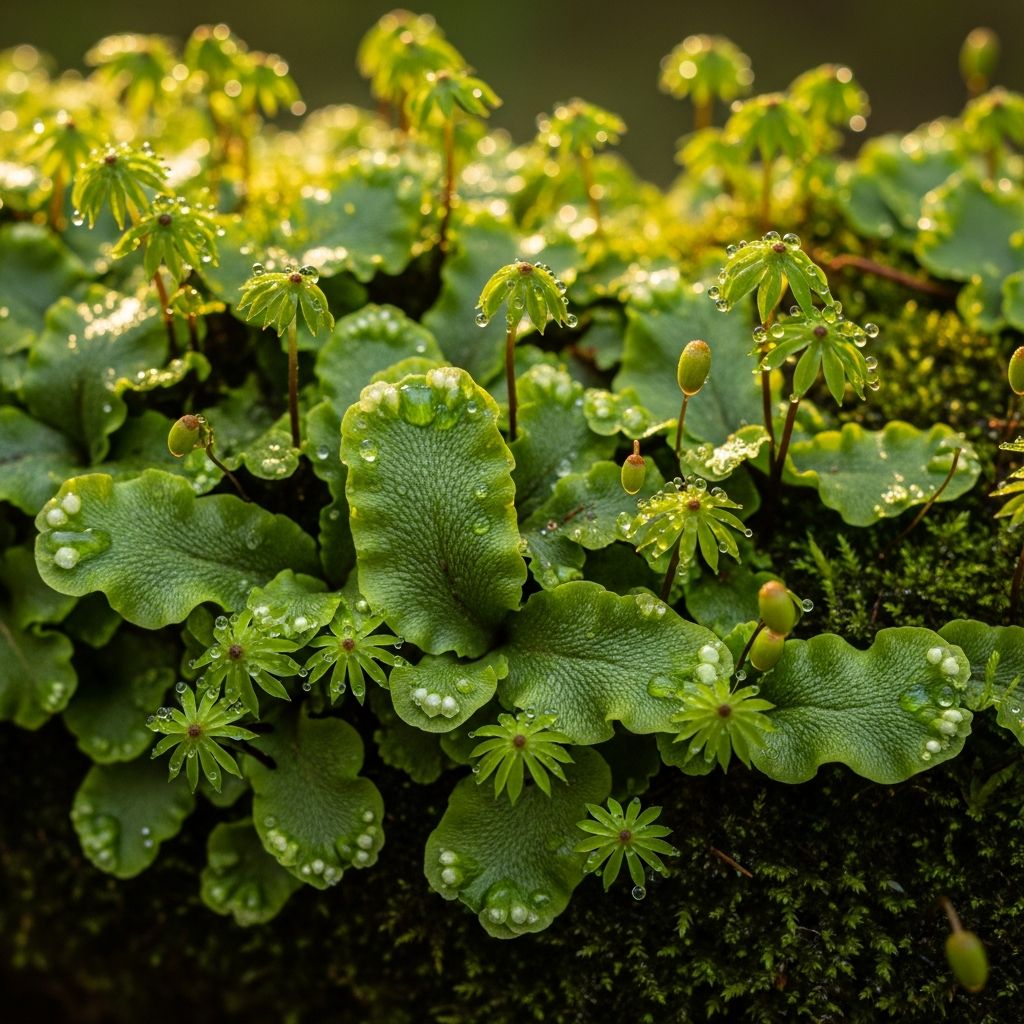
Liverworts belong to a group of plants known as the
bryophytes
, which are usually green, small, and among the simplest land-dwelling plants, with a few aquatic species. The name “liverwort” originates from the Anglo-Saxon words “lifer” (liver) and “wyrt” (plant), historically applied to genera like Marchantia due to their lobe-shaped forms resembling liver lobes.| Common name | Liverworts |
|---|---|
| Botanical name | The bryophytes comprise mosses, liverworts, and hornworts; approximately 25,000 bryophyte species exist worldwide. |
| Family | Hepaticae (liverworts) |
| Origin | Fossils date back to the Palaeozoic Era; they share ancestry with green algae. About 8,500 liverwort species are distributed from arctic to tropics, thriving in moist environments like damp soil, rotting logs, stream banks, and wet rocks. |
| Description | Liverworts lack flowers, seeds, and vascular tissues for water/nutrient transport. Two main types: leafy (Jungermaniales) and thallose (flat, ribbon-like). Leaves vary from undivided to lobed or hair-like. |
| Uses | Bryophytes regulate ecosystem humidity by absorbing/retaining water and indicate environmental quality changes from pollution. |
What are liverworts?
Liverworts are non-vascular plants in the division
Marchantiophyta
, representing one of the earliest land plant lineages. Unlike higher plants, they reproduce via spores and alternate between gametophyte (dominant, photosynthetic) and sporophyte stages. The gametophyte is the visible plant body, either thalloid (flat, undifferentiated) or leafy (with leaf-like structures arranged in two or three rows). Globally, there are around 8,500 species, with New Zealand hosting over 500, about 7% of the world’s total, rivaling moss diversity locally.Key distinguishing features include
oil bodies
in leaf cells—unique organelles containing terpenoids, lipids, and aromatic compounds. These oil bodies aid taxonomy, chemosystematics, and defense, with over 700 lipophilic compounds identified, mostly mono-, sesqui-, and diterpenoids, plus bibenzyls and bis-bibenzyls exhibiting antimicrobial, antifungal, cytotoxic, and neuroprotective activities. Liverworts like Frullania dilatata also show antioxidant properties and traditional uses for wounds, digestion, and respiratory issues, despite unpalatability and allergenicity.Ecology and distribution
Liverworts prefer moist, shaded habitats, contributing to forest floor carpets alongside mosses and lichens. In New Zealand, species like Schistochila appendiculata reach up to 1 meter in damp areas. Some have woolly hairs retaining water multiple times their dry weight or water sacs hosting nitrogen-fixing microbes. They grow epiphytically on tree bark (e.g., chestnut, acacia, poplar, beech, oak), exposing forestry workers and gardeners to contact.
Ecologically, they stabilize soil, retain moisture, and signal pollution via sensitivity to air, water, and soil quality changes. Fossil records confirm their ancient presence, with fragments in shales indicating early terrestrial adaptation.
Structure and morphology
Liverworts exhibit two forms:
- Thallose liverworts: Flat, ribbon-like thalli with lobed margins; e.g., Marchantia, used historically for liver ailments under the Doctrine of Signatures.
- Leafy liverworts (Jungermaniales): Erect or prostrate stems with underleaves and lateral leaves, often bilobed. New Zealand species show diverse hairs or sacs.
Oil bodies vary morphologically and chemically, serving defense against herbivores and stress. Terpenoids from these dominate, with bioactive potential in medicine. Spore capsules mature before stalk elongation, and the sporophyte is short-lived and non-green.
Related Stories



Medicinal and biochemical properties
Beyond allergens, liverworts hold promise. Frullania dilatata extracts demonstrate antimicrobial activity (potent ethanol extracts against bacteria/yeasts at low MICs), antioxidants, and compounds like frullanolide. Bis-bibenzyls offer anti-inflammatory, anticancer, and neuroprotective effects, potentially aiding Alzheimer’s/Parkinson’s. Traditional Chinese use of Marchantia for liver issues is supported by antibacterial marchantins.
However, scarcity limits research, emphasizing their unique secondary metabolites absent in vascular plants.
Allergens in liverworts
Only
leafy liverworts (Jungermaniales)
sensitize, via sesquiterpene lactones and related compounds. Key species include:- Frullania spp. (e.g., F. dilatata, F. franciscana): Cause intense allergic contact dermatitis; frullanolide identified.
- Diplophyllum albicans
- Blepharostoma trichophyllum
- Others like Adiantum, Cephaoziella.
These grow on tree bark, leading to occupational exposure in forestry/gardening.
Allergic reactions
**Allergic contact dermatitis (ACD)** or
airborne contact dermatitis
is primary, with photosensitivity and rare vasculitis. Reactions are severe in sensitized individuals, often linear on exposed skin from tree contact. Frullania notoriously provokes intense responses.Cross-reactions
Cross-sensitivity with laurel, Compositae plants (sesquiterpene lactone mix), and lichens (co-habiting environments may cause simultaneous sensitization).
Patch testing
Diagnose via:
- Sesquiterpene lactone mix (0.1% petrolatum)
- Compositae mix
- Specific liverwort species extracts
Positive reactions confirm sensitization; test forestry workers with tree bark history.
Frequently Asked Questions
What are liverworts?
Simple bryophyte plants, non-vascular, lacking flowers/seeds, divided into thallose and leafy types, often in moist habitats.
Which liverworts cause skin allergies?
Leafy Jungermaniales like Frullania spp., due to sesquiterpenes; common on tree bark.
Who is at risk for liverwort dermatitis?
Forestry workers, gardeners contacting infested trees like oak, beech.
How is liverwort allergy diagnosed?
Patch testing with sesquiterpene lactone mix, Compositae mix, or species extracts.
Do liverworts have medicinal uses?
Yes, compounds show antimicrobial, antioxidant, anti-inflammatory potential, e.g., in Frullania dilatata, despite allergenicity.
Are there cross-reactions with other plants?
Yes, laurel, Compositae, possibly lichens.
References
- Biochemical, Antioxidant Properties and Antimicrobial Activity of Epiphytic Leafy Liverwort Frullania dilatata (L.) Dumort — Ozcan Simsek, PMC. 2023-05-10. https://pmc.ncbi.nlm.nih.gov/articles/PMC10181397/
- The Oil Bodies of Liverworts: Unique and Important Organelles — Tiantong ECNU. 2014-09-19. https://tiantong.ecnu.edu.cn/ueditor/net/upload/2014-09-19/09110af4-b8cf-4378-ac7a-3495dd59be8c.pdf
- Liverworts and hornworts – Features — Te Ara Encyclopedia of New Zealand. N/A. https://teara.govt.nz/en/liverworts-and-hornworts/page-2
- Liverworts – DermNet — Dr Marius Rademaker, DermNet NZ. 1999. https://dermnetnz.org/topics/liverworts
- Dwarf Hepatic Floral Fragments (Possibly Liverworts) from the Barnett Shale — Search and Discovery. 2011. https://www.searchanddiscovery.com/documents/2011/70091schwab/ndx_schwab.pdf
Similar Articles








Read full bio of medha deb