Lobomycosis In 2025: Complete Guide To Diagnosis & Treatment
Rare chronic fungal skin infection causing keloid-like lesions, primarily in tropical Latin America.
What is lobomycosis?
Lobomycosis, also known as
Jorge Lobo disease
,keloidal blastomycosis
,Lobo disease
, orlacaziosis
, is a rare, chronic fungal infection affecting the skin and subcutaneous tissue. This deep mycosis is characterised by keloid-like lesions that typically remain localised but can progress slowly over years, leading to significant disfigurement if untreated.The disease primarily occurs in tropical regions of Central and South America, with the highest prevalence in the Amazon basin countries like Brazil, Venezuela, Colombia, and Guyana. It predominantly affects rural workers such as rubber tappers, miners, and indigenous people who have frequent contact with forest environments.
Caused by the unculturable dimorphic fungus Lacazia loboi, lobomycosis does not spread from human to human. Instead, it is acquired through traumatic inoculation of the fungus from environmental sources like soil, water, and vegetation into the dermis.
Who gets lobomycosis?
Lobomycosis has a striking epidemiological pattern, almost exclusively reported in humans and dolphins within the Americas. Human cases are overwhelmingly more common in adult males engaged in forest-related occupations. Prevalence is notably high among:
- Rubber tappers and bushmen in the Amazon region
- Miners and lumberjacks
- Indigenous populations in endemic areas
- Rarely, exported cases in travelers or immigrants from endemic zones
The male-to-female ratio exceeds 4:1, attributed to occupational exposure rather than biological sex differences. Disease onset typically occurs between ages 20-50, coinciding with peak working years in high-risk environments.
Dolphins, particularly coastal species in South America, represent the only known animal reservoir, with lesions appearing on fins, flukes, and tails. Human-dolphin transmission has not been documented.
Causes
Lacazia loboi is the sole causative agent, a yeast-like fungus belonging to the Onygenales order. This organism cannot be cultured in vitro, complicating research, but its morphology is distinctive: round to oval cells measuring 6-12 μm with thick, birefringent double-contoured walls. Characteristic features include simple budding and chains resembling ‘Rosario beads’ or catenular arrangements.
The fungus exists as a saprophyte in aquatic and terrestrial environments of tropical latitudes. Traumatic implantation via cuts, abrasions, insect bites, or animal injuries introduces it into the dermis, initiating infection. Speculation exists around vector transmission by insects or via snakebites/stingray injuries, though direct evidence is lacking.
Pathogenesis
Following dermal inoculation, L. loboi proliferates within macrophages, evading effective immune clearance. The fungus induces elevated levels of transforming growth factor β1 (TGF-β1), a potent immunosuppressive cytokine produced by macrophages and Th3 lymphocytes. This creates a fibrogenic, Th2-biased microenvironment favouring chronic granulomatous inflammation over resolution.
Histologically, the dermis shows pseudo-Gaucher cells laden with fungi, multinucleated giant cells, lymphocytes (predominantly CD4+ T cells with CD4:CD8 ratio ~3:2), plasma cells, and natural killer cells. Striking fibrosis and occasional asteroid bodies are hallmarks. Neutrophils appear mainly in ulcerated areas or when fungi invade the epidermis.
Lymphatic dissemination occurs in some cases, causing regional lymphadenopathy. Chronic lesions in moist, trauma-exposed sites develop polymorphic features: hyper/hypopigmentation, ulceration (especially rainy season), infiltration, and exophytic growth.
Related Stories



Clinical features
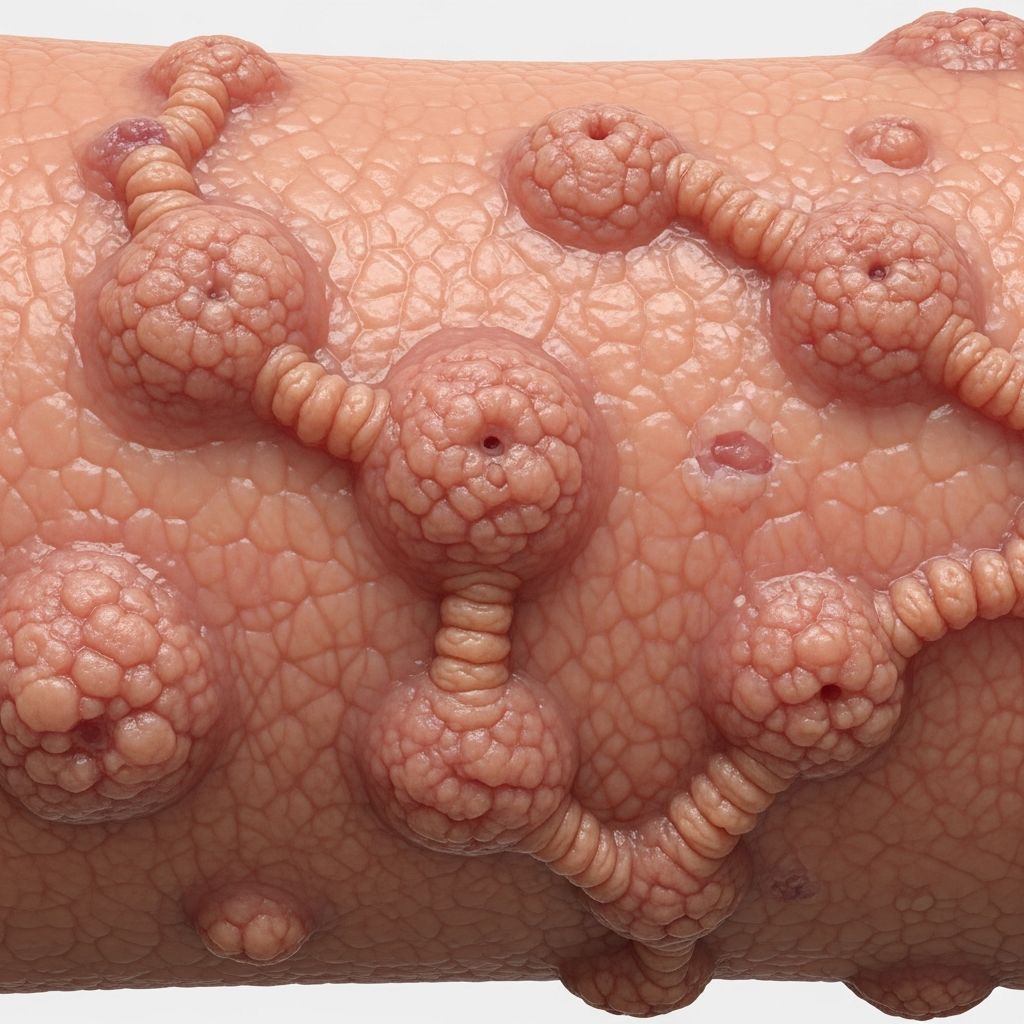
Lesions begin months post-trauma as indurated, painless papules or nodules in superficial or deep dermis. Over months to years, they expand contiguously into single or multiple keloid-resembling plaques/nodules with smooth, shiny surfaces. Colours range from skin tone to red-brown; telangiectasias are common.
Preferred sites are trauma-exposed areas:
- Ears (most frequent, ~30-50% cases)
- Arms and legs
- Face and trunk (less common)
Advanced disease shows polymorphism: verrucous surfaces, central ulceration, hypopigmented halos, or elephantiasis-like swelling. Extensive involvement causes lymphatic obstruction, auto-amputation risk (e.g., ear), and rare squamous cell carcinoma in chronic plaques.
| Clinical Type | Description | Common Sites |
|---|---|---|
| Keloidal | Smooth, shiny, scar-like plaques | Ears, limbs |
| Infiltrative | Thickened, plaque-like with sharp borders | Extremities |
| Verrucous | Warty, hyperkeratotic nodules | Legs, arms |
| Ulcerated | Secondary ulceration over plaques | Moist areas |
Diagnosis
Diagnosis combines clinical suspicion with mycological/histological confirmation. Direct microscopy of lesion scrapings, adhesive tape impressions, or cytology reveals pathognomonic yeast cells in chains (6-12 μm, double-refractile walls).
Histopathology shows epidermal atrophy/rectification over Grenz zone, dermal granulomas packed with fungi, fibrosis, and mixed infiltrate. Asteroid bodies and transepidermal elimination aid diagnosis.
Differential includes keloids, hypertrophic scars, chromoblastomycosis, leishmaniasis, leprosy, and cutaneous lymphoma. Fungal culture fails; PCR is experimental.
Treatment
No medical cure exists; surgery remains first-line for localised disease. Wide local excision with margins yields lowest recurrence (~10-20%). Mohs micrographic surgery is ideal for facial/ear lesions.
Medical therapies show variable efficacy:
- Antifungals: Itraconazole (400 mg/day, 3-6 months) or posaconazole achieve partial responses in 40-60% disseminated cases.
- Clofazimine: 100 mg 3x/week for lepromatous forms.
- Immunotherapy: BCG vaccine occasionally induces regression.
Combination itraconazole + clofazimine/surgery used for multifocal disease. Recurrence common (up to 50%) without complete excision. Monitor for secondary SCC.
Complications
- Functional impairment (e.g., hearing loss from ear destruction)
- Cosmetic disfigurement and social stigma
- Lymphoedema and elephantiasis
- Secondary bacterial infections in ulcers
- Malignant transformation to squamous cell carcinoma (rare, <1% chronic cases)
Prevention
Preventive measures target high-risk groups:
- Use protective clothing/gloves in forests
- Prompt wound care after trauma
- Avoid barefoot walking in endemic areas
- Vector control (insect repellents)
No vaccine available. Early diagnosis/excision prevents progression.
Prognosis
Benign but chronic; spontaneous resolution exceptional. Localised lesions respond well to surgery (80-90% cure). Extensive disease recurs frequently, causing lifelong morbidity. Dolphins show similar indolent course.
Frequently asked questions
Is lobomycosis contagious?
No, lobomycosis does not spread person-to-person. Transmission requires environmental fungal inoculation via trauma.
Can lobomycosis be cured?
Surgical excision cures localised disease, but medical treatment only controls disseminated forms. Recurrence is common.
What does lobomycosis look like?
Keloid-like, smooth shiny plaques/nodules, often on ears/ limbs, red-brown, painless, slowly growing.
Who is at risk for lobomycosis?
Adult males in Amazon occupations like rubber tapping, mining.
How is lobomycosis diagnosed?
Clinical + direct microscopy showing characteristic fungal chains.
References
- Lobomycosis: epidemiology, clinical presentation, and management options — Therapeutics and Clinical Risk Management (Dove Press). 2014-10-09. https://www.dovepress.com/lobomycosis-epidemiology-clinical-presentation-and-management-options-peer-reviewed-fulltext-article-TCRM
- Lobomycosis — DermNet NZ. 2025. https://dermnetnz.org/topics/lobomycosis
- Lobomycosis: epidemiology, clinical presentation, and management — PMC / NCBI. 2014. https://pmc.ncbi.nlm.nih.gov/articles/PMC4199563/
Similar Articles








Read full bio of Sneha Tete