Loop Diuretics: Essential Guide For Heart Failure Management
Essential guide to loop diuretics for managing heart failure symptoms and fluid overload effectively.
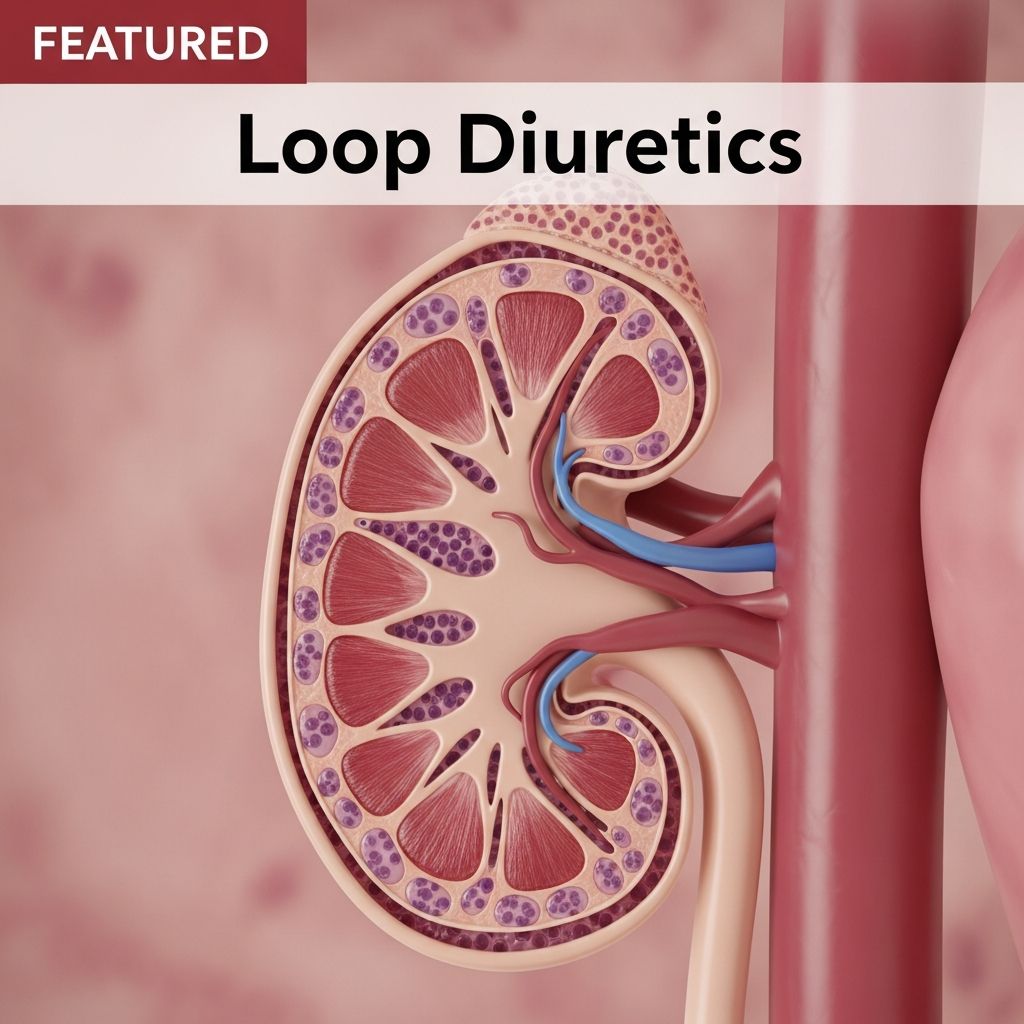
Loop diuretics are a cornerstone in managing fluid overload and congestion in heart failure patients. They work by inhibiting sodium reabsorption in the loop of Henle, promoting rapid diuresis to alleviate symptoms like shortness of breath and swelling.
What are loop diuretics?
Loop diuretics, also known as high-ceiling diuretics, are the most potent class of diuretics used primarily for conditions involving significant fluid retention. They target the
thick ascending limb of the loop of Henle
in the kidneys, where they reversibly and competitively inhibit the sodium-potassium-chloride cotransporter-2 (NKCC2) on the luminal side of epithelial cells. This inhibition prevents the reabsorption of about 25–30% of filtered sodium chloride (NaCl), leading to increased excretion of sodium, water, potassium, and other electrolytes.Unlike thiazide diuretics, which act distally, loop diuretics have a
sigmoid-shaped dose-response curve
. They exhibit minimal effect below a threshold dose but rapidly reach a maximum (ceiling) effect with further increases. Doses above the ceiling still prolong exposure time, enhancing natriuresis. In heart failure, this curve often shifts rightward and downward due to reduced renal perfusion, necessitating higher doses.Common loop diuretics include
furosemide
(Lasix),bumetanide
(Bumex), andtorsemide
(Demadex). Furosemide is most widely used, but torsemide offers better bioavailability and a longer half-life, potentially improving outcomes in chronic use.Why are loop diuretics used in people with heart failure?
Heart failure often leads to
congestion
, causing pulmonary edema, dyspnea, peripheral edema, and frequent hospitalizations. Loop diuretics are recommended asfirst-line therapy
by guidelines like the 2014 ACCF/AHA and ESC for relieving these symptoms in both HFrEF and HFpEF with volume overload.They receive a
Class I recommendation
for acute decompensated heart failure (ADHF) to reduce morbidity. While not reducing mortality like the four pillars (ACEi/ARNI, beta-blockers, MRA, SGLT2i), loop diuretics are essential for symptom control and achieving euvolemia at the lowest effective dose.- Relieve congestion symptoms rapidly.
- Reduce hospital stay and rehospitalizations when titrated properly.
- Enable addition of other HF therapies by preventing fluid retention.
How do loop diuretics work?
Loop diuretics bind to the chloride site on NKCC2, blocking Na+, K+, and Cl- reabsorption. This increases delivery of filtrate to the distal nephron, enhancing water excretion. Their rapid onset (IV: 5 minutes; oral: 1 hour) makes them ideal for acute settings.
Pharmacokinetics vary: furosemide has variable oral bioavailability (10-100% in HF), while torsemide is more consistent (80%). Continuous IV infusion may sustain levels better than boluses, though the DOSE trial showed similar efficacy with high-dose strategies.
Which is the best loop diuretic?
No single loop diuretic is universally superior, but choices depend on bioavailability, duration, and patient factors. Furosemide is traditional due to familiarity, but torsemide’s longer half-life (3-5 hours vs. 1-2 for furosemide) and higher bioavailability make it preferable in chronic HF.
| Diuretic | IV/Oral Dose Ratio | Half-Life | Bioavailability |
|---|---|---|---|
| Furosemide | 1:2-4 | 1-2 hrs | 10-100% |
| Bumetanide | 1:10 | 1-1.5 hrs | 80-100% |
| Torsemide | 1:2-4 | 3-5 hrs | ~80% |
The TRANSFORM-HF trial is comparing torsemide vs. furosemide in HF discharges.
Related Stories



How are doses chosen and adjusted?
Acute Decompensated Heart Failure (ADHF)
ESC guidelines recommend IV loop diuretics: 20-40 mg furosemide (or equivalent) for diuretic-naïve patients; 1-2x oral home dose for chronic users. High-dose (2.5x home) strategies yield more weight loss and dyspnea relief per DOSE trial.
Stepwise titration based on urine output (target >3-5 mL/kg/day) and natriuresis:
- Start IV bolus or infusion.
- If inadequate response, double dose.
- Add adjuncts for resistance.
Chronic Heart Failure
Use lowest effective dose for euvolemia. Down-titrate in stable patients; trials show no increased risk of rehospitalization. Monitor weight daily.
What are the problems with taking loop diuretics?
While effective, loop diuretics cause significant side effects due to electrolyte and volume shifts.
- Hypotension: Excessive diuresis leads to intravascular depletion.
- Electrolyte imbalances: Hypokalemia (most common), hyponatremia, hypomagnesemia.
- Worsening renal function (WRF): >30% creatinine rise in 25% of ADHF patients; often transient but prognostic.
- Ototoxicity: Rare, high-dose IV, reversible hearing loss.
- Gout: Uric acid retention.
- Neurohormonal activation: RAAS and sympathetic surge worsening HF long-term.
High chronic doses associate with higher mortality, likely reflecting severity.
What is diuretic resistance?
**Diuretic resistance** is failure to achieve target decongestion despite escalating doses, affecting 20-30% of ADHF patients and portending poor prognosis.
Mechanisms:
- Post-diuretic sodium retention: Distal nephron hypertrophy compensates.
- Reduced delivery: Poor renal perfusion, nephron loss.
- Braking phenomenon: Hormonal counter-regulation.
How can diuretic resistance be overcome?
Sequential nephron blockade and adjuncts are key:
- Add thiazide (e.g., metolazone 2.5-5 mg): Acts distally; monitor electrolytes.
- SGLT2 inhibitors: Synergistic natriuresis in proximal tubule.
- Acetazolamide: ADVOR trial: 42% vs. 30% decongestion rate with loop combo; shorter LOS.
- Tolvaptan: For hyponatremia, enhances aquaresis.
Optimize delivery: IV preferred, continuous infusion if bolus fails.
When should I take loop diuretics?
Timing optimizes efficacy and minimizes nocturia:
- Morning dose for once-daily.
- Split BID for higher doses (>80 mg furosemide).
- With/without food per tolerance; take with meals if stomach upset.
Monitor weight daily; contact doctor if >2-3 kg gain or worsening symptoms.
Further reading and references
For more on heart failure management, see NHS and AHA guidelines.
Frequently Asked Questions
What if I miss a dose?
Take as soon as remembered unless near next dose; do not double up.
Can I stop loop diuretics?
Never abruptly; taper under guidance in stable euvolemia.
Do loop diuretics cause kidney damage?
WRF occurs but often reversible; monitor creatinine.
Are oral and IV doses equivalent?
No; oral requires 2-4x IV dose due to bioavailability.
Interactions?
Avoid NSAIDs; monitor with ACEi/ARBs for hyperkalemia risk.
References
- Diuretic Treatment in Heart Failure: A Practical Guide for Clinicians — PMC. 2024. https://pmc.ncbi.nlm.nih.gov/articles/PMC11313642/
- Loop Diuretics – StatPearls — NCBI Bookshelf. 2023-09-04. https://www.ncbi.nlm.nih.gov/books/NBK546656/
- A Brief Overview of Loop Diuretics Used in Heart Failure — Pharmacy Times. 2023. https://www.pharmacytimes.com/view/a-brief-overview-of-loop-diuretics-used-in-heart-failure
- Congestion and Diuretic Resistance in Acute or Worsening Heart Failure — CFR Journal. 2023. https://www.cfrjournal.com/articles/congestion-and-diuretic-resistance-acute-or-worsening-heart-failure
- Loop Diuretics Administration and Acute Heart Failure (DOSE) — ClinicalTrials.gov. 2011. https://clinicaltrials.gov/study/NCT01441245
Similar Articles








Read full bio of Sneha Tete