Lymph Node Surgery For Melanoma: 5 Risks, Benefits, Recovery
Essential guide to sentinel lymph node biopsy and completion lymphadenectomy in melanoma treatment and staging.
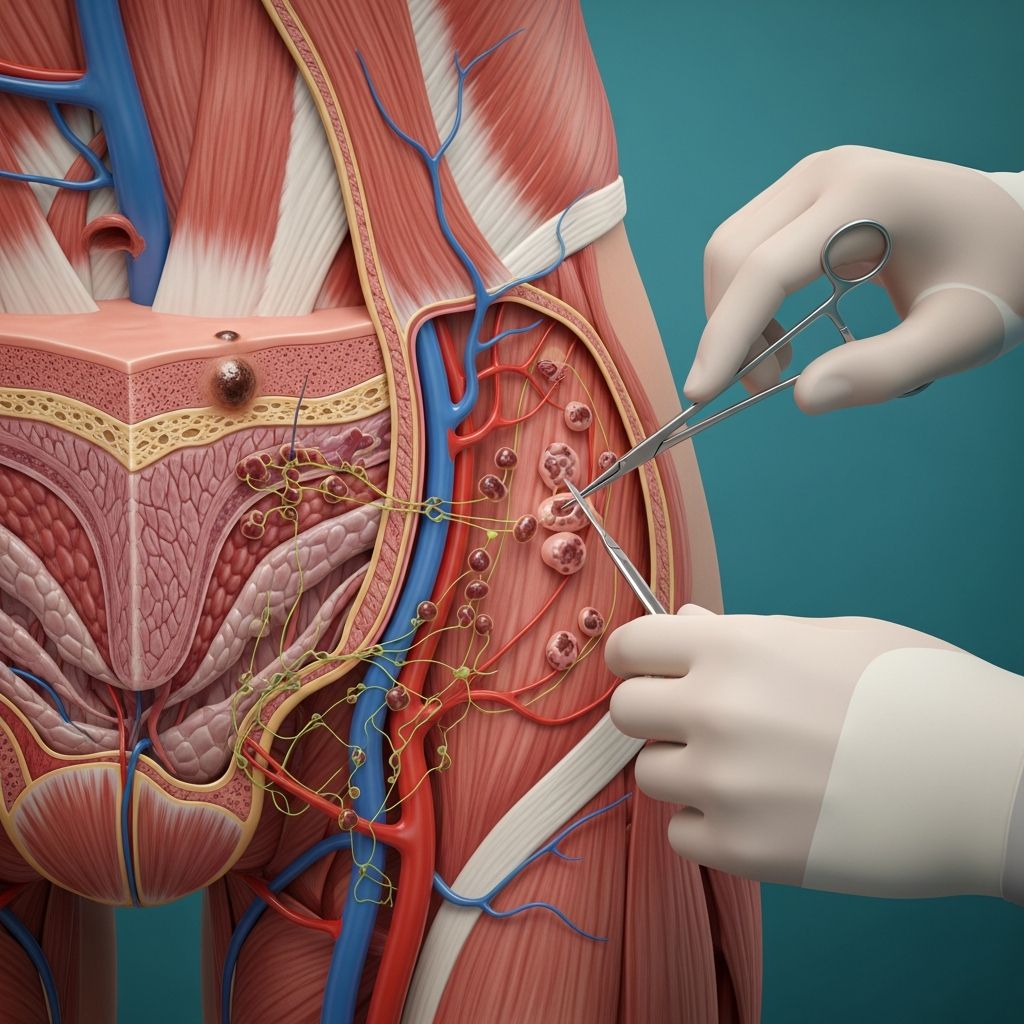
Lymph Node Surgery for Melanoma
Lymph node surgery plays a critical role in the management of cutaneous melanoma, particularly for staging and assessing regional metastasis risk. There are two primary procedures:
sentinel lymph node biopsy (SLNB)
andcompletion lymphadenectomy
(lymph node dissection).Introduction
Cutaneous melanoma can spread via lymphatic vessels to regional lymph nodes. Early detection of nodal involvement improves staging accuracy and guides adjuvant therapy decisions. SLNB identifies the first (‘sentinel’) lymph node(s) draining the primary tumor site, while completion lymphadenectomy removes all nodes in the affected basin. These procedures are typically performed during wide local excision of the primary melanoma under general anesthesia.
Demographics
SLNB is most commonly offered to patients with intermediate-thickness melanomas (Breslow thickness 1.2–4.0 mm), where the risk of nodal metastasis is 15–25%. It is also considered for high-risk thin melanomas (≥0.8 mm with adverse features like ulceration or high mitotic rate) and thick melanomas (>4 mm) for prognostic stratification. Guidelines from the National Comprehensive Cancer Network (NCCN) recommend SLNB for T1b–T4 melanomas.
- Intermediate-thickness melanomas benefit most from SLNB for early microscopic disease detection.
- Approximately 20% of SLNB-positive patients have non-sentinel node involvement.
Contraindications
Contraindications primarily apply to SLNB and include:
- Clinically palpable or radiologically evident nodal disease (perform fine-needle aspiration first).
- Advanced primary melanoma with gross extracapsular extension.
- Patient factors: severe comorbidities precluding surgery, pregnancy (relative), or inability to tolerate general anesthesia.
- Prior wide local excision disrupting lymphatic mapping (though feasible in many cases).
Completion lymphadenectomy is contraindicated if distant metastases are present or for palliation only.
Sentinel Lymph Node Biopsy
**Sentinel lymph node biopsy (SLNB)** is a minimally invasive procedure to sample the first lymph node(s) likely to harbor metastasis. It is performed in clinically node-negative patients during wide local excision.
Procedure
Preoperative lymphoscintigraphy maps drainage using a radiotracer injected around the primary scar. Intraoperatively, blue dye (e.g., isosulfan blue) and/or radiotracer guide identification. Sentinel nodes are excised and sent for pathological analysis (serial sectioning, immunohistochemistry for S100, HMB45, Melan-A).
- Success rate: >95% with dual mapping (dye + radiotracer).
- Pathology assesses metastasis size, extracapsular extension (poorer prognosis).
Indications
SLNB is indicated based on MSLT-1 trial evidence for prognostic staging:
- Breslow thickness ≥1.2 mm (or ≥0.8 mm with ulceration).
- Head/neck melanomas due to complex drainage.
- Thick melanomas for adjuvant therapy eligibility.
Lymph Node Dissection (Completion Lymphadenectomy)
**Completion lymphadenectomy** removes all lymph nodes in the regional basin (axilla, groin, neck) after positive SLNB or clinically detected nodal disease.
Procedure
Performed under general anesthesia, it involves comprehensive dissection of the nodal basin. Pathology examines all nodes for metastasis. Inguinal dissections carry higher morbidity than axillary.
Indications
Current practice post-MSLT-II and DeCOG-SLT trials limits routine use:
- Clinically palpable nodal metastasis (after FNA confirmation).
- Positive SLNB with high-risk features (e.g., extracapsular extension, >1 mm deposit).
- Not routine for all SLNB-positive cases; observation with ultrasound preferred.
Benefits
Key advantages include:
- Prognostic staging: SLNB provides accurate nodal status, risk stratification (5-year survival drops 40–50% if positive).
- Regional control: Immediate removal in select cases reduces nodal recurrence.
- Adjuvant therapy guidance: Identifies candidates for immunotherapy (e.g., pembrolizumab) or targeted therapy.
- SLNB avoids unnecessary full dissection in 80–85% node-negative patients.
MSLT-1 showed no survival benefit from early SLNB vs. observation but improved staging.
Risks and Disadvantages
Complications vary by procedure. SLNB risks: 6–14%.
| Complication | SLNB Risk | Completion Dissection Risk |
|---|---|---|
| Lymphoedema | <5% | 10–30% (higher inguinal) |
| Infection | 1–5% | 5–15% |
| Nerve injury | Rare | 5–20% (e.g., marginal mandibular) |
| Seroma/hematoma | 5–10% | 10–25% |
| Wound dehiscence | Rare | 5–10% |
Lymphoedema is limb swelling from lymphatic disruption, managed with compression but often chronic. Completion dissection risks are higher, including disability from arm/leg swelling.
More Information
Post-MSLT-II (2017) and DeCOG-SLT (2016), routine completion dissection after positive SLNB is not recommended due to no melanoma-specific survival benefit, though it improves short-term nodal control. Observation with serial ultrasound is standard for SLNB-positive patients without high-risk features. NCCN guidelines endorse shared decision-making.
Follow-up includes clinical exams, ultrasound, and imaging for stage III disease. Adjuvant therapies have transformed outcomes: 3-year recurrence-free survival improved from 40–50% to 60–70% with anti-PD-1 agents.
Frequently Asked Questions (FAQs)
What is the recovery time after SLNB?
Most patients resume normal activities in 1–2 weeks; drain removal in 5–10 days. Full recovery 4–6 weeks.
Does positive SLNB mean the melanoma has spread?
It indicates microscopic nodal involvement (stage III), but distant metastasis risk depends on burden. Prognosis varies; adjuvant therapy improves outcomes.
Can SLNB be done after previous excision?
Yes, in 80–90% cases if performed within 120 days; lymphoscintigraphy aids mapping.
Is lymphoedema permanent?
Often chronic but manageable with therapy; risk higher after groin dissection (up to 30%).
Who performs these procedures?
Surgical oncologists or dermatologic surgeons trained in melanoma; multidisciplinary team input essential.
References
- Lymph node surgery for melanoma — DermNet NZ. 2023. https://dermnetnz.org/topics/lymph-node-surgery-for-melanoma
- Sentinel Lymph Node Biopsy in Cutaneous Melanoma, a Clinical Practice Review — National Library of Medicine (PMC). 2022-11-14. https://pmc.ncbi.nlm.nih.gov/articles/PMC9698247/
- Melanoma – a management guide for GPs — Royal Australian College of General Practitioners (RACGP). 2012-07. https://www.racgp.org.au/afp/2012/july/melanoma-guide
- Sentinel lymph node biopsy — DermNet NZ. 2023. https://dermnetnz.org/topics/sentinel-lymph-node-biopsy
- Melanoma Skin Cancer: Images, Diagnosis, and Treatment — DermNet NZ. 2023. https://dermnetnz.org/topics/melanoma
Similar Articles




Read full bio of Sneha Tete