Lymphocytes: What They Are, Function & Normal Range
Understand lymphocytes—the key immune cells that fight infections, their normal ranges, and what high or low levels mean for your health.
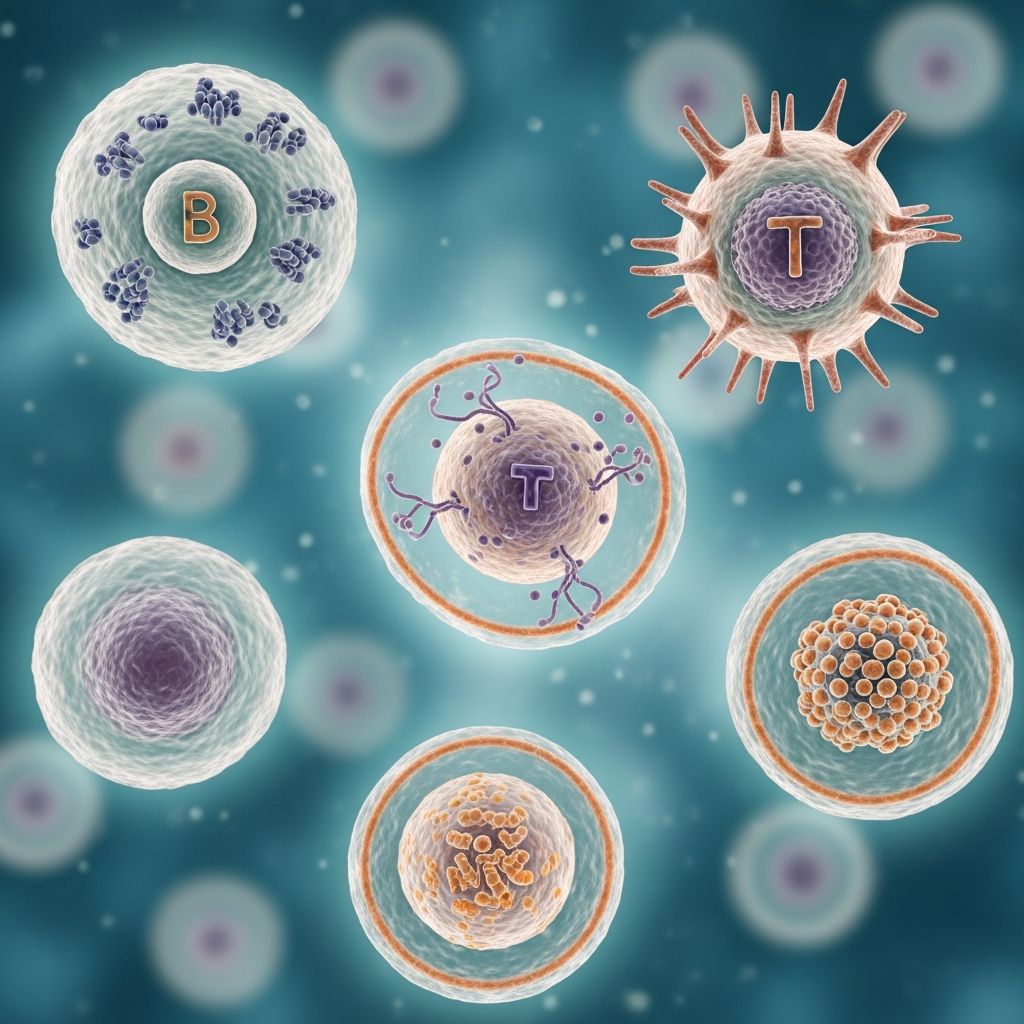
Lymphocytes are a type of white blood cell essential to the body’s immune defense, comprising 20% to 40% of total white blood cells and typically ranging from 1,000 to 4,800 cells per microliter (µL) of blood in adults. These cells orchestrate both immediate innate responses and long-term adaptive immunity, recognizing pathogens, producing antibodies, and forming memory cells for faster future responses. Monitoring lymphocyte levels through a complete blood count (CBC) helps detect infections, autoimmune issues, cancers, or immune deficiencies.
What Are Lymphocytes?
Lymphocytes belong to leukocytes (white blood cells) and represent about 20-40% of the total WBC count in adults, concentrated in blood, lymph, spleen, tonsils, and lymph nodes. Unlike other WBCs focused on phagocytosis, lymphocytes provide targeted immunity via antigen-specific responses, with roughly 2 × 10¹² cells in the human body—comparable to the liver or brain in mass. They mature in primary lymphoid organs (bone marrow for all, thymus for T cells) before circulating and residing in secondary sites like lymph nodes.
Their small size (7-10 µm diameter) features a large nucleus with scant cytoplasm, distinguishing them under microscopy. Lymphocytes enable immunological memory: upon first antigen encounter, they proliferate, differentiate, and create memory cells for rapid re-responses, underpinning vaccination efficacy against diseases like measles.
Types of Lymphocytes
Three primary lymphocyte types—B cells, T cells, and natural killer (NK) cells—each with specialized roles in immunity. B cells (10-15% of lymphocytes) originate and mature in bone marrow, producing antibodies that neutralize extracellular pathogens like bacteria and viruses. Plasma cells (differentiated B cells) secrete immunoglobulins (IgM, IgG, IgA, IgE, IgD), while memory B cells ensure long-term protection.
T cells (70-80% of lymphocytes) mature in the thymus into subtypes: helper T cells (CD4+) coordinate immunity by activating B cells, cytotoxic T cells, and macrophages via cytokines; cytotoxic T cells (CD8+) directly kill virus-infected or cancerous cells; regulatory T cells suppress excessive responses to prevent autoimmunity; and memory T cells provide enduring antigen recall. NK cells (5-15%), part of innate immunity, rapidly destroy virus-infected and tumor cells without prior sensitization, using perforin and granzymes.
- B cells: Antibody production and humoral immunity.
- T cells: Cell-mediated immunity (helper, cytotoxic, regulatory, memory).
- NK cells: Innate killing of infected/abnormal cells.
Lymphocytes’ Function
Lymphocytes bridge innate and adaptive immunity: NK cells offer immediate defense, while B and T cells deliver precise, memory-based responses. Upon antigen detection via surface receptors, lymphocytes activate, proliferate (clonal expansion), and differentiate—helper T cells via MHC class II, cytotoxic T via MHC class I.
B cells bind antigens directly, internalize for MHC presentation to helper T cells, receiving signals for proliferation into plasma/memory cells. Cytotoxic T and NK cells induce apoptosis in targets using perforin/granzymes. Regulatory T cells maintain tolerance, preventing autoimmunity. Collectively, they combat viruses, bacteria, parasites, cancers, and facilitate transplant rejection. Memory cells ensure lifelong or vaccine-induced immunity.
Normal Lymphocyte Levels
Normal ranges vary by age, lab, and measurement (absolute count or percentage). Adults: 1,000-4,800 lymphocytes/µL (20-40% of WBCs); children: 3,000-9,500/µL (higher percentage). Absolute lymphocyte count (ALC) = total WBC × lymphocyte percentage.
| Age Group | Absolute Count (cells/µL) | Percentage of WBCs |
|---|---|---|
| Adults | 1,000-4,800 | 20-40% |
| Children (6-12 yrs) | 1,500-6,500 | 25-45% |
| Infants (<2 yrs) | 3,000-9,500 | 40-70% |
Related Stories



Slight variations occur due to diurnal rhythms, stress, or ethnicity; always compare to lab reference. CBC with differential quantifies lymphocytes.
High Lymphocytes (Lymphocytosis)
Lymphocytosis: ALC >4,000-4,800/µL adults (>40-45%) or persistent elevation. Often reactive to infections; severe/chronic cases warrant investigation for malignancies.
- Viral infections: EBV (mono), CMV, hepatitis, HIV acute phase.
- Bacterial: Pertussis, TB.
- Inflammatory/autoimmune: RA, IBD.
- Malignancies: CLL, ALL, lymphomas.
- Other: Stress, smoking, post-splenectomy.
Symptoms: Often none; severe cases show fatigue, nodes, splenomegaly. Diagnosis: Flow cytometry, bone marrow biopsy.
Low Lymphocytes (Lymphopenia)
Lymphopenia: ALC <1,000/µL adults or <3,000 children. Increases infection/cancer risk.
- Infections: HIV destroys CD4+ T cells; flu, hepatitis.
- Autoimmune: Lupus.
- Medications: Steroids, chemo, immunosuppressants.
Other: Malnutrition, sepsis, congenital immunodeficiencies.
Symptoms: Recurrent infections, fatigue. HIV monitoring targets CD4 <200/µL.
Frequently Asked Questions (FAQs)
What level of lymphocytes is dangerous?
No universal “dangerous” threshold; context-dependent. Lymphopenia <1,000/µL risks infections; extreme lymphocytosis (>50,000/µL) suggests leukemia. Persistent abnormalities need evaluation.
What if lymphocytes are 45%?
45% exceeds 20-40% normal, often indicating mild viral response; monitor if persistent.
What’s the lymphocytes normal range?
Adults: 1,000-4,800/µL (20-40% WBCs); varies by age/lab.
Lymphocytes vs. monocytes?
Lymphocytes (20-40%): Adaptive virus immunity; monocytes (2-8%): Innate phagocytosis/healing.
How to test lymphocytes?
CBC with differential measures count/percentage.
When to See a Doctor
Consult if unexplained fatigue, frequent infections, swollen nodes, or CBC abnormalities persist. High/low counts alone aren’t diagnostic—combine with history, exams, further tests. Early intervention manages underlying causes effectively.
References
- Lymphocyte Count: Normal Range, Causes, Symptoms & Treatment — PACE Hospitals. 2024. https://www.pacehospital.com/lymphocyte-count-normal-range
- Lymphocytes and the Cellular Basis of Adaptive Immunity — NCBI Bookshelf/NIH. 2023-10-01. https://www.ncbi.nlm.nih.gov/books/NBK26921/
- Lymphocytes: Function, Definition, Levels & Ranges — Cleveland Clinic. 2024-05-23. https://my.clevelandclinic.org/health/body/23342-lymphocytes
- Lymphocytes: Levels, ranges, and functions — Medical News Today. 2023-11-21. https://www.medicalnewstoday.com/articles/320987
- Lymphocytes — Physiopedia. 2024. https://www.physio-pedia.com/Lymphocytes
- What Does High Lymphocytes Mean? A Comprehensive Guide — Rupa Health. 2024-06-15. https://www.rupahealth.com/post/what-does-high-lymphocytes-mean-a-comprehensive-guide-for-patients-and-practitioners
- What level of lymphocytes is considered dangerous? — MD Anderson Cancer Center. 2023-04-12. https://www.mdanderson.org/cancerwise/what-level-of-lymphocytes-is-considered-dangerous.h00-159701490.html
Similar Articles








Read full bio of medha deb