Lymphomatoid Granulomatosis: Diagnosis, Treatment, Prognosis
Rare EBV-driven lymphoproliferative disorder affecting lungs, skin, and CNS with grade-based immunotherapy.
What is lymphomatoid granulomatosis?
Lymphomatoid granulomatosis (LYG; also known as lymphomatoid granuloma) is a rare Epstein–Barr virus (EBV)-driven angioinvasive lymphoproliferative disorder characterised by nodular infiltrates of EBV-positive B-cells admixed with reactive cytotoxic T-cells, resulting in tissue necrosis due to vascular occlusion and damage. It predominantly affects the lungs but frequently involves extrapulmonary sites including the skin (30–50% of cases), central nervous system (CNS; 25–50%), kidneys, and liver. Lymph nodes and bone marrow are rarely involved, distinguishing LYG from conventional lymphomas.
LYG exists on a spectrum from low-grade (grade 1) indolent disease responsive to immunotherapy to high-grade (grade 3) aggressive lymphoma-like malignancy requiring intensive immunochemotherapy. The disease arises from defective immune surveillance permitting uncontrolled proliferation of EBV-infected B-cells despite a prominent reactive T-cell infiltrate. Incidence is estimated at 0.5–1 per million annually, primarily affecting adults aged 40–60 years with a male predominance (M:F 2:1), though paediatric cases occur. Immunosuppression (iatrogenic, HIV, or idiopathic T-cell defects) predisposes to LYG development.
Who gets lymphomatoid granulomatosis?
LYG typically presents in middle-aged adults (median age 50 years) with a 2:1 male-to-female ratio. Risk factors include:
- Immunosuppression: Post-transplant (e.g., methotrexate, azathioprine), HIV infection, or common variable immunodeficiency.
- EBV seropositivity: All cases demonstrate EBV-encoded RNA (EBER) in neoplastic B-cells.
- Idiopathic T-cell dysfunction: Reduced CD8+ cytotoxic T-cells despite prominent infiltrate.
Rare familial cases suggest genetic predisposition. Unlike post-transplant lymphoproliferative disorders (PTLD), LYG often occurs in immunocompetent hosts.
What causes lymphomatoid granulomatosis?
LYG pathogenesis involves EBV-infected atypical B-cells proliferating within vessel walls (angioinvasion), accompanied by a disproportionate reactive cytotoxic T-cell (CD8+) response that paradoxically contributes to necrosis via cytokine storm and vascular occlusion rather than effective viral control. Key mechanisms include:
- Immune dysregulation: Selective CD8+ T-cell dysfunction permits EBV-B-cell escape.
- Angiodestruction: EBV+ B-cells infiltrate and occlude vessels, causing ischaemic necrosis.
- Grading progression: Low-grade lesions show few EBV+ B-cells amid abundant T-cells; high-grade shows B-cell predominance with necrosis.
Unlike polymorphic PTLD, LYG demonstrates clonal EBV+ B-cells with T-cell rich background.
What are the clinical features of lymphomatoid granulomatosis?
Pulmonary involvement occurs in >90% of cases, manifesting as multiple bilateral nodules (1–3 cm) on imaging, often with cavitation or ‘haloed’ appearance. Symptoms include:
- Respiratory: Cough (most common), dyspnoea, chest pain, haemoptysis.
- Systemic: Fever, night sweats, weight loss, fatigue (B symptoms in 30–50%).
Cutaneous lesions (30–50%) appear as red-brown papules, nodules, or plaques on extremities/trunk, often ulcerating. Lesions are usually asymptomatic but may itch or be tender.
CNS involvement (25–50%): Headache, confusion, seizures, cranial neuropathies, ataxia. MRI shows enhancing lesions.
Rare sites: Renal (haematuria), hepatic (elevated LFTs), corneal ulcers.
How is lymphomatoid granulomatosis diagnosed?
Diagnosis requires histopathologic confirmation via biopsy of accessible lesions (lung, skin preferred). Key diagnostic criteria:
| Feature | Description |
|---|---|
| Histology | Angiocentric/angiodestructive lymphoid infiltrate with variable atypia, necrosis, and granulomatous features. EBV+ (EBER) atypical B-cells amid T-cells. |
| Grading (0–3) | Grade 1: Few atypical B-cells (<5/HPF), abundant T-cells. Grade 2: Intermediate. Grade 3: Numerous atypical B-cells (>50/HPF), necrosis. |
| IHC | CD20+ EBV+ B-cells; CD3+/CD8+ TIA-1+ T-cells; rare CD56+ NK-cells. |
| Molecular | Clonal Ig gene rearrangements; EBV terminal repeats. |
Investigations:
- CXR/CT chest: Multiple nodules.
- LDH, CBC, LFTs, RFTs, ESR.
- EBV PCR (quantitative).
- PET-CT for staging.
- Rule out infection/malignancy.
Related Stories



What is the differential diagnosis for lymphomatoid granulomatosis?
- Pulmonary: Wegener granulomatosis (ANCA+), infections (mycobacteria, fungi), lymphoma (primary pulmonary), metastases.
- Cutaneous: Lymphomatoid papulosis, cutaneous T-cell lymphoma, granuloma faciale, vasculitis.
- CNS: Primary CNS lymphoma, glioblastoma, infections.
What is the treatment for lymphomatoid granulomatosis?
Treatment is grade-dependent per NCI prospective paradigm (ongoing since 1994):
- Grade 1–2 (low-grade): Interferon alfa-2b (IFN-α2b) – subcutaneous, dose-escalated 3x/week for 1 year. Achieves 61% CR; augments EBV-specific T-cell response.
- Grade 3 (high-grade): DA-EPOCH-R (dose-adjusted etoposide, prednisone, vincristine, cyclophosphamide, doxorubicin, rituximab) – 6 cycles q3 weeks. 47–75% response, >50% CR.
Progression low→high (or vice versa) managed by crossover therapy. Refractory cases: HSCT (limited data), novel checkpoint inhibitors (PD-1). Corticosteroids ± cyclophosphamide for symptomatic relief. Observation for indolent grade 1.
What is the outcome for lymphomatoid granulomatosis?
Prognosis varies by grade:
- Low-grade: 5-year survival ~70% with IFN.
- High-grade: 5-year survival 30–50%; improves with DA-EPOCH-R.
Relapse common (25%); CNS involvement portends poor prognosis. Durable remissions in ~1/3 with tailored therapy.
Investigations
- Bloods: CBC (lymphocytosis rare), LDH↑, β2-microglobulin, EBV PCR.
- Imaging: CT/PET-CT (lung nodules, extranodal disease).
- Biopsy: Lung wedge/VATS, skin punch.
Histology of lymphomatoid granulomatosis
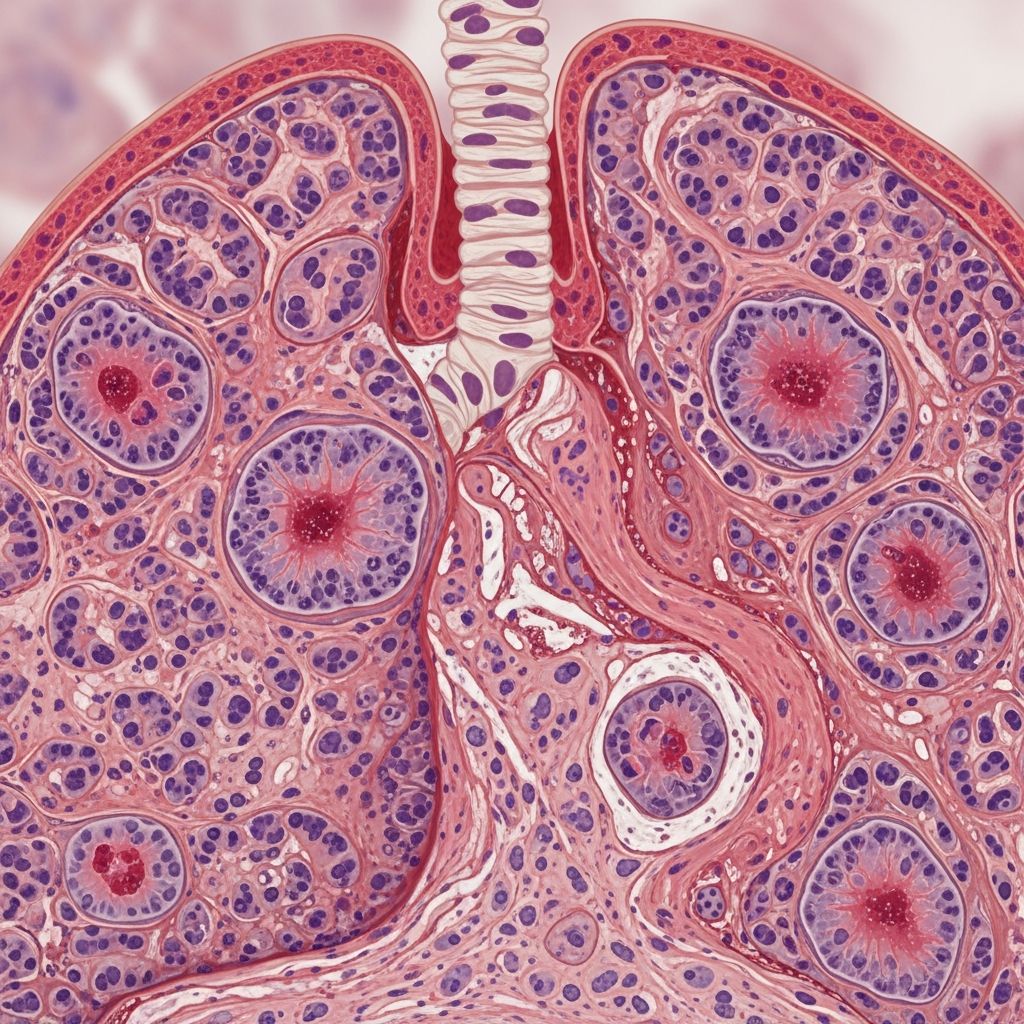
Characteristic angioinvasive polymorphous infiltrate with medium-large atypical B-cells (CD20+, EBER+, CD30±), abundant background small CD3+/CD8+/TIA1+ cytotoxic T-cells, eosinophils, histiocytes. Vascular wall invasion → fibrinoid necrosis → geographic tissue necrosis. Grading based on atypical B-cell density/HPF.

Frequently asked questions about lymphomatoid granulomatosis
Q: Is lymphomatoid granulomatosis curable?
Yes, ~1/3 achieve durable remission with grade-appropriate therapy (IFN low-grade, DA-EPOCH-R high-grade). Relapses occur but respond to retreatment.
Q: Can LYG be treated without chemotherapy?
Low-grade: Yes, IFN-α monotherapy effective (61% CR). High-grade requires chemotherapy.
Q: Does LYG always involve the skin?
No, skin affected in 30–50%; lung universal.
Q: Is LYG associated with HIV?
Yes, immunosuppression (HIV, iatrogenic) predisposes, but most cases immunocompetent.
Q: What are LYG skin lesions like?
Red-brown papules/nodules/plaques on limbs/trunk; may ulcerate. Often asymptomatic.
References
- Pathobiology and treatment of lymphomatoid granulomatosis — National Cancer Institute (PMC). 2020-04-15. https://pmc.ncbi.nlm.nih.gov/articles/PMC7162687/
- Immunotherapy effective for lymphomatoid granulomatosis — National Cancer Institute. 2023-06-13. https://www.cancer.gov/news-events/press-releases/2023/immunotherapy-lymphomatoid-granulomatosis
- Lymphomatoid granulomatosis — DermNet NZ. 2023-01-01. https://dermnetnz.org/topics/lymphomatoid-granulomatosis
Similar Articles








Read full bio of Sneha Tete