Understanding Macular Hole: Vision Loss and Treatment
Comprehensive guide to macular holes, symptoms, causes, and surgical treatment options.
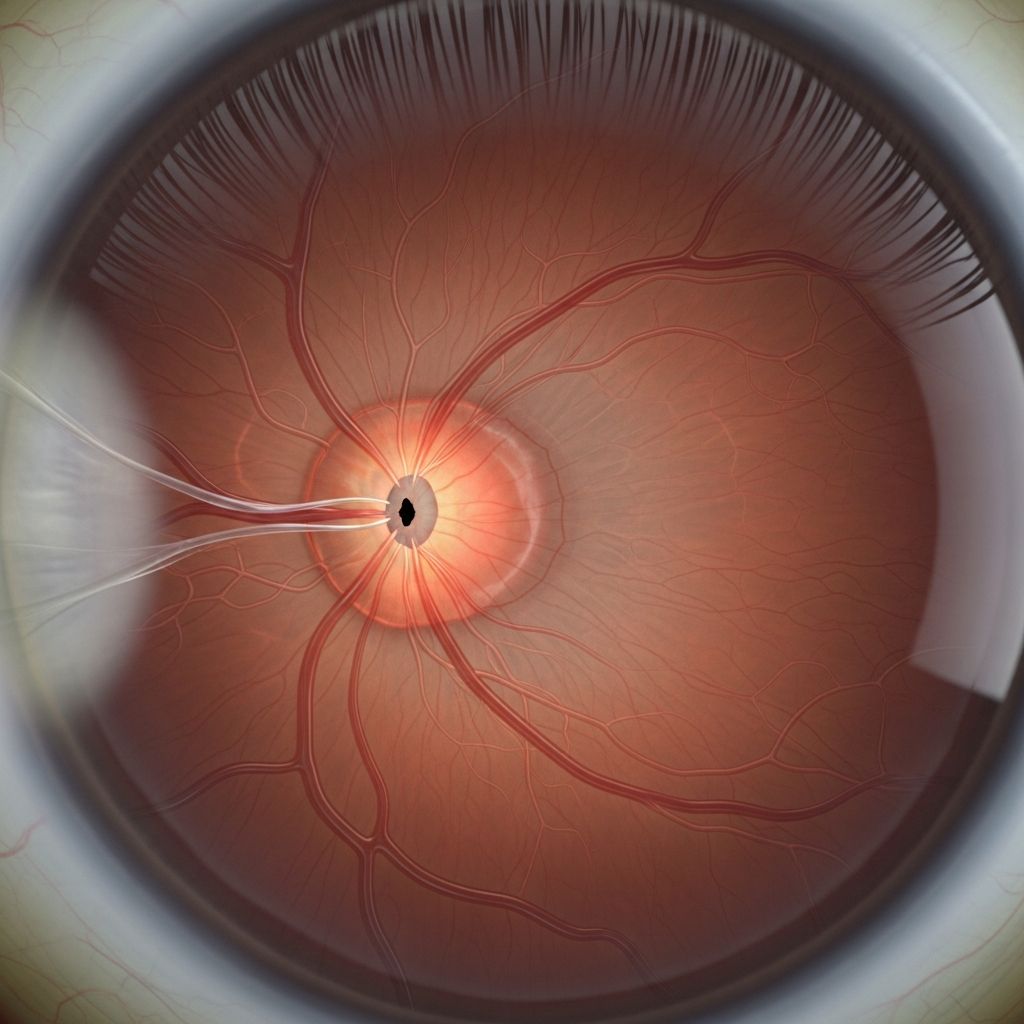
A macular hole represents a critical break in the macula, the specialized region at the center of the retina responsible for detailed, sharp vision. This condition develops when a small opening forms in this vital tissue, typically causing progressive blurring and distortion of the central visual field. While relatively uncommon, macular holes significantly impact daily activities such as reading, driving, and recognizing faces, making early recognition and intervention essential for preserving functional vision.
Anatomy and Function of the Macula
The macula occupies a small but critically important area within the retina, a light-sensitive layer of tissue at the back of the eye. Within this region, nerve cells are densely packed together, allowing for the precise visual acuity necessary for detailed tasks. The fovea, located at the center of the macula, contains the highest concentration of specialized photoreceptor cells called cones, which enable color vision and fine detail perception.
The retina functions by capturing light and converting it into electrical signals that travel through the optic nerve to the brain. The macula is responsible for approximately 30 percent of the retina’s nerve fibers, despite occupying less than one percent of the retina’s surface area. This disproportionate concentration of neural tissue underscores why even small defects in the macula produce noticeable vision problems.
How Macular Holes Develop: The Role of Vitreous Changes
The mechanism behind macular hole formation primarily involves age-related changes in the vitreous humor, the clear gel-like substance that fills the eye and maintains its spherical shape. Understanding this process provides insight into why the condition predominantly affects older individuals.
In youth, the vitreous is firmly attached to the retinal surface throughout the eye. As individuals age, the vitreous undergoes chemical changes, causing it to shrink and gradually separate from the retinal tissue. This natural process, called vitreous detachment or posterior vitreous detachment (PVD), occurs in virtually everyone as they grow older.
In most people, this detachment proceeds without incident. However, in some cases, the vitreous remains abnormally adherent to the macula. As the vitreous continues to shrink, it exerts tangential and anteroposterior traction on the macular tissue, pulling and stretching the delicate retinal cells. This persistent pulling can exceed the structural capacity of the retina, resulting in a small tear that expands into a full-thickness hole.
Risk Factors and Population Characteristics
While macular holes can theoretically develop in anyone, certain demographic and clinical factors increase susceptibility:
- Age: Macular holes predominantly affect individuals aged 60 to 80, with incidence increasing with advancing age
- Biological sex: Women experience macular holes more frequently than men
- High myopia: Individuals with severe nearsightedness face elevated risk, as the elongated eyeball structure may predispose the macula to traction
- Ocular trauma: Direct eye injuries can occasionally trigger macular hole formation
- Other conditions: Macular pucker (epiretinal membrane), diabetic retinopathy, and retinal detachment increase susceptibility
Interestingly, genetic factors, environmental exposures, and systemic diseases do not appear to play significant roles in idiopathic macular hole development, with the vast majority of cases occurring without an identifiable preceding cause.
Related Stories



Recognizing the Symptoms
Macular holes typically present with a characteristic pattern of visual symptoms that progress from subtle to pronounced. Recognition of early warning signs enables timely medical consultation and intervention.
Early Stage Manifestations
Initial symptoms are often mild and may be overlooked by patients. In the earliest phases, individuals report slight blurring or haziness of straight-ahead vision. Metamorphopsia, the distortion of straight lines, becomes apparent as lines that should be straight (such as text, grid patterns, or architectural elements) appear wavy, bowed, or bent.
Reading difficulties represent a hallmark early symptom, as patients struggle to focus on small print or experience text that appears jumbled or misaligned. Some individuals describe difficulty with fine detail work or notice that numbers and letters seem to shift position as they scan across a page.
Notably, these early symptoms may appear suddenly overnight or develop gradually over weeks or months. Some patients remain unaware of the problem until they cover the unaffected eye and recognize the vision loss in the symptomatic eye.
Advanced Stage Symptoms
As the macular hole enlarges, visual symptoms become more pronounced. Patients develop awareness of a dark spot, gray area, or black patch in the absolute center of their vision—the area directly in front of the eye where they are trying to focus. This central scotoma (blind spot) appears to move with the patient’s gaze, remaining centered in the visual field.
The size and precise location of the hole determine the extent of vision loss. Larger holes produce more extensive scotomas and greater functional impairment. Despite the central vision loss, patients retain their peripheral vision, preventing total blindness.
Diagnostic Approach and Staging
Accurate diagnosis requires specialized ophthalmologic examination using advanced imaging technology. Optical coherence tomography (OCT) provides cross-sectional images of the retina, allowing visualization of the hole’s size, depth, and structural characteristics.
Macular holes are classified into stages based on size and morphological features. Stage 1 holes measure less than 250 micrometers and may be associated with a yellowish injury at the fovea. Stage 2 holes range from 250 to 400 micrometers in size, while Stage 3 holes exceed 400 micrometers. Most Stage 2 holes progress to Stage 3, with vision declining further at each stage.
Advanced cases may exhibit a grayish macular rim suggesting subretinal fluid accumulation and retinal pigment epithelial changes at the hole’s base. The posterior hyaloid (the back portion of the vitreous membrane) may appear detached from the macula, sometimes with a residual tissue fragment called an operculum overlying the defect.
Treatment Approaches and Surgical Intervention
Treatment strategies depend on the hole’s stage, size, and impact on functional vision. Early-stage, small holes may be observed with serial imaging, as some demonstrate spontaneous closure. However, most macular holes, particularly those in Stage 2 or beyond, require surgical intervention to prevent further vision loss and promote anatomical closure.
Vitreoretinal surgery represents the gold standard treatment. The procedure involves removing the vitreous gel (vitrectomy) and any abnormally adherent vitreous membrane, eliminating the traction responsible for the hole’s persistence. Surgeons often place a gas bubble or silicone oil bubble in the eye to support retinal reattachment while the hole heals.
Following surgery, patients must maintain specific head positioning, keeping the bubble pressing against the macular hole for optimal healing. Positioning requirements typically last one to two weeks, depending on the gas used. Visual recovery is gradual, often requiring several weeks to months for maximum improvement.
Visual Outcomes and Realistic Expectations
Surgical treatment successfully closes macular holes in the majority of cases, particularly when performed early. However, patients should understand that vision, while improved, typically does not return to pre-hole levels. Some persistent distortion, mild blurriness, or subtle visual artifacts may remain despite successful anatomical closure.
Factors influencing visual recovery include the hole’s duration before treatment, its size, and the degree of retinal thinning or photoreceptor loss. Holes detected and treated promptly generally demonstrate more favorable visual outcomes than those treated after extended symptomatic periods.
Important Considerations and Complications
While surgical treatment offers substantial benefits, patients should be aware of potential complications. These may include infection, bleeding, retinal detachment, or cataract formation. Additionally, some eyes may require additional procedures if the hole reopens or fails to close completely.
Patients with macular holes should avoid activities that increase intraocular pressure and should follow all postoperative instructions meticulously, particularly regarding positioning requirements, to maximize healing potential.
When to Seek Medical Attention
Immediate or urgent ophthalmologic consultation is warranted if vision symptoms develop suddenly, particularly if accompanied by flashing lights, floaters (small objects appearing to drift across vision), or rapid vision fading, which may indicate retinal detachment rather than simple macular hole.
Any persistent blurring, distortion, or difficulty reading should prompt a scheduled appointment with an eye care provider for comprehensive evaluation.
Frequently Asked Questions
Can a macular hole heal on its own?
Most macular holes do not spontaneously close without intervention. While very small Stage 1 holes may occasionally close spontaneously, larger holes typically require surgical repair to restore anatomical integrity and prevent continued vision decline.
Will a macular hole cause complete blindness?
No. Even with an untreated macular hole, patients retain peripheral vision. The condition affects central vision only, leaving the outer visual field intact. This distinction is crucial for patient counseling.
Can macular holes occur in both eyes?
While uncommon, bilateral macular holes can develop, though typically at different times rather than simultaneously. If a patient has had a macular hole in one eye, careful monitoring of the fellow eye is warranted.
What is the recovery timeline after surgery?
Initial healing occurs within the first one to two weeks, during the critical positioning period. However, visual improvement continues for several weeks to months as the eye heals completely and the brain adapts to improved central vision.
References
- Macular Hole: Symptoms, Causes, & Treatment — Cleveland Clinic. 2024. https://my.clevelandclinic.org/health/diseases/14208-macular-hole
- Macular Hole — American Academy of Ophthalmology (EyeWiki). 2024. https://eyewiki.org/Macular_Hole
- Macular hole — ICR Ophthalmology Center. 2024. https://icrcat.com/en/eye-conditions/macular-hole/
- Macular Hole – Patients — American Society of Retinal Specialists. 2024. https://www.asrs.org/patients/retinal-diseases/4/macular-hole
- Macular hole — Macular Disease Foundation Australia. 2024. https://www.mdfoundation.com.au/about-macular-disease/other-macular-conditions/macular-hole/
- Macular Hole — National Eye Institute, National Institutes of Health. 2024. https://www.nei.nih.gov/eye-health-information/eye-conditions-and-diseases/macular-hole
- Macular Hole — National Health Service (NHS). 2024. https://www.nhs.uk/conditions/macular-hole/
Similar Articles








Read full bio of medha deb