Maculopapular Cutaneous Mastocytosis Pathology
Detailed histopathological analysis of maculopapular cutaneous mastocytosis, including mast cell distribution, morphology, and diagnostic criteria.
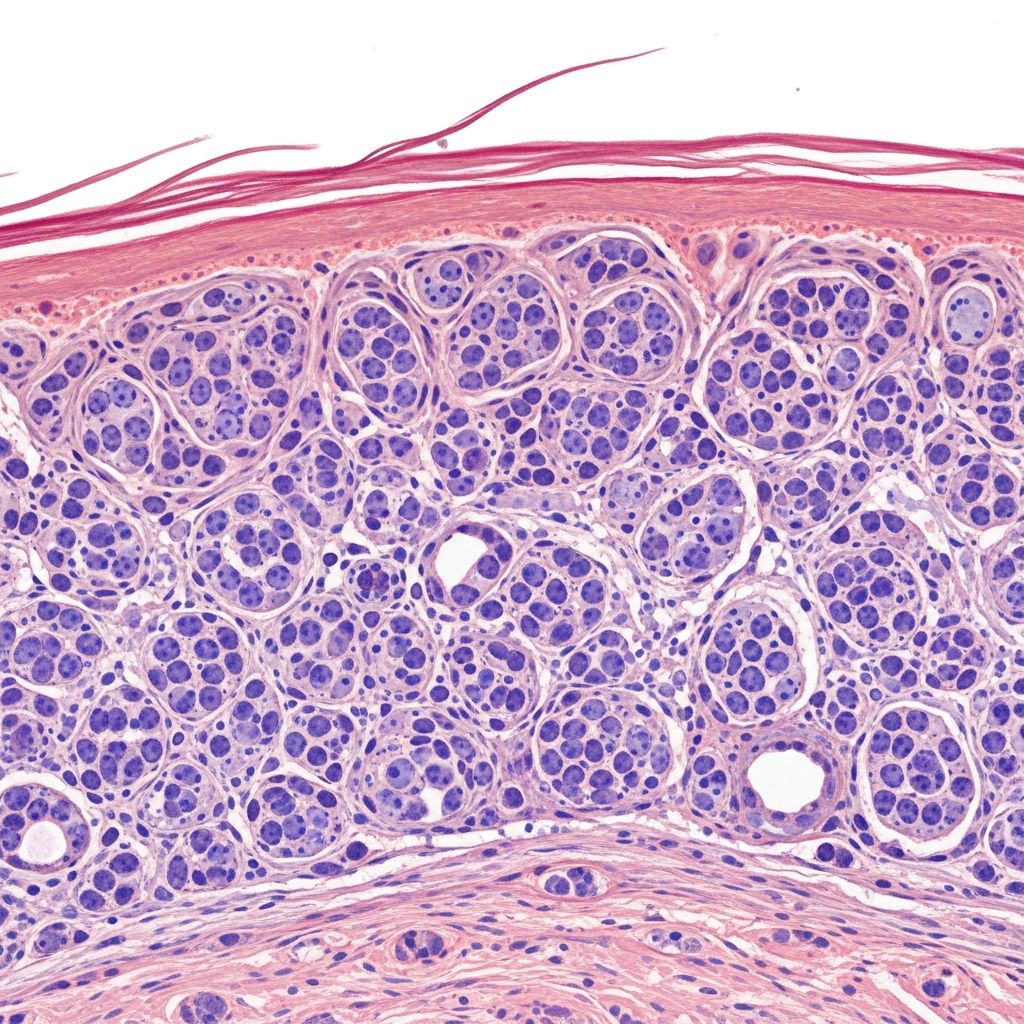
Author: Dr Anthony Yung, Dermatologist, Hamilton, New Zealand. Chief Editor: Dr Amanda Oakley, Dermatologist, Hamilton, New Zealand. February 2024.
Introduction
Maculopapular cutaneous mastocytosis (MPCM), also known as urticaria pigmentosa, represents the most prevalent form of cutaneous mastocytosis. This condition arises from the abnormal accumulation of mast cells within the dermal layer of the skin, manifesting clinically as characteristic tan to brown macules and papules. These lesions are typically present from infancy and may exhibit the Darier sign, where mechanical stroking or rubbing induces urtication due to mast cell degranulation.
Histopathologically, MPCM is defined by perivascular and interstitial aggregates of mast cells in the papillary and reticular dermis. The World Health Organization (WHO) classifies cutaneous mastocytosis into subtypes including maculopapular cutaneous mastocytosis, diffuse cutaneous mastocytosis, and mastocytoma of skin. MPCM is subdivided into monomorphic and polymorphic variants, with the former more common in adults and associated with potential systemic involvement.
Understanding the pathology is crucial for distinguishing MPCM from other dermatoses and assessing for extracutaneous disease, particularly in persistent adult-onset cases. This article delves into the microscopic features, immunohistochemical profiles, mast cell quantification, and differential diagnostic considerations.
Clinical features
Lesions of MPCM appear as multiple yellowish-tan to reddish-brown macules and papules, symmetrically distributed across the trunk, extremities, neck, and occasionally the face and scalp. In infants, lesions emerge within the first few months of life, initially mistaken for insect bites or nevi. They progressively increase in number and may blister upon friction, leading to systemic symptoms like irritability if widespread degranulation occurs.
In children, the polymorphic variant predominates, featuring larger, more varied lesions that often resolve spontaneously by adolescence. Adult-onset MPCM tends toward the monomorphic type, with smaller, uniform papules that persist indefinitely and carry a higher risk of systemic mastocytosis. Triggers such as heat, friction, medications, and insect stings can provoke mast cell mediator release, resulting in pruritus, flushing, hypotension, or anaphylaxis.
Pathology
Microscopic features
Skin biopsies from MPCM lesions reveal a superficial and deep perivascular infiltrate composed predominantly of mast cells, admixed with lymphocytes, histiocytes, and occasional eosinophils. Mast cells exhibit variable morphology: in early or polymorphic lesions, they are spindle-shaped with elongated nuclei and scant cytoplasm; mature forms are round with abundant granular cytoplasm.
The papillary dermis often shows edema, increased melanin in basal keratinocytes, and dilated capillaries. In monomorphic adult MPCM, mast cells form tight interstitial clusters extending into the reticular dermis, contrasting with the periadnexal distribution in normal skin or inflammatory dermatoses.
Mast cell distribution patterns
According to Wolff et al., four histologic patterns of mast cell distribution are recognized in cutaneous mastocytosis:
- Perivascular: Mast cells cluster around superficial vascular plexuses in the papillary dermis.
- Periadnexal: Aggregation around hair follicles and sweat glands, mimicking normal skin.
- Diffuse interstitial: Scattered throughout the dermis, typical of adult monomorphic MPCM.
- Band-like: Dense subepidermal band, rare and associated with aggressive forms.
Related Stories



Non-papillary dermal predominance in pediatric cases correlates with monomorphic MPCM and increased systemic mastocytosis risk.
Mast cell quantification
Quantitative assessment is pivotal for diagnosis. Normal skin harbors <75 mast cells/mm², while inflammatory dermatoses average 7–93/mm². MPCM thresholds are:
| Condition | Mast Cells/mm² (Range) | Specificity |
|---|---|---|
| Normal skin | <75 | – |
| Inflammatory dermatoses | 7–93 (median 7–89) | – |
| Polymorphic MPCM (children) | 121–821 | High |
| Monomorphic MPCM (adults) | >139–250 | 95% (>139) |
| Definite CLM | >250 | Diagnostic |
Counts are higher in sun-exposed areas, lower extremities, and upper dermis. Pediatric lesions show significantly elevated numbers compared to adults.
Special stains and immunohistochemistry
Mast cells are optimally visualized with Giemsa or toluidine blue stains, highlighting metachromatic granules. Immunohistochemistry employs:
- CD117 (c-KIT): Membrane staining of >15–20 mast cells in aggregates confirms diagnosis.
- Trypatase: Cytoplasmic staining, quantifies total mast cells.
- CD25: Aberrant expression indicates neoplastic mast cells in systemic mastocytosis.
- CD30: Expressed in aggressive variants.
Mutations in KIT gene (D816V) are detected via PCR in lesional skin or bone marrow for systemic evaluation.
WHO classification
The WHO recognizes cutaneous mastocytosis (CM) as a distinct entity from systemic mastocytosis (SM). CM subtypes include:
- Maculopapular CM (MPCM): Polymorphic (pediatric) vs. monomorphic (adult).
- Diffuse CM: Erythrodermic skin infiltration.
- Mastocytoma: Solitary or few nodules.
SM requires one major (multifocal BM aggregates) and one minor criterion (KIT mutation, aberrant expression), or three minor criteria. Skin lesions in SM-ISM (indolent SM) are typically monomorphic MPCM.
Differential diagnosis
- Mast cell-rich inflammatory conditions: Lower mast cell counts (<100/mm²), periadnexal distribution.
- Urticaria: Transient edema without aggregates.
- Lentigo simplex: Epidermal hyperpigmentation sans infiltrate.
- Mastocytic sarcoma: Dense sheets, atypia, mitoses.
- Drug eruptions: Eosinophil predominance.
Investigations
Diagnosis relies on clinicopathologic correlation. Biopsy is indicated for atypical or adult-onset lesions. Systemic workup (serum tryptase, 24h urine methylhistamine, BM biopsy) if B symptoms, organomegaly, or elevated tryptase.
Treatment
Most pediatric cases regress spontaneously; symptomatic relief includes:
- H1/H2 antihistamines for pruritus.
- Topical corticosteroids for localized lesions.
- Phototherapy (NB-UVB) for extensive disease.
- Tyrosine kinase inhibitors (midostaurin) for advanced SM.
Avoid mast cell degranulators: NSAIDs, opioids, vancomycin, radiocontrast. Epinephrine auto-injectors for anaphylaxis risk.
Frequently asked questions
Q: When is a skin biopsy necessary for MPCM?
A: Biopsy confirms diagnosis in atypical presentations, adult-onset, or suspected systemic involvement via mast cell counts and IHC.
Q: What mast cell count supports MPCM diagnosis?
A: >139/mm² has 95% specificity; >250/mm² is diagnostic.
Q: Does adult MPCM always indicate systemic disease?
A: No, but monomorphic variant warrants tryptase and BM evaluation.
Q: Can MPCM resolve completely?
A: Yes, 90% of childhood cases fade by puberty.
References
- Maculopapular cutaneous mastocytosis — DermNet NZ (Dr Amanda Oakley, Dr Anthony Yung). 2024-03. https://dermnetnz.org/topics/maculopapular-cutaneous-mastocytosis
- Cutaneous Lesions of Mastocytosis: Mast Cell Count, Distribution, Morphology, and Ancillary Studies — The American Journal of Dermatopathology (Wolters Kluwer). 2023-10. https://www.binasss.sa.cr/bibliotecas/bhm/oct23/7.pdf
- Mastocytosis — World Health Organization Classification of Tumours (Pathology and Genetics). 2022. https://publications.iarc.who.int/Book-And-Report-Series/Who-Classification-Of-Tumours/Myeloid-Neoplasms-And-Acute-Leukemia-2022
- Guidelines for diagnosis and treatment of cutaneous mastocytosis — Journal of the European Academy of Dermatology and Venereology. 2023-05. https://doi.org/10.1111/jdv.19087
- Systemic mastocytosis: a concise clinical review — American Journal of Hematology (Wiley). 2024-01. https://onlinelibrary.wiley.com/doi/10.1002/ajh.26948
Similar Articles








Read full bio of Sneha Tete