Maggot Debridement Therapy: 6 Essential Uses
Discover how sterile maggots revolutionize wound care by cleaning necrotic tissue, fighting infection, and promoting healing in chronic wounds.
What is maggot debridement therapy?
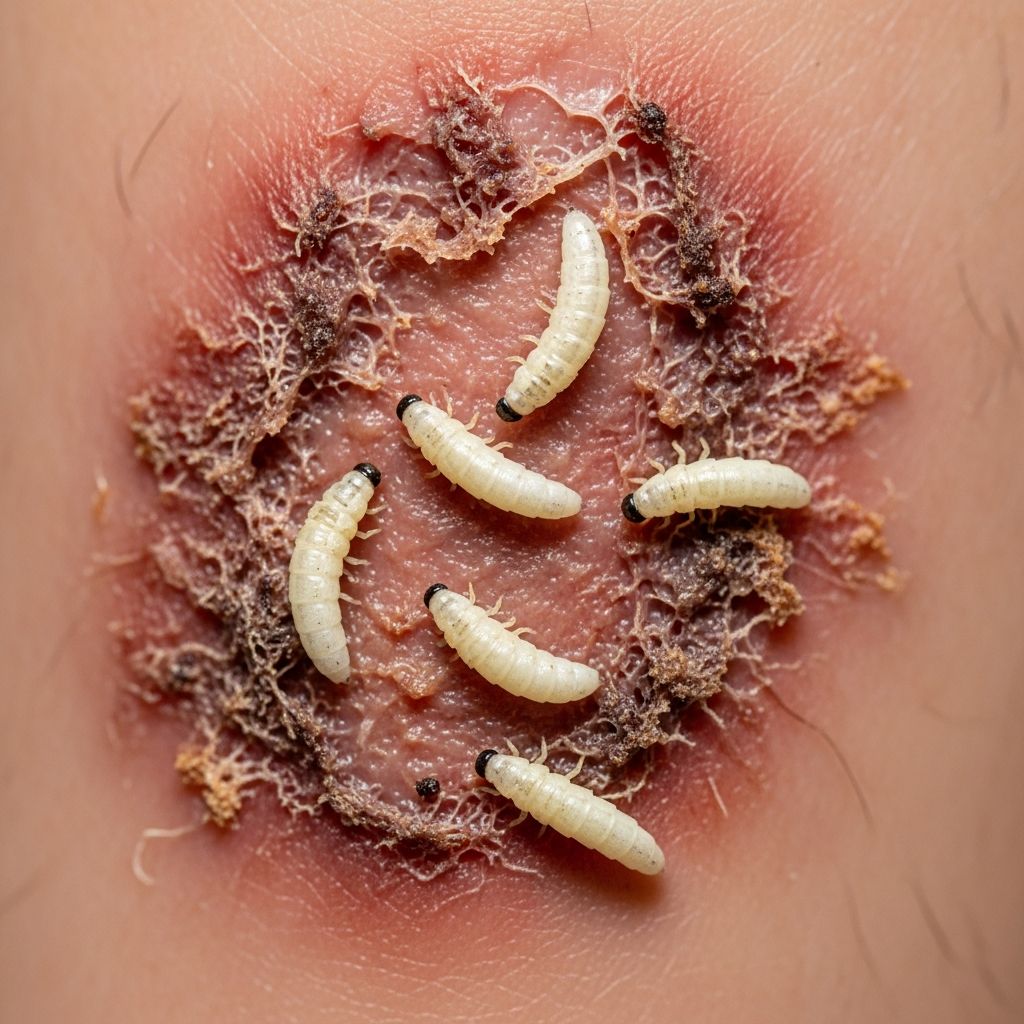
Maggot debridement therapy (MDT), also known as larval therapy, maggot therapy, or biosurgery, is a biotherapeutic treatment that introduces specially bred, sterile larvae (maggots) of the green bottle fly (Lucilia sericata, also called Phaenicia sericata) into non-healing skin and soft tissue wounds. These medical-grade maggots selectively consume necrotic (dead) tissue, eliminate bacteria, and promote wound healing without damaging healthy tissue.
MDT has ancient origins, with records of its use dating back to Mayan civilizations and documented by surgeons during the Napoleonic Wars and World War I, where wounds containing maggots showed faster healing and less infection. In the 1930s, American surgeon William Baer pioneered its modern use for osteomyelitis. The therapy fell out of favor with the advent of antibiotics but resurged in the 1980s–1990s amid rising antibiotic resistance and chronic wounds. Today, MDT is FDA-approved in the US (since 2004 as a medical device) and widely used in Europe, Australia, and New Zealand for wounds unresponsive to conventional treatments.
Who is maggot debridement therapy suitable for?
MDT is indicated for chronic, non-healing wounds containing necrotic tissue, slough, or biofilm, particularly when surgical debridement is contraindicated or has failed. Common applications include:
- Diabetic foot ulcers: Reduces amputation risk by rapidly cleaning deep, infected ulcers.
- Pressure ulcers: Effective for stage III/IV wounds with eschar or slough.
- Venous leg ulcers: Clears sloughy debris to enable compression therapy.
- Post-surgical wounds: Manages dehiscence or infection.
- Traumatic wounds: Including burns, necrotizing fasciitis residuals, and animal bites.
- Veterinary use: Proven in horses, dogs, and cats for lacerations, abscesses, and fractures.
Patients with large surface-area wounds (>100 cm²) or deep cavities benefit most, as maggots access undermined areas surgically inaccessible. MDT is suitable for outpatient or home use, cost-effective (often cheaper than hospitalization), and safe for most adults, including the elderly and immunocompromised.
How does maggot debridement therapy work?
Maggots exert four key actions via mechanical feeding, enzymatic secretions, and excretions:
- Debridement: Maggots ingest necrotic tissue at 4–12 mg/hour per larva, liquefying it with proteases (trypsin, chymotrypsin, collagenase). A dose of 100 maggots debrides ~50 g of tissue in 24–72 hours, precisely sparing healthy tissue due to pH-sensitive enzymes.
- Disinfection: Larvae ingest >50 bacterial species (e.g., MRSA, Pseudomonas), killing them in their alkaline gut (pH 8–9). Secretions contain antimicrobial peptides, allantoin, urea, phenylacetic acid, and NH₃, raising wound pH to inhibit bacterial growth.
- Biofilm disruption: Proteases and mechanical action break down protective bacterial biofilms, common in chronic wounds.
- Healing stimulation: Growth factors increase angiogenesis, collagen synthesis, fibroblast proliferation, and nitric oxide. Wound pH normalization and reduced inflammation accelerate granulation and epithelialization.
| Action | Mechanism | Benefit |
|---|---|---|
| Debridement | Ingestion + enzymes | Cleans wound bed in 1–3 days |
| Disinfection | Antibacterial secretions + gut digestion | Reduces bioburden by 10,000x |
| Biofilm eradication | Proteases | Exposes bacteria to antibiotics |
| Healing promotion | Growth factors, pH change | 50% faster granulation |
Studies confirm MDT debrides 2–5x faster than hydrogels and reduces hospital stays by 20–50%.
What are the advantages of maggot debridement therapy?
- Selective: Removes only dead tissue, unlike surgical methods.
- Outpatient-friendly: Applied in clinics; patients report returning to work sooner.
- Cost-effective: ~$100–200/course vs. $10,000+ for surgery/hospitalization.
- Antibiotic-sparing: Effective against resistant bacteria, preserving systemic drugs.
- High success rate: 70–90% debridement in 1 cycle; limb salvage in 60–80% diabetic cases.
Related Stories



Preparation for maggot debridement therapy
Assess wound: Confirm necrosis/slough/biofilm via clinical exam or swab. Obtain informed consent, addressing maggot sensation and odor. Contraindications include dry eschar (no substrate), active arteritis, or patient refusal. Prep wound: Irrigate with saline; no antiseptics (harms maggots). Train patient/caregiver on application/removal.
Methods of maggot debridement therapy
Two FDA-approved techniques use LB-01 strain P. sericata maggots (5–8 mg each, lab-sterilized):
- Free-range (open): 50–100 maggots/10 cm² scattered on wound. Cover with absorbent gauze (e.g., Mesalt); secure with tape. Ideal for shallow, broad wounds.
- Contained (bag): Maggots in permeable polyacrylate-hydrogel bag (BioBag). Sutured over wound; prevents migration. Best for deep/cavity wounds.
Dosage: 5–8/cm² surface area; x depth (cm) for cavities. E.g., 5×10 cm ulcer = 250–400 maggots. Apply for 24–72 hours max (maggots grow 10x, liquify tissue).
Procedure for maggot debridement therapy
- Day 1: Clean wound; apply maggots. Cover loosely. Patient feels ‘ticking’ (normal).
- 24–48h: Monitor seepage (liquefied debris). Change outer dressing prn.
- Removal: Irrigate with saline/pulse-lavage. Remove all larvae (they detach easily). Black specks = dead maggots (discard).
- Repeat: Reassess; reapply 2–4x until granulating.
Home kits available; nurses supervise weekly.
What happens after maggot debridement therapy?
Post-removal: Wound shows pink granulation. Apply standard dressings (e.g., foam, silver if infected). Healing accelerates 30–50%; transition to skin grafts/compression if needed. Monitor for recurrence. Full course: 1–6 weeks.
Clinical outcomes of maggot debridement therapy
Meta-analyses show MDT doubles debridement speed vs. controls, heals 40% wounds in 8 weeks (vs. 30%), and cuts amputations by 50% in diabetes. Veterinary: 100% healing in refractory equine wounds. Success: 80–95% in venous ulcers.
Complications of maggot debridement therapy
MDT is safe; <5% complications:
- Common: Transient stinging (10–20%), serous ooze, healthy tissue maceration if overhydrated.
- Rare: Allergic reactions (<1%), secondary infection, maggot escape (<2% with bags).
- Patient distress: Odor (ammonia-like), wriggling sensation; mitigated by education.
No systemic sepsis reported in 1000s of cases.
Alternatives to maggot debridement therapy
| Method | Pros | Cons |
|---|---|---|
| Surgical | Fast for large areas | Painful, bleeding, anesthesia |
| Enzymatic (papain-urea) | Non-invasive | Slow, expensive, irritant |
| Hydrogel/autolytic | Painless | Very slow (weeks) |
| NPWT | Cleans + heals | Costly, contraindicated in infection |
MDT excels in selectivity and biofilms.
Frequently asked questions (FAQs) in maggot debridement therapy
What wounds is maggot therapy used for?
Chronic ulcers (diabetic, venous, pressure), surgical wounds, trauma, and infected burns.
Does maggot therapy hurt?
Mild stinging possible initially; most tolerate well with paracetamol.
Can patients shower with maggots?
Yes, with waterproof cover; no bathing.
How long do maggots stay in the wound?
24–72 hours per cycle; 2–5 cycles total.
Is maggot therapy covered by insurance?
Often yes (US Medicare); check locally.
Are maggots painful to remove?
No; they detach easily with saline rinse.
References
- Maggot therapy – Wikipedia — Wikipedia contributors. 2023-10-15. https://en.wikipedia.org/wiki/Maggot_therapy
- Maggot debridement therapy as primary tool to treat chronic wound… — PMC (NCBI). 2016-05-25. https://pmc.ncbi.nlm.nih.gov/articles/PMC4864483/
- Maggot Debridement: An Alternative Method for Debridement – PMC — PMC (NCBI). 2011-07-01. https://pmc.ncbi.nlm.nih.gov/articles/PMC3136394/
- Maggot therapy: Uses, how it works, and more — Medical News Today. 2023-08-20. https://www.medicalnewstoday.com/articles/maggot-therapy
- Maggot debridement therapy: utility in chronic wounds and a… — Cambridge Media Journals. 2018-09-01. https://journals.cambridgemedia.com.au/wpr/volume-26-number-3/maggot-debridement-therapy-utility-chronic-wounds-and-perspective-beyond
- Maggot therapy – Chelsea and Westminster Hospital — Chelsea and Westminster Hospital NHS. 2022-01-01. https://www.chelwest.nhs.uk/your-visit/patient-leaflets/tissue-viability/maggot-therapy
Similar Articles








Read full bio of Sneha Tete