Majocchi Granuloma: Symptoms, Diagnosis & Treatment Guide
Deep fungal folliculitis caused by dermatophytes: symptoms, causes, diagnosis, and effective treatments explained.
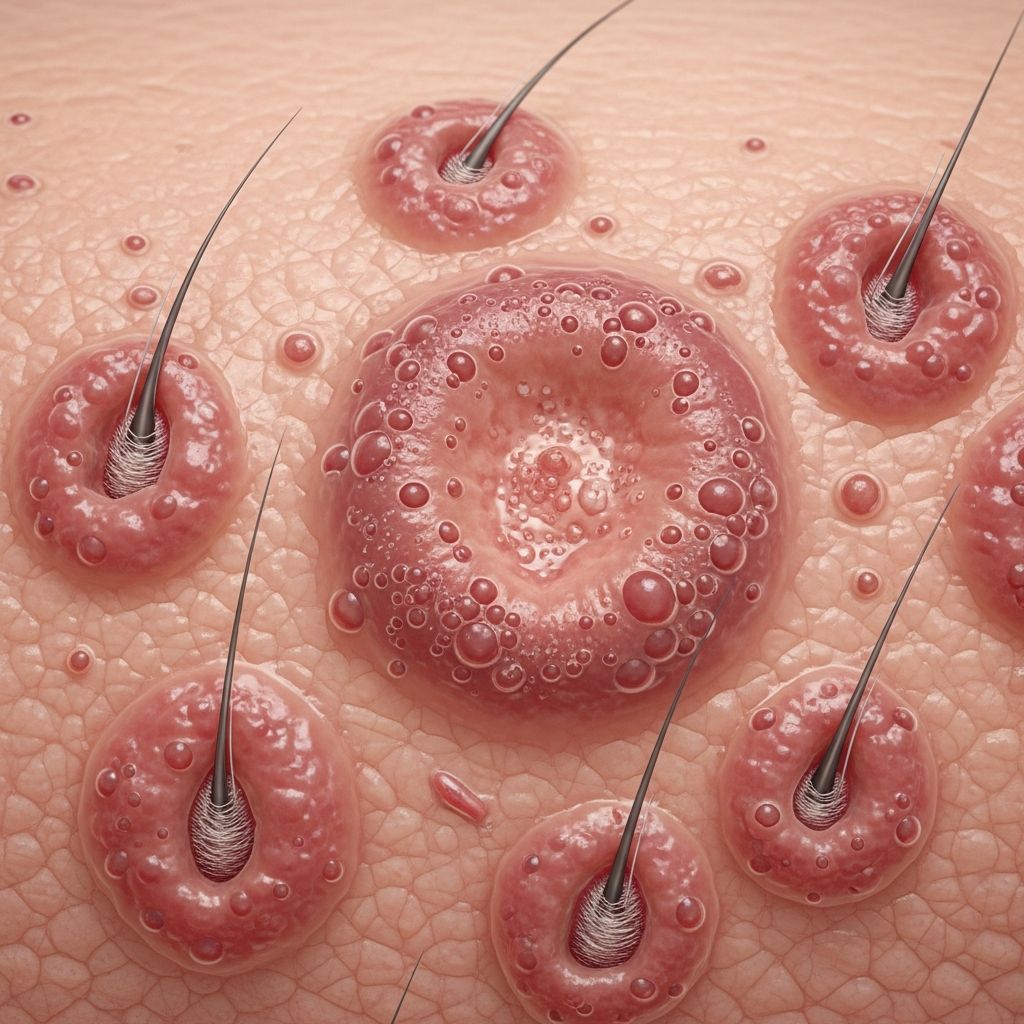
Majocchi granuloma, also known as granuloma trichophyticum, is a rare deep fungal infection characterized by suppurative and granulomatous folliculitis, where dermatophytes invade hair follicles and the dermis.
Introduction
Majocchi granuloma represents a deeper form of tinea corporis, progressing beyond the superficial stratum corneum to involve hair follicles and subcutaneous tissue. First described by Italian dermatologist Domenico Majocchi in 1883, it manifests as persistent inflammatory lesions due to fungal penetration triggered by trauma or immunosuppression.
This condition differs from common superficial ringworm by its dermal involvement, leading to granulomatous inflammation. It affects individuals worldwide but is more prevalent in adults from developing countries, often on lower extremities.
Who gets Majocchi granuloma and why?
Majocchi granuloma primarily impacts adults, with higher incidence in developing regions. Various predisposing factors facilitate fungal entry into deeper skin layers:
- Trauma to hair follicles, such as shaving, waxing, or tight clothing, especially on legs in women.
- Immunosuppression from conditions like HIV, diabetes, or medications (e.g., corticosteroids, chemotherapy).
- Prolonged use of topical steroids on undiagnosed tinea infections, masking symptoms and promoting deeper invasion.
- Athletic activities involving skin-to-skin contact, like wrestling (tinea corporis gladiatorum).
- Chronic superficial dermatophytosis on buttocks, feet, or nails spreading subcutaneously.
In healthy individuals, perifolliculitis form predominates on lower limbs due to minor trauma. Immunocompromised patients develop nodular subcutaneous forms, often on upper limbs.
Causes
The infection arises when dermatophytes disrupt infected hair follicles, allowing hair shafts and hyphae to penetrate the dermis. Keratinophilic fungi thrive on introduced keratin.
Common causative organisms:
- Trichophyton rubrum (most frequent, >95% of cases).
- Trichophyton mentagrophytes, Trichophyton verrucosum, Microsporum canis, Aspergillus species (less common).
Anthropophilic fungi like T. rubrum are primary culprits, with non-dermatophytes rare. Progression from superficial tinea corporis occurs via follicular invasion.
Clinical features
Majocchi granuloma presents as irregular red, scaly plaques with perifollicular papules, pustules, and nodules. Lesions are typically solitary on one lower leg but can cluster.
- Perifolliculitis form: Small pink/red papules or pustules (0.5 cm) around follicles, scaly center, peripheral pustules; common on extremities.
- Subcutaneous nodular form: Plaques (3-10 cm), nodules, hyperpigmented with scaling; seen in immunosuppressed.
Symptoms include itching, tenderness; hairs pluck easily from pustules. Sites: lower legs (most common), forearms, abdomen, face (recent trend), upper limbs.
In wrestlers, it mimics persistent plaques from tinea gladiatorum. Differential includes bacterial folliculitis, eosinophilic folliculitis, or other granulomas.
Diagnosis
Diagnosis combines clinical suspicion with laboratory confirmation, as superficial scrapings may miss deep infection.
| Method | Description | Findings |
|---|---|---|
| KOH Microscopy | Skin scrapings, hair plucking | Hyphae (often negative due to depth) |
| Fungal Culture | Samples from lesions | Dermatophyte identification (e.g., T. rubrum) |
| Histopathology | Skin biopsy | Perifollicular granulomatous inflammation, lymphohistiocytic infiltrate, PAS/Grocott-positive hyphae in dermis/follicles |
| Molecular PCR | Tissue/culture | Speciation if culture inconclusive |
Biopsy is gold standard, showing destroyed follicles with fungal elements. Negative stains do not rule out.
Related Stories



Treatment
Oral antifungals are essential due to poor topical penetration; continue 4-8 weeks until resolution.
| Agent | Dose/Duration | Notes |
|---|---|---|
| Terbinafine | 250 mg daily, 4-8 weeks | Preferred: effective, safe for dermatophytes |
| Itraconazole | 200 mg daily, 4-8 weeks | Alternative; good for T. rubrum |
| Griseofulvin | 500-1000 mg daily, 4-8 weeks | Historical option |
| Topicals (adjunct) | Clotrimazole, etc. | Insufficient alone |
Monitor LFTs with systemic therapy. Historical treatments (iodide, X-ray) obsolete. Relapse rare with full course; combine with addressing predispositions.
Frequently Asked Questions
What is Majocchi granuloma?
A deep fungal folliculitis from dermatophytes invading dermis via hair follicles, causing pustular nodules.
Who is at risk?
Adults with leg trauma, topical steroid users, immunocompromised; common in developing countries.
How does it look?
Red scaly plaques with perifollicular pustules/nodules on legs; serpiginous bumps possible.
Is biopsy always needed?
Yes for confirmation, as it reveals dermal hyphae missed by scrapings.
How long is treatment?
4-8 weeks oral terbinafine/itraconazole until clearance; topicals inadequate.
Can it recur?
Rare if fully treated and predispositions managed; no robust data.
Is it contagious?
Like tinea, via contact, but deep form less so.
References
- Fungal folliculitis – Wikipedia — Wikipedia. 2023. https://en.wikipedia.org/wiki/Fungal_folliculitis
- Majocchi granuloma – DermNet — DermNet NZ. 2023-10-01. https://dermnetnz.org/topics/majocchi-granuloma
- Majocchi’s granuloma – Cosmoderma — Cosmoderma. 2023. https://cosmoderma.org/majocchis-granuloma/
- Majocchi’s granuloma: current perspectives — PubMed (Dermatol Ther). 2018-06. https://pubmed.ncbi.nlm.nih.gov/29861637/
- Majocchi’s Granuloma – Appalachian Spring Dermatology — WV Derm. 2023. https://wvderm.com/majocchiss-granuloma/
- Treating Rare Fungal Infections: Majocchi’s Granuloma — HMP Global Learning Network. 2023. https://www.hmpgloballearningnetwork.com/site/thederm/site/cathlab/event/treating-rare-fungal-infections-majocchis-granuloma
Similar Articles








Read full bio of Sneha Tete