Malakoplakia Of The Skin And Tongue: Diagnosis & Treatment
Rare inflammatory condition affecting skin and tongue due to defective macrophage response to bacterial infection, often E. coli.
What is malakoplakia?
Malakoplakia (from Greek: malako meaning soft + plakion meaning plaque) is a rare chronic granulomatous inflammatory condition characterized by soft plaques or tumor-like masses in various organs. It most commonly affects the urinary bladder (over 70% of cases) but can involve the gastrointestinal tract, lungs, bones, and rarely the skin or tongue. Cutaneous malakoplakia represents less than 5% of reported cases, while tongue involvement is exceptionally uncommon, with fewer than 20 documented instances worldwide.
The condition arises from a defective immune response where macrophages (histiocytes) phagocytose bacteria but fail to fully digest them due to impaired lysosomal activity. This leads to accumulation of bacterial debris, forming characteristic intracellular inclusions. A key biochemical defect is reduced levels of cyclic guanosine monophosphate (cGMP), impairing bacterial killing.
Who gets malakoplakia?
Malakoplakia predominantly affects individuals with compromised immune systems, occurring in approximately 40% of cases associated with immunosuppression. Risk factors include:
- Organ transplantation (renal, hepatic, cardiac) with immunosuppressive therapy
- Hematological malignancies (leukemia, lymphoma)
- Acquired immunodeficiency syndrome (AIDS)
- Chronic steroid use or other immunomodulators
- Diabetes mellitus
- Advanced age or debilitating diseases
Skin malakoplakia often occurs in adults over 40 years, with a female predominance in cutaneous forms. Tongue malakoplakia shows no clear immunosuppression link and affects both genders across ages, from children to the elderly, possibly with male predominance.
Causes of malakoplakia
Malakoplakia is triggered by bacterial infections, most commonly gram-negative rods. The primary pathogen is Escherichia coli (E. coli), identified in up to 75% of cases. Other implicated organisms include:
- Staphylococcus aureus
- Pseudomonas aeruginosa
- Klebsiella pneumoniae
- Proteus mirabilis
- Rhodococcus equi
- Corynebacterium species
These bacteria persist within macrophages due to defective phagolysosomal fusion and digestion. Partially degraded microbes calcify, forming diagnostic Michaelis-Gutmann bodies. Viral or fungal associations are rare.
Pathophysiology
The hallmark is macrophage dysfunction: histiocytes engulf bacteria but cannot eliminate them, leading to cytoplasmic accumulation of undigested material. Key features include:
- Von Hansemann cells: Enlarged, foamy macrophages stuffed with bacterial debris.
- Michaelis-Gutmann bodies: Pathognomonic laminated, basophilic inclusions (5-20 μm) containing calcium and iron. They stain positively with von Kossa (calcium), Prussian blue/Perls (iron), and PAS; appear as ‘owl’s eye’ on H&E.
A reduced cGMP/cAMP ratio in macrophages impairs microtubule function needed for phagolysosome formation. Chronic inflammation ensues, producing soft, plaque-like lesions.
Clinical features of malakoplakia of the skin
Cutaneous malakoplakia favors perianal, genital, and gluteal regions but can appear on abdomen, thighs, limbs, face, or trunk. Lesions are solitary or multiple, often following skin folds or Blaschko lines. Characteristics include:
- Soft, reddish-brown or yellow papules/nodules (0.5-3 cm)
- Plaque-like or tumorous masses
- Asymptomatic, pruritic, or painful
- Surface erosion, ulceration, or crusting
- Slow growth over weeks to months
In immunocompromised patients, lesions may disseminate or mimic malignancy/infection.
Clinical features of malakoplakia of the tongue
Related Stories



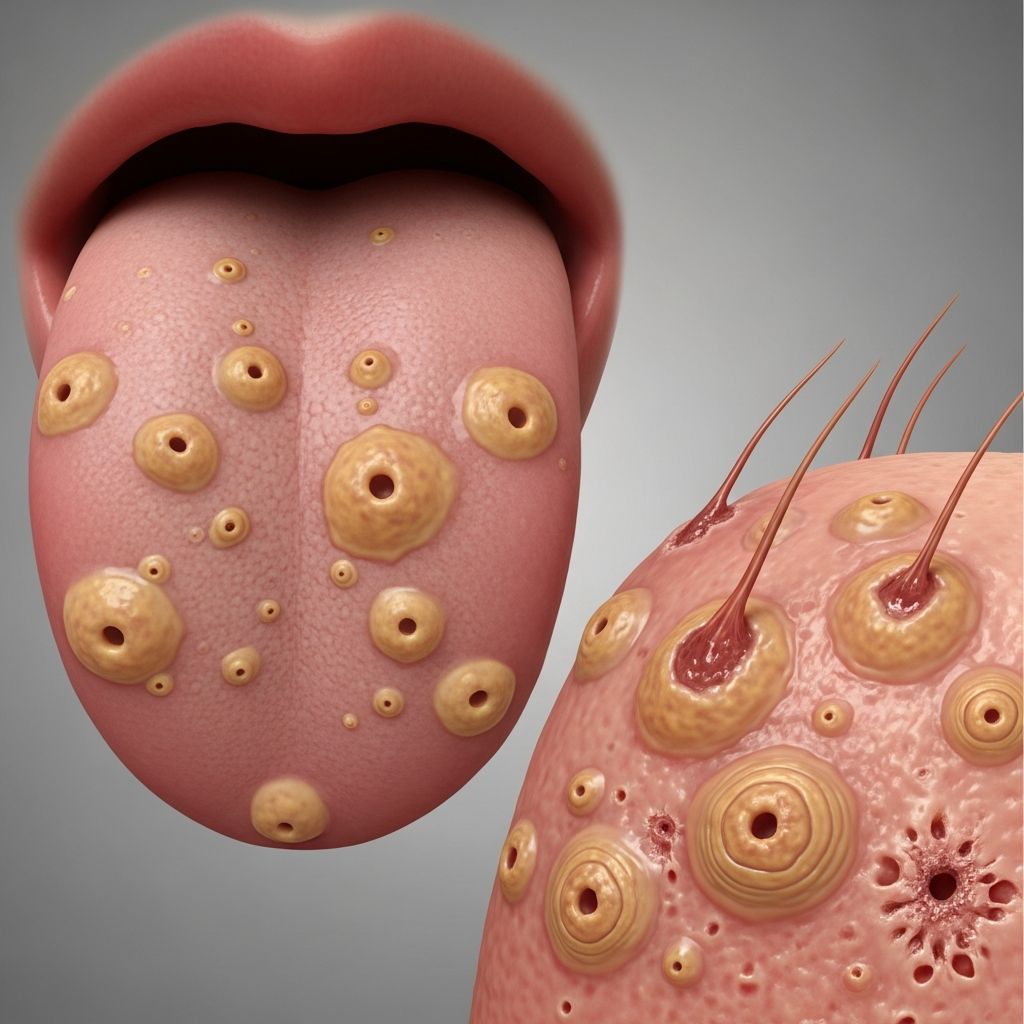
Tongue malakoplakia is exceedingly rare, presenting as a solitary soft mass at the base or lateral border. Symptoms include:
- Sensation of foreign body in throat
- Dysphagia (difficulty swallowing)
- Odynophagia (painful swallowing)
- Hoarseness or referred otalgia
Lesions measure 1-4 cm, appearing yellow-pink-tan, friable, and polypoid. Duration varies from days to months; no immunosuppression link noted.
Diagnosis
Diagnosis requires biopsy, as clinical appearance mimics carcinoma, infection, or granulomatous disease (e.g., TB, sarcoid). Key histopathological findings:
| Feature | Description | Stains |
|---|---|---|
| Von Hansemann cells | Foamy histiocytes with granular cytoplasm | H&E: basophilic inclusions |
| Michaelis-Gutmann bodies | Target/owl’s eye calcified bodies | Von Kossa (+), Perls (+), PAS (+) |
| Inflammatory infiltrate | Lymphocytes, plasma cells ± neutrophils | – |
Microbiology: Bacterial culture/swab for targeted antibiotics. Imaging (CT/MRI) assesses deeper involvement. Differential includes rhinosporidiosis, histoplasmosis, xanthogranuloma.
Treatment
Management combines surgery and antimicrobials. Isolated skin/tongue lesions have excellent prognosis; internal involvement worsens outlook.
- Surgical excision: Preferred for accessible lesions; curative if complete.
- Antibiotics: Prolonged (4-6 weeks) targeting cultured organism:
- Ciprofloxacin or trimethoprim-sulfamethoxazole (intracellular penetration)
- Alternatives: rifampicin, ampicillin
- Immunomodulators: Chloroquine/ascorbic acid to boost cGMP (limited evidence).
- Observation: Some spontaneous regressions reported.
Recurrence risk ~20-30%; monitor immunocompromised patients.
Prognosis
Localized cutaneous/oral malakoplakia resolves with treatment in >90% cases. Spontaneous remission occurs occasionally. Poor prognostic factors: multiorgan disease (25% skin cases), persistent immunosuppression, E. coli resistance. Fatal disseminated forms rare but reported in AIDS/transplant patients.
Frequently Asked Questions (FAQs)
Q: Is malakoplakia contagious?
A: No, it results from host immune dysfunction, not direct transmission.
Q: Can malakoplakia be cured?
A: Yes, localized forms respond well to excision and antibiotics; recurrence possible.
Q: What does malakoplakia look like on the tongue?
A: A soft, yellow-pink mass (up to 4 cm) causing swallowing difficulty.
Q: Who is at risk for skin malakoplakia?
A: Immunosuppressed patients, especially transplant recipients or those with malignancies.
Q: How is malakoplakia diagnosed?
A: By biopsy showing Michaelis-Gutmann bodies in von Hansemann cells.
Differential Diagnosis
- Malignancy (squamous cell carcinoma, lymphoma)
- Granulomatous infections (TB, fungi)
- Other histiocytoses (xanthoma, sarcoidosis)
- Rhinosporidiosis (tongue)
References
- Malakoplakia of the skin and tongue — DermNet NZ. 2023-10-15. https://dermnetnz.org/topics/malakoplakia-of-the-skin-and-tongue
- Malakoplakia — MD Searchlight. 2024-05-20. https://mdsearchlight.com/health/malakoplakia/
- Malakoplakia — MalaCards. 2025-01-10. https://www.malacards.org/card/malakoplakia
- Malakoplakia — Orphanet. 2024-08-01. https://www.orpha.net/en/disease/detail/556
- Malakoplakia: An Update on Pathophysiology and A Review — MDPub (Peer-reviewed). 2016-01-01. https://mdpub.net/fulltext/172-1555322016.pdf
Similar Articles








Read full bio of Sneha Tete