Male Pattern Hair Loss: 6 Effective Treatments For 2025
Understanding the causes, progression, and effective treatments for androgenetic alopecia in men.
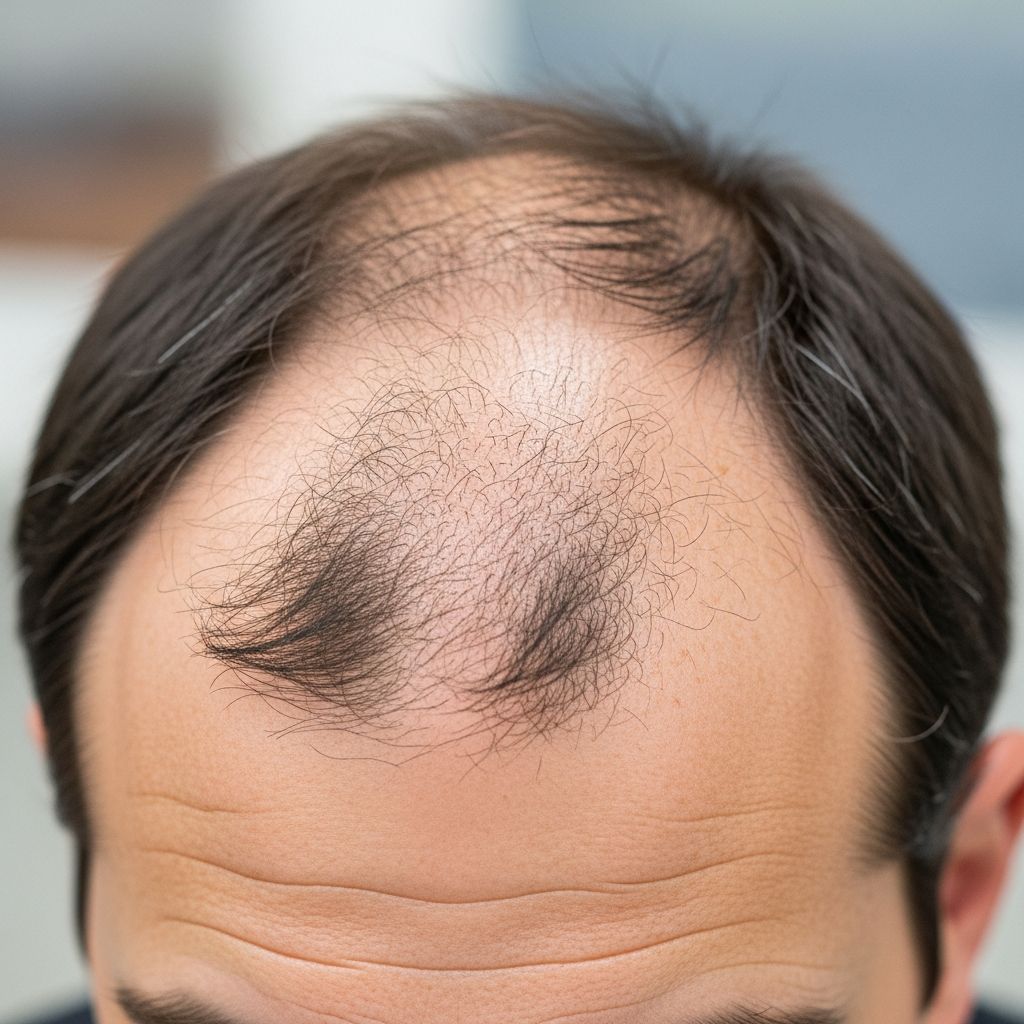
Male pattern hair loss, also known as
androgenetic alopecia
or commonbalding
, is the most prevalent type of diffuse hair thinning and balding affecting adult males. It is a progressive, genetically determined condition characterised by gradual hair loss from the frontal scalp, temporal regions, and vertex (crown), often resulting in a receding hairline and bald spot that may eventually merge.Introduction
Male pattern hair loss (MPHL) represents a non-scarring, progressive alopecia driven by androgen hormones and genetic predisposition. It typically manifests after puberty, with bi-temporal recession followed by vertex thinning, sparing the occipital and temporal sides, creating a characteristic ‘horseshoe’ pattern. While not medically harmful, it impacts psychosocial well-being for many men, prompting demand for effective interventions. Up to 80% of Caucasian men experience some degree by age 70.
Causes
The primary causes of MPHL involve a combination of
genetic susceptibility
andandrogenic hormones
, particularly dihydrotestosterone (DHT). Men genetically predisposed exhibit heightened sensitivity of scalp follicles in affected areas to DHT, leading to follicular dysfunction without systemic hyperandrogenism. Key mechanisms include:- Hormonal influence: DHT, derived from testosterone, binds to androgen receptors in follicles, triggering miniaturisation.
- Genetic factors: Polygenic inheritance from both parental lines, with over 389 loci identified, explaining ~39% of variance.
- Enzyme activity: 5-alpha-reductase converts testosterone to DHT.
Unlike other alopecias (e.g., telogen effluvium), MPHL shows no increased shedding but gradual thinning with miniaturised hairs.
The Hair Growth Cycle
Hair follicles cycle through three phases:
anagen
(growth, 2–6 years, 85–90% of scalp hairs),catagen
(transition, 2–3 weeks), andtelogen
(resting, 3 months, followed by shedding). In MPHL:- Anagen shortens dramatically from years to weeks/months.
- Telogen prolongs, reducing overall hair density.
- Affected follicles produce progressively finer, shorter vellus hairs instead of thick terminal hairs.
This dysregulated cycle, androgen-dependent in susceptible follicles, underlies the visible progression.
Hair Miniaturisation
**Hair miniaturisation** is the hallmark histopathological feature of MPHL, where terminal hairs (70–100 μm diameter) progressively shrink to vellus-like hairs (<30 μm) over successive cycles. DHT shortens anagen, leading to smaller follicles incapable of producing robust hair shafts. Clinical signs include:
- Thinning at vertex and frontal scalp.
- Increased scalp visibility.
- Miniaturised hairs visible on trichoscopy (hair pull test shows >10% telogen hairs).
Miniaturisation spares occipital follicles, which lack DHT sensitivity.
Role of DHT
Dihydrotestosterone (**DHT**) is the principal mediator, exerting paracrine effects via androgen receptors (AR) in the dermal papilla. DHT:
- Induces follicular regression by upregulating TGF-β and downregulating growth factors like IGF-1.
- Shortens anagen and promotes catagen/telogen.
- Causes perifollicular fibrosis in advanced cases.
Scalp DHT levels are elevated in balding areas despite normal serum androgens, due to local 5-alpha-reductase activity.
Role of 5-Alpha-Reductase
The enzyme
5-alpha-reductase
(types 1 and 2) catalyses testosterone to DHT. Type 2 predominates in scalp and prostate; genetic variations increase activity in MPHL. Inhibitors like finasteride target type 2, reducing scalp DHT by 60–70% and halting progression.Related Stories



Role of Heredity and Genetics
MPHL is
highly heritable
(polygenic, h² ~0.79), with genome-wide studies identifying 389 loci, including the X-linked AR/EDA2R (strongest association). Inheritance is from both parents; maternal pattern was overstated historically. Prediction models achieve 60–83% accuracy for severity/early onset.Prevalence
MPHL affects nearly all men eventually, with rates varying by ethnicity and age:
| Population | Prevalence by Age 50 | By Age 70 |
|---|---|---|
| Caucasian | ~50% | ~80% |
| Japanese/Chinese | <25% | Lower |
| Black | ~40% | High |
Onset averages age 30 but can start post-puberty; severity increases with age.
A Cosmetic Issue?
Though benign, MPHL causes significant
psychological distress
, reducing quality of life, self-esteem, and increasing anxiety/depression risk, comparable to chronic diseases. It prompts treatments for cosmetic restoration, as untreated progression leads to permanent follicular loss.Treatment
Early intervention maximises outcomes; FDA-approved options stabilise or regrow hair in 60–80% of users.
Topical Minoxidil
**Minoxidil** 2–5% solution/foam prolongs anagen via vasodilation and growth factors. Apply twice daily; efficacy peaks at 1 year (30–40% regrowth). Side effects: scalp irritation (5%). Oral low-dose emerging.
Oral Finasteride/Dutasteride
**Finasteride** 1 mg/day inhibits 5α-reductase, reducing DHT; 86% halt loss, 65% regrow at 2 years. Rare sides: sexual dysfunction (<2%, reversible).
Dutasteride
more potent (off-label).Low-Level Laser Therapy (LLLT)
LLLT devices stimulate follicles via photobiomodulation; moderate evidence for density increase.
Hair Transplant Surgery
Follicular unit extraction (FUE/FUT) relocates DHT-resistant occipital hairs; natural results, but costly and requires stabilisation first.
Platelet-Rich Plasma (PRP)
Injections deliver growth factors; adjunctive, with variable efficacy.
Emerging Therapies
Anti-androgens, JAK inhibitors, microneedling under trial. Combination therapy optimal.
Frequently Asked Questions
What causes male pattern hair loss?
Genetic sensitivity to DHT shortens hair growth cycles and miniaturises follicles.
At what age does it start?
Often post-puberty, peaking around 30; progresses lifelong.
Can it be reversed?
Early treatment with minoxidil/finasteride halts/reverses in most; advanced cases require surgery.
Is it only from the mother’s side?
No, polygenic from both parents.
Does stress cause it?
No, unlike telogen effluvium; it’s androgenetic.
References
- Male pattern hair loss (androgenetic alopecia, balding) — DermNet NZ. 2023. https://dermnetnz.org/topics/male-pattern-hair-loss
- Male-pattern hair loss: Comprehensive identification of the genetic basis — NIH/PMC. 2024-01-15. https://pmc.ncbi.nlm.nih.gov/articles/PMC10842561/
- Hair loss – normal or hereditary — Healthify NZ. 2023. https://healthify.nz/health-a-z/h/hair-loss-normal-or-hereditary
- Androgenetic Alopecia (Male) — The London Skin and Hair Clinic. 2024. https://thelondonskinandhairclinic.com/androgenetic-alopecia-male/
- A Guide to Androgenetic Alopecia — Healthgrades. 2023. https://resources.healthgrades.com/right-care/skin-hair-and-nails/androgenetic-alopecia
- Male baldness — RACGP Australian Family Physician. 2016-04-01. https://www.racgp.org.au/afp/2016/april/male-baldness
Similar Articles








Read full bio of medha deb