Mammary Paget’s Disease: Symptoms, Diagnosis & Treatment
Understanding mammary Paget's disease: A rare breast cancer affecting the nipple and areola.
Mammary Paget’s Disease: Overview
Mammary Paget’s disease (also known as Paget’s disease of the breast) is a rare form of breast cancer that originates in the nipple and areola. This condition involves distinctive tumor cells called Paget cells present within the outermost layer of skin (epidermis) of the nipple. The disease typically occurs in one breast only and may be accompanied by underlying ductal carcinoma in situ (DCIS) or invasive cancer within the breast tissue.
Understanding this rare condition is essential for early detection and appropriate management. Many individuals initially mistake the symptoms for benign inflammatory skin conditions, which can lead to significant diagnostic delays.
Clinical Presentation and Symptoms
Paget’s disease of the breast presents with characteristic clinical features that often resemble common skin conditions. Recognition of these symptoms is crucial for timely diagnosis.
Initial Skin Changes
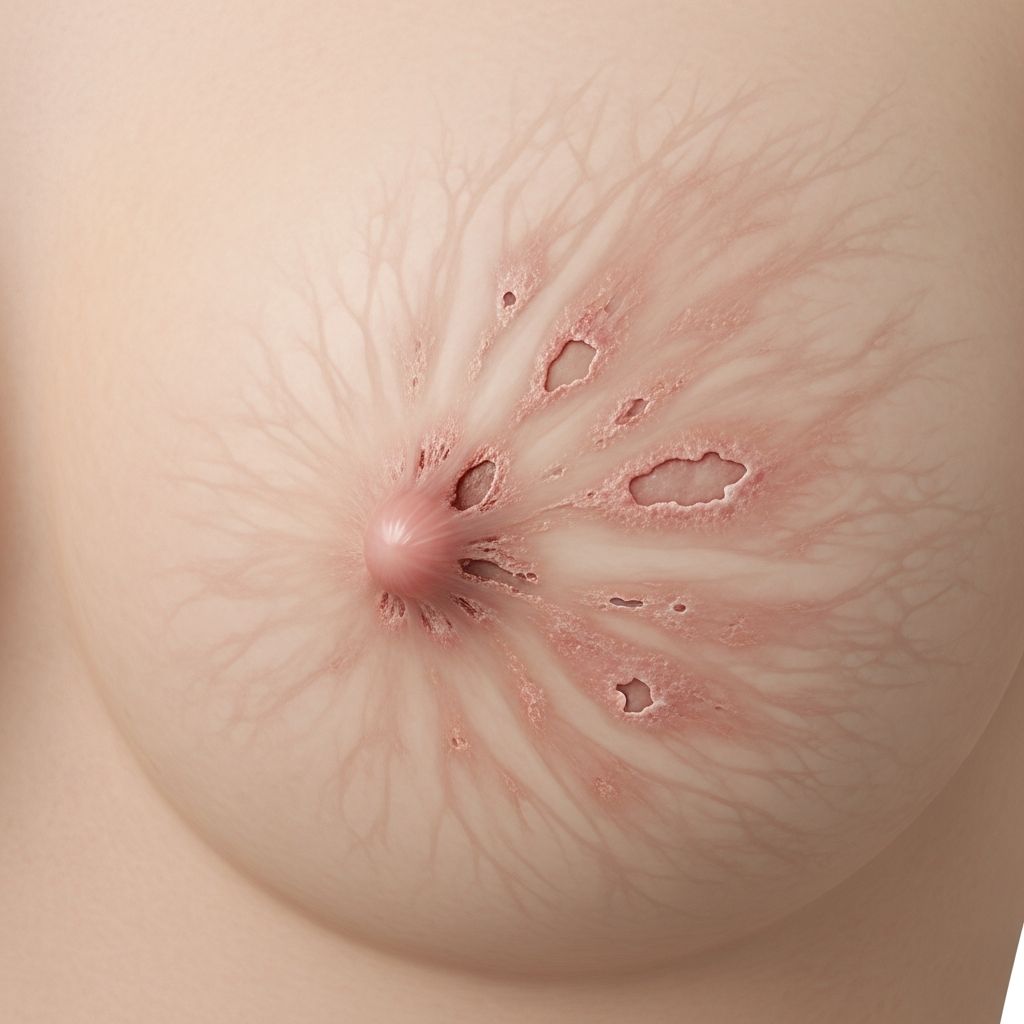
The characteristic skin manifestations typically begin on the nipple and may extend to the areola and surrounding breast tissue. Initial findings often include:
- Itching (pruritus) and burning sensations
- Scaling and crusting of the nipple
- Reddish (erythematous) patches or plaques
- Thickened or abnormally textured skin
- Flaky or scaly appearance resembling eczema
Advanced Symptoms
As the disease progresses, additional symptoms may develop:
- Nipple discharge that may be straw-colored or bloody
- Oozing or weeping lesions
- Nipple retraction or deformation
- Raw areas that fail to heal
- Soreness or pain of the affected area
- A palpable breast lump
- Thickening of breast tissue
- Destruction of the nipple-areola complex in severe cases
Diagnostic Delay
A significant challenge in managing Paget’s disease is diagnostic delay. The initial skin changes may appear relatively benign, and both patients and healthcare providers may attribute them to inflammatory conditions such as eczema or dermatitis. Topical treatments may temporarily improve the inflammatory component, further masking the underlying malignancy. This misdiagnosis can delay diagnosis by six months or longer.
Diagnostic Approach
Clinical Evaluation
Diagnosis begins with a thorough clinical examination and complete patient history. Healthcare professionals will specifically ask about:
- Specific skin changes observed on the nipple
- Presence of nipple discharge, bleeding, or abnormal sensations
- Duration and progression of symptoms
- Associated breast lumps or areas of thickening
- Breast pain or tenderness
- Factors that worsen or improve symptoms
Tissue Biopsy
Biopsy remains the gold standard for diagnosing Paget’s disease of the breast. A small sample of affected nipple tissue is removed and examined under a microscope to identify Paget cells. Different biopsy techniques include:
- Wedge biopsy: Most useful method as it adequately represents the epidermis and likely includes part of the lactiferous duct
- Punch biopsy: Uses a circular cutting tool to remove a small disk-shaped tissue sample
- Shave biopsy: Removes superficial epidermis; less useful as it may not contain sufficient Paget cells, particularly if the lesion surface is ulcerated
If nipple discharge is present, a cytologic smear may be performed to examine the discharge microscopically for cancerous cells.
Related Stories



Immunohistochemical Testing
Immunohistochemical stainings using markers such as carcinoembryonic antigen (CEA), mucin, or Her-2 oncoprotein may enhance diagnosis. However, negative immunohistochemical results do not exclude Paget’s disease, and open surgical biopsy remains the diagnostic standard.
Imaging Studies
Imaging is essential to detect underlying carcinoma and assess disease extent. Recommended imaging modalities include:
- Mammography: X-ray imaging of breast tissue used to detect masses, calcifications, or DCIS; however, it has limited sensitivity for detecting Paget’s disease and underlying DCIS
- Breast ultrasound: May provide additional detail about breast tissue and identify suspicious areas
- Magnetic resonance imaging (MRI): Advanced imaging technique to create detailed breast images and determine if underlying cancer is present
If imaging identifies a suspicious lesion, a needle biopsy of that area may be recommended.
Sentinel Node Biopsy
After diagnosis confirmation, a sentinel node biopsy may be performed to identify the first lymph nodes into which a tumor drains. This involves using a harmless dye and weak radioactive solution to locate these nodes, which are then removed and tested for cancer.
Treatment Options
Surgical Management
Surgery is the primary treatment modality for Paget’s disease of the breast. The approach depends on disease extent and whether underlying breast cancer is present.
- Breast-conserving surgery (lumpectomy): Removal of the nipple, areola, and surrounding affected tissue. The entire nipple-areola complex must be removed to ensure complete tumor elimination. Breast-conserving surgery followed by appropriate adjuvant therapy is an acceptable option for carefully selected patients
- Total mastectomy: Complete removal of the entire breast. This option is acceptable for carefully selected patients and may be preferred when extensive underlying cancer is present
Adjuvant Therapies
Following surgery, additional treatments may be recommended based on cancer characteristics and stage:
- Radiation therapy: May be recommended depending on the type of surgery performed and to reduce recurrence risk
- Chemotherapy: May be administered to treat invasive cancer or high-risk disease
- Hormone therapy: May be used if the cancer is hormone receptor-positive
Treatment Individualization
Treatment recommendations depend on several factors, including whether cancer is confined to the nipple or extends into breast tissue, the presence and extent of underlying DCIS or invasive carcinoma, lymph node involvement, and overall patient health status.
Prognosis and Outcomes
Early identification and treatment of Paget’s disease significantly improve outcomes. Many individuals achieve full recovery with appropriate surgical intervention. The prognosis depends on whether cancer extends beyond the nipple-areola complex and the stage of any underlying breast cancer.
Differential Diagnosis
Paget’s disease of the breast is frequently confused with other dermatologic conditions, leading to diagnostic delays. Conditions that may resemble Paget’s disease include:
- Eczema or atopic dermatitis
- Contact dermatitis
- Psoriasis
- Infectious conditions (bacterial or fungal)
- Other inflammatory skin disorders
The key distinguishing feature is the presence of Paget cells on histologic examination.
Clinical Significance and Follow-up
Paget’s disease of the breast represents early-stage breast cancer of the milk ducts occurring in the nipple. Most individuals with this condition have concurrent cancer within the breast tissue, necessitating thorough staging and imaging evaluation.
After treatment, regular follow-up is essential to monitor for recurrence. Follow-up should include clinical breast examinations and imaging studies as recommended by the treating oncologist and surgeon.
Frequently Asked Questions
Q: Is Paget’s disease of the breast the same as Paget’s disease of bone?
A: No. Paget’s disease of the breast is a type of skin cancer affecting the nipple and areola, while Paget’s disease of bone is a separate metabolic bone disorder. These are two distinct conditions unrelated to each other.
Q: Why is diagnosis often delayed?
A: Diagnosis is frequently delayed because the initial symptoms resemble benign inflammatory skin conditions such as eczema or dermatitis. Additionally, topical treatments may temporarily improve symptoms, masking the underlying malignancy. Many individuals overlook early skin changes, sometimes delaying diagnosis by six months or more.
Q: Can Paget’s disease affect both breasts?
A: Typically, Paget’s disease affects only one breast. Bilateral involvement is extremely rare.
Q: What is the relationship between Paget’s disease and underlying breast cancer?
A: Most individuals with Paget’s disease of the breast have concurrent cancer within the breast tissue itself, either as ductal carcinoma in situ (DCIS) or invasive cancer. This is why imaging and thorough evaluation of the entire breast are essential components of diagnosis and treatment planning.
Q: Is breast-conserving surgery always possible?
A: Breast-conserving surgery (lumpectomy) followed by radiation therapy is an acceptable option for carefully selected patients. However, the extent of disease, presence of underlying malignancy, and individual patient factors determine whether this approach is appropriate. Some patients may require total mastectomy.
Q: What symptoms should prompt evaluation for Paget’s disease?
A: Any persistent nipple symptoms—including crusting, scaling, discharge, itching, or burning sensations that do not respond to standard eczema treatment—warrant evaluation. Early medical consultation for nipple changes significantly improves diagnostic and treatment outcomes.
References
- Paget’s Disease of the Breast – Symptoms, Causes, Treatment — National Organization for Rare Disorders (NORD). https://rarediseases.org/rare-diseases/pagets-disease-of-the-breast/
- Practical Consensus Recommendations for Paget’s Disease in Breast — PubMed Central/NIH. https://pmc.ncbi.nlm.nih.gov/articles/PMC5909301/
- Paget’s Disease of the Breast – Symptoms & Causes — Mayo Clinic. https://www.mayoclinic.org/diseases-conditions/pagets-disease-of-the-breast/symptoms-causes/syc-20351079
- Paget Disease of the Breast: Symptoms, Treatment, and Diagnosis — Breast Cancer Organization. https://www.breastcancer.org/types/paget-disease
- Paget’s Disease of the Breast – Diagnosis & Treatment — Mayo Clinic. https://www.mayoclinic.org/diseases-conditions/pagets-disease-of-the-breast/diagnosis-treatment/drc-20351084
- Paget’s Disease of the Breast: Stages, Symptoms & Prognosis — Cleveland Clinic. https://my.clevelandclinic.org/health/diseases/17913-pagets-disease-of-the-breast
- Paget Disease of the Breast — National Cancer Institute (NCI). https://www.cancer.gov/types/breast/breast-cancer-types/paget-disease-breast
Similar Articles








Read full bio of medha deb