CMV Retinitis: Diagnosis, Treatment, And Follow-Up Guide
Comprehensive strategies for diagnosing, treating, and preventing cytomegalovirus retinitis in immunocompromised patients to preserve vision.
Cytomegalovirus (CMV) retinitis represents a serious ocular threat primarily to individuals with weakened immune systems, such as those living with advanced HIV/AIDS. This condition arises when the CMV virus invades the retina, potentially leading to blindness if not addressed promptly. Effective management hinges on a combination of antiviral medications, immune system restoration through antiretroviral therapy (ART), and vigilant monitoring by eye care specialists.
Understanding the Pathophysiology of CMV Retinitis
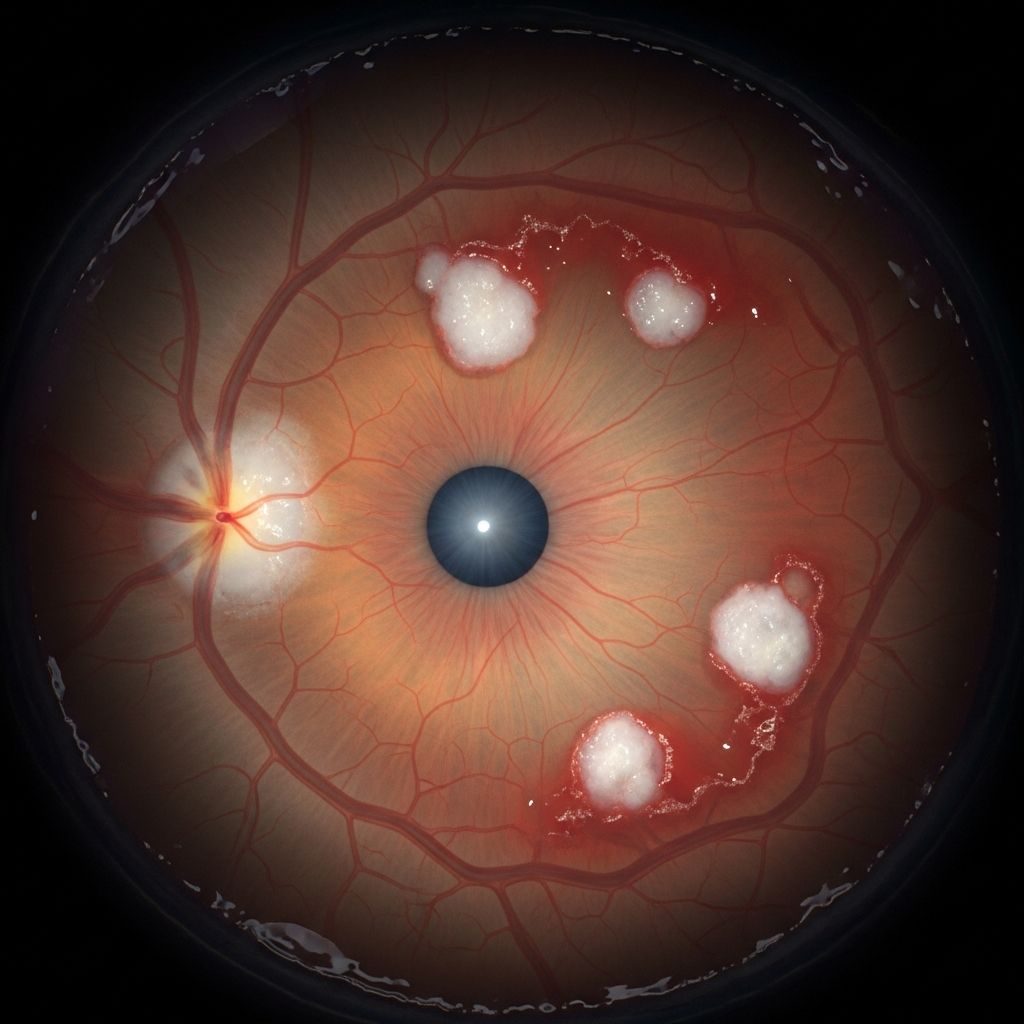
CMV, a member of the herpesvirus family, remains latent in most healthy people after initial infection. In immunocompromised hosts, particularly when CD4 counts drop below 50 cells/µL, the virus reactivates and targets the retina. It causes necrotizing inflammation, starting peripherally and progressing toward the central vision areas like the macula and optic nerve. Early lesions appear as white, granular patches with trailing hemorrhages, earning the description of ‘pizza pie’ retinopathy.
The retina’s vulnerability stems from its rich blood supply and proximity to the vitreous humor, allowing viral spread. Without intervention, progression can occur rapidly, with peripheral lesions advancing 0.5-1 disc diameter per week. Zone 1 disease, involving the posterior pole within 1.5 mm of the fovea or optic disc, demands immediate action to avert irreversible vision loss.
Diagnostic Approaches for Accurate Identification
Diagnosis begins with a comprehensive dilated fundus examination using indirect ophthalmoscopy. Fundus photography and fluorescein angiography help delineate lesion extent and activity. Optical coherence tomography (OCT) reveals retinal thickening and edema, while wide-field imaging tracks peripheral involvement.
Confirmatory tests include aqueous or vitreous PCR for CMV DNA, offering high sensitivity and specificity. Blood CMV PCR monitors viral load but is less specific for retinitis. In HIV patients, low CD4 counts strongly suggest CMV as the etiology, though differentials like toxoplasma chorioretinitis or syphilitic retinitis must be ruled out via serology or imaging.
- Key diagnostic tools: Indirect ophthalmoscopy for lesion visualization.
- PCR from ocular fluids for viral confirmation.
- OCT for macular assessment.
- Fundus autofluorescence to detect active inflammation.
Primary Treatment Modalities: Systemic Antivirals
Systemic therapy forms the cornerstone of CMV retinitis management, aiming to suppress viremia and halt retinal progression. Oral valganciclovir, a prodrug of ganciclovir, is the preferred first-line agent due to its bioavailability and outpatient convenience. Induction dosing involves 900 mg twice daily for 21 days, followed by 900 mg daily maintenance.
Intravenous ganciclovir serves as an alternative for severe cases or poor oral tolerance: 5 mg/kg every 12 hours for 14-21 days induction, then 5 mg/kg daily maintenance. It requires hospitalization initially but effectively controls disseminated disease.
| Therapy | Induction Regimen | Maintenance Regimen | Key Side Effects |
|---|---|---|---|
| Valganciclovir (oral) | 900 mg BID x 21 days | 900 mg daily | Myelosuppression, neutropenia |
| Ganciclovir (IV) | 5 mg/kg q12h x 14-21 days | 5 mg/kg daily | Bone marrow suppression, catheter risks |
| Foscarnet (IV) | 90 mg/kg BID x 14 days | 90-120 mg/kg daily | Nephrotoxicity, electrolyte imbalance |
| Cidofovir (IV) | 5 mg/kg weekly x 2-3 weeks | 5 mg/kg every 2 weeks | Nephrotoxicity, uveitis |
Foscarnet and cidofovir are reserved for ganciclovir intolerance or resistance. Foscarnet dosing is 90 mg/kg twice daily for induction, with renal monitoring essential. Cidofovir, administered weekly initially then biweekly, necessitates probenecid and hydration to mitigate kidney damage.
Related Stories



Local Therapies for Immediate Vision Protection
For sight-threatening Zone 1 lesions, intravitreal injections provide rapid local drug levels. Ganciclovir 2 mg/0.1 mL or foscarnet 2.4 mg/0.1 mL is injected twice weekly for the first two weeks alongside systemic therapy. These bridge the gap until systemic agents take effect, with risks including endophthalmitis, retinal detachment, and cataract.
Surgical options like the ganciclovir intraocular implant release drug over 6-8 months, ideal for unilateral disease or non-ART candidates. However, implants carry higher complication rates and do not address contralateral eye or systemic CMV.
Role of Antiretroviral Therapy in Long-Term Control
ART is pivotal, restoring CD4 counts and enabling immune recovery, which controls CMV without lifelong antivirals. Initiate ART promptly after starting anti-CMV therapy, targeting viral suppression. Immune recovery uveitis (IRU), a complication of rising CD4 counts, manifests as vitritis or cystoid macular edema, managed with corticosteroids and continued antivirals.
Discontinuation criteria include inactive retinitis, CD4 >100 cells/µL (or +50 from baseline) for 3-6 months, and at least three months of therapy. Monitor quarterly with dilated exams post-discontinuation.
Addressing Drug Resistance and Relapse
Resistance arises from UL97 or UL54 mutations, affecting 20-30% of cases on long-term ganciclovir. Suspect if progression occurs despite therapy. Switch to foscarnet or cidofovir; combination regimens or emerging agents like letermovir and maribavir show promise for refractory disease.
Relapse management involves reinduction, dose escalation, or agent switch. Most effective prevention is sustained ART adherence, reducing relapse to 0.03 per person-year in immune-recovered patients.
Potential Complications and Their Management
Anti-CMV drugs cause myelosuppression (ganciclovir), nephrotoxicity (foscarnet, cidofovir), and infusion reactions. Ocular risks include rhegmatogenous retinal detachment (25-40% lifetime risk), treated surgically with vitrectomy and laser.
IRU requires topical/systemic steroids, avoiding cidofovir due to heightened risk. Persistent macular edema may need intravitreal steroids or anti-VEGF, balanced against reactivation potential.
- Monitoring schedule: Weekly initially for Zone 1, biweekly for Zone 2, monthly for peripheral disease.
- Lab checks: CBC, renal function, CMV PCR.
Patient Education and Follow-Up Protocols
Educate on adherence, symptom reporting (floaters, vision loss), and ART compliance. Multidisciplinary care involving ophthalmologists, infectious disease experts, and HIV specialists optimizes outcomes. Regular fundus exams detect subclinical progression.
Prognosis improves with early intervention: 80-90% achieve remission with combined therapy. Untreated, bilateral blindness occurs in months.
Frequently Asked Questions (FAQs)
What is the first sign of CMV retinitis?
Peripheral vision loss or floaters, often painless, progressing centrally if untreated.
Can CMV retinitis be cured?
Not cured, but controlled indefinitely with therapy and immune recovery.
Is intravitreal injection painful?
Mild discomfort with topical anesthesia; rare serious complications.
When can anti-CMV drugs be stopped?
After inactive disease, CD4 >100 for 3-6 months, on stable ART.
How does HIV treatment help CMV retinitis?
Rebuilds immunity, allowing viral suppression without chronic antivirals.
Future Directions in CMV Retinitis Care
Emerging oral agents like letermovir target terminase complexes, bypassing common resistances. Gene therapies and vaccines hold potential for prevention. Personalized regimens based on viral genotyping promise better efficacy with fewer side effects.
In summary, timely diagnosis, aggressive induction therapy, ART integration, and vigilant follow-up form the bedrock of CMV retinitis management, safeguarding vision in vulnerable populations.
References
- Cytomegalovirus: clinical features and management — PMC – NIH. 2020-04-27. https://pmc.ncbi.nlm.nih.gov/articles/PMC7205174/
- CMV Retinitis — EyeWiki. Recent update. https://eyewiki.org/CMV_Retinitis
- CMV retinitis — Johns Hopkins HIV Guide. Recent update. https://www.hopkinsguides.com/hopkins/view/Johns_Hopkins_HIV_Guide/545041/all/CMV_retinitis
- Cytomegalovirus (CMV) Retinitis: Treatment — National HIV Curriculum. Recent update. https://www.hiv.uw.edu/mini-lectures/lecture/cytomegalovirus-cmv-retinitis-treatment
Similar Articles








Read full bio of Sneha Tete