Marjolin Ulcer: Comprehensive Guide to Causes & Treatment
Rare squamous cell carcinoma arising in chronic scars and ulcers, often from burns, with aggressive potential.
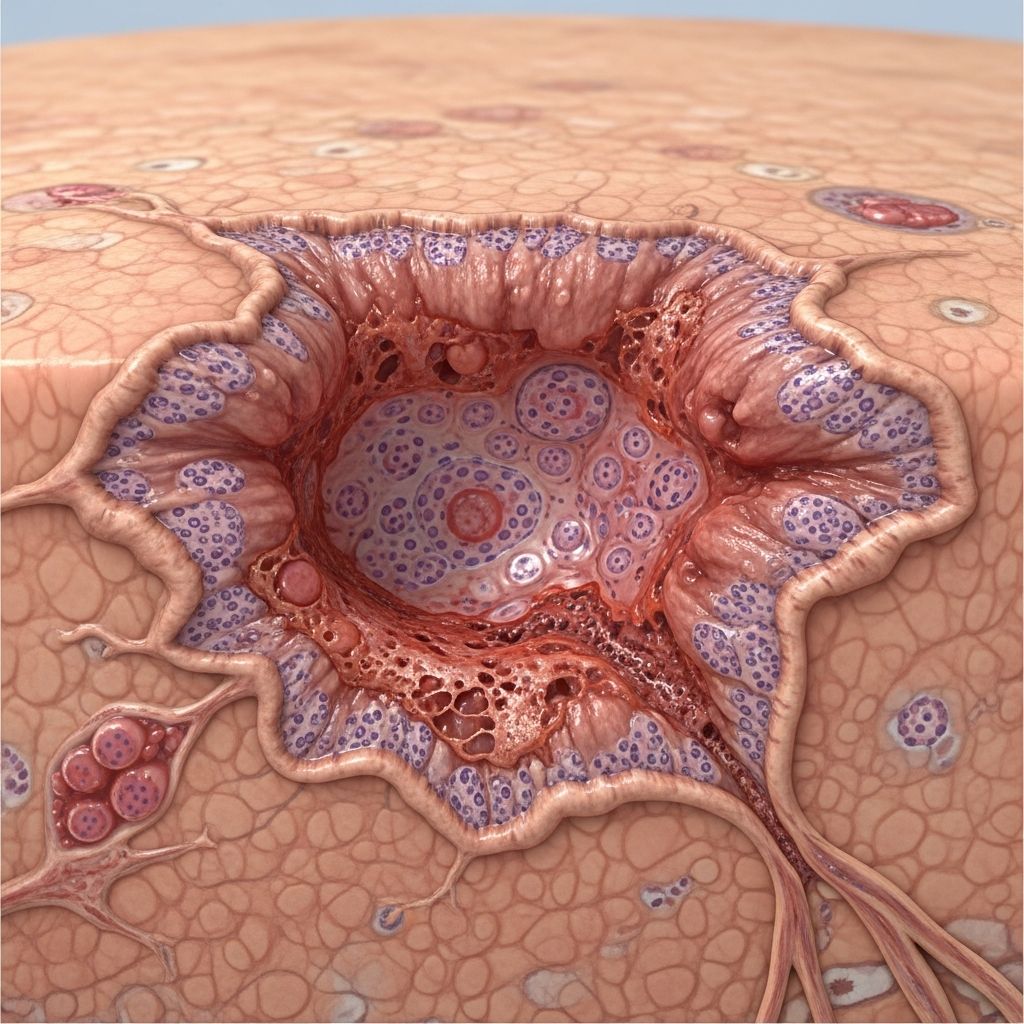
A
Marjolin ulcer
is the rare development of cutaneoussquamous cell carcinoma (SCC)
in the site of a scar or chronic ulcer. It most commonly arises in old thermal burn scars but can also develop from other longstanding skin injuries or wounds.What is the Marjolin ulcer?
The Marjolin ulcer represents a malignant transformation where chronic scars or non-healing wounds evolve into aggressive skin cancer, specifically squamous cell carcinoma. Named after French surgeon Jean-Nicolas Marjolin who described it in 1828, this condition typically emerges decades after the initial injury, turning seemingly stable scar tissue into a life-threatening lesion.
Unlike typical skin cancers, Marjolin ulcers originate in areas of previously damaged skin, where repeated trauma, inflammation, and impaired healing create a fertile ground for carcinogenesis. The majority—over 90%—manifest as SCC, though rare cases of basal cell carcinoma or even sarcomas have been reported. These ulcers are notorious for their aggressive local invasion and high metastatic potential, particularly when arising in burn scars or osteomyelitis sinuses.
Demographics
Marjolin ulcers show no strong gender predilection, affecting males and females equally in most series, though some studies note a slight male predominance due to occupational burn exposures. Age at diagnosis typically ranges from 40 to 70 years, reflecting the long latency period required for malignant transformation.
Geographically, higher incidence occurs in regions with frequent severe burns or chronic wounds, such as rural areas with limited healthcare access or developing countries where osteomyelitis and untreated injuries are common. Immunocompromised individuals, including those with HIV, diabetes, or on immunosuppressive therapy, face elevated risk due to impaired immune surveillance.
Causes
The precise aetiology of Marjolin ulcers remains multifactorial, involving chronic inflammation, genetic mutations, and immune evasion in scar tissue. Key predisposing factors include:
- Thermal burns: The most common precursor, accounting for 70-80% of cases. Approximately 1-2% of large burn scars undergo malignant change.
- Osteomyelitis sinuses: Chronic bone infections lead to persistent draining tracts where SCC develops in 0.7-1.7% of cases.
- Chronic venous or arterial ulcers: Longstanding lower limb ulcers from vascular insufficiency.
- Pressure sores: Decubitus ulcers in bedridden patients, especially over bony prominences.
- Surgical scars, fistulas, and other traumas: Including radiation dermatitis, animal bites, or leprosy ulcers.
The latency period averages 30-40 years (range: 1 month to 75 years), with shorter intervals (<1 year) termed ‘acute Marjolin ulcers,’ which carry better prognosis.
Pathophysiology
Scar tissue lacks normal skin appendages and vascularity, creating an immune-privileged site resistant to tumour surveillance. Chronic irritation induces repeated cycles of inflammation, hyperplasia, and dysplasia. Key mechanisms include:
- Impaired lymphatic drainage hinders anti-tumour immunity.
- Persistent inflammation releases cytokines promoting angiogenesis and cell proliferation.
- Genetic instability from p53 mutations and HPV involvement in some cases.
- Biofilm formation in chronic wounds fosters a carcinogenic microenvironment.
Two histological subtypes exist: the aggressive ‘ulcerative’ form (flat, indurated with heaped-up edges) and the less invasive ‘exophytic’ papillary type.
Clinical features
Early detection is challenging as Marjolin ulcers mimic benign chronic wounds. Presenting signs include:
Related Stories



- Non-healing or enlarging sore within a scar.
- Foul-smelling discharge, bleeding on touch, and pain.
- Excessive, friable granulation tissue.
- Indurated base with raised, everted margins.
- Lymphadenopathy in advanced cases.
Common sites: lower extremities (65%), scalp, upper limbs, trunk. The ulcerative type progresses rapidly, while papillary forms grow slowly outward.
| Feature | Ulcerative Type | Papillary Type |
|---|---|---|
| Growth Pattern | Flat, invasive | Exophytic, finger-like |
| Aggressiveness | High, metastatic | Lower |
| Common Signs | Bleeding, pus, pain | Slow enlargement |
Diagnosis
Diagnosis relies on high clinical suspicion in chronic scars showing unexplained changes. Steps include:
- History and examination: Note latency, scar changes, symptoms.
- Biopsy: Punch or incisional biopsy confirms SCC. Depth and margins assessed.
- Imaging: X-rays for osteomyelitis; CT/MRI for bone/soft tissue invasion; PET-CT for staging.
- Lymph node evaluation: FNA or sentinel biopsy if palpable nodes.
Differential diagnoses: Infected ulcers, basal cell carcinoma, keratoacanthoma, pyoderma gangrenosum.
Differential diagnoses
- Chronic infection/abscess: Responds to antibiotics; no induration.
- Other SCC: De novo, sun-exposed areas.
- Basal cell carcinoma: Pearly borders, less aggressive.
- Melanoma: Pigmented, irregular.
- Pyoderma gangrenosum: Rapid onset, pathergy.
Treatment
Management is multimodal, prioritizing wide surgical excision:
- Surgery: Gold standard—excision with 2-4 cm margins, down to bone if needed. Reconstruction via flaps/grafts.
- Lymph node dissection: For clinical N+ disease.
- Adjuvant therapy: Radiotherapy for positive margins, high-risk features; chemotherapy (cisplatin-based) for metastatic disease.
- Follow-up: Regular skin exams, imaging for recurrence (peaks at 2-3 years).
Multidisciplinary approach involving dermatology, oncology, plastic surgery essential.
Outcome and complications
Prognosis varies by subtype and stage: 5-year survival 50-70% for localized disease, drops to 20-35% with metastases (lungs, nodes common). Complications include local recurrence (20-50%), osteomyelitis exacerbation, amputation for limb lesions. Early detection improves outcomes significantly.
Prevention
Vigilant scar surveillance: annual exams for large burns/osteomyelitis. Prompt treatment of chronic wounds, smoking cessation, immunosuppression management reduce risk. Patient education on reporting scar changes crucial.
Frequently asked questions
What is a Marjolin ulcer?
A rare SCC arising in chronic scars/ulcers, often burns.
How long after injury does it develop?
Average 30 years; acute forms <1 year.
Is it always aggressive?
Ulcerative type yes; papillary less so.
What is the treatment?
Wide excision ± lymphadenectomy, adjuvant RT.
Can it be prevented?
Regular scar monitoring and wound care.
References
- Marjolin’s ulcers – Sergio Mazzei — Dr. Sergio Mazzei. 2023. https://drsergiomazzei.health/marjolins-ulcers/
- Marjolin ulcer – DermNet — DermNet NZ. 2023-10-01. https://dermnetnz.org/topics/marjolin-ulcer
- Marjolin Ulcers: Causes, Diagnosis, Treatments, and More — WebMD. 2024. https://www.webmd.com/skin-problems-and-treatments/what-is-a-marjolin-ulcer
- Marjolin Ulcer — MD Searchlight. 2024. https://mdsearchlight.com/cancer/marjolin-ulcer/
- Marjolin’s Ulcer – Everything You Need To Know — Dr. Nabil Ebraheim (YouTube). 2016-05-01. https://www.youtube.com/watch?v=B_-trwNdg2s
- Understanding Marjolin’s ulceration — Wounds UK. 2023-02-01. https://wounds-uk.com/wp-content/uploads/2023/02/ff8da38a80f8ec22d884ed359f27b181.pdf
Similar Articles








Read full bio of medha deb