MIGS Billing Strategies: Key Coding, Modifiers, Reimbursement
Unlock optimal reimbursement for minimally invasive glaucoma surgeries through precise coding and compliance best practices.
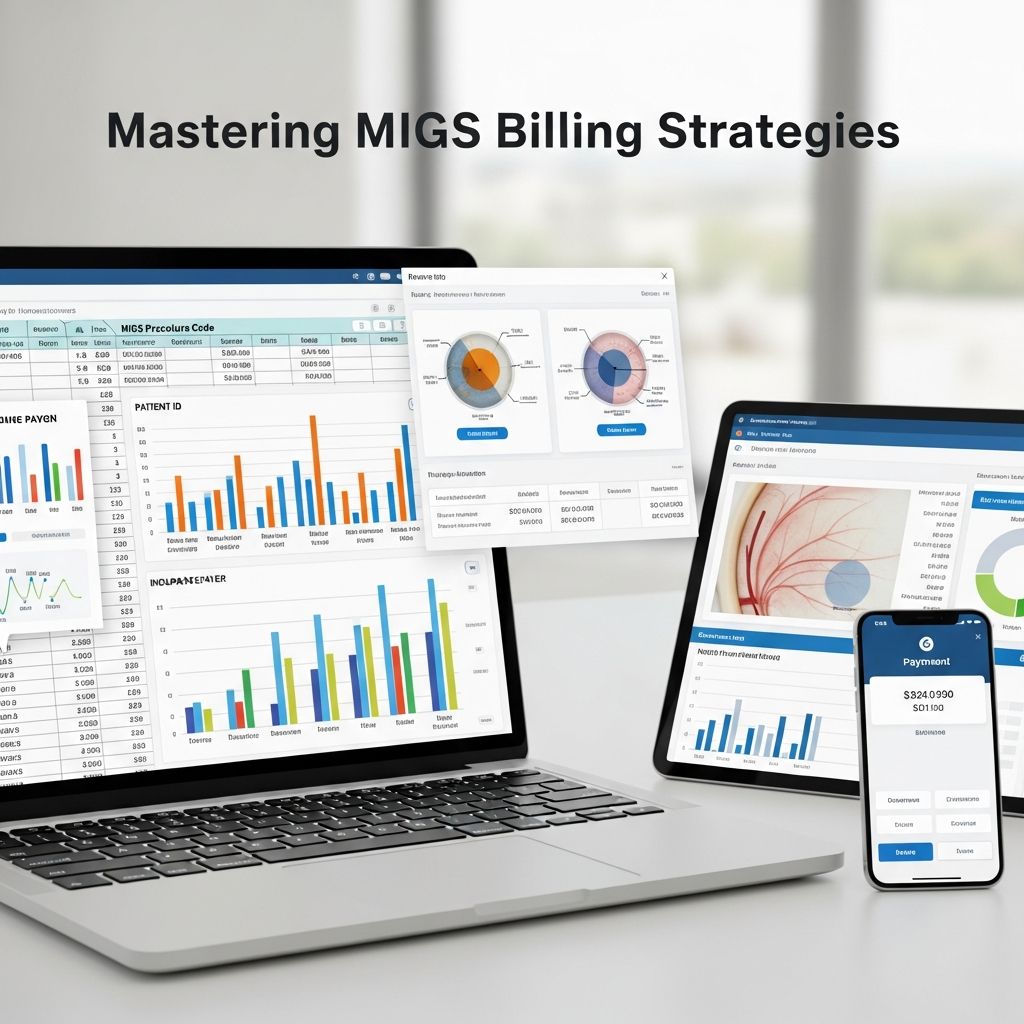
Micro-invasive glaucoma surgery (MIGS) represents a transformative approach in managing glaucoma, offering safer alternatives to traditional surgeries with quicker recovery times. Proper billing is crucial for ophthalmologists to secure fair compensation, especially when combining these procedures with cataract extraction. This article explores coding fundamentals, reimbursement landscapes, modifier applications, and practical tips drawn from established guidelines.
Understanding the MIGS Landscape
MIGS procedures target the trabecular meshwork and Schlemm’s canal to enhance aqueous outflow, reducing intraocular pressure with minimal tissue disruption. Common techniques include goniotomy (excising trabecular meshwork), canaloplasty (dilating Schlemm’s canal), and trabecular micro-bypass stent implantation. These are often performed alongside cataract surgery, amplifying their appeal for mild-to-moderate glaucoma patients.
The shift toward MIGS has been driven by improved safety profiles and patient outcomes, but reimbursement complexities arise from evolving CPT codes and payer policies. Accurate documentation and code selection directly impact professional and facility fees, making billing proficiency essential for practice sustainability.
Key CPT Codes for MIGS Procedures
Central to MIGS billing are specific CPT codes that distinguish standalone from combined procedures. For goniotomy, use CPT 65820, which describes destruction of the trabecular meshwork by incision or excision. Canaloplasty falls under CPT 66174, covering transluminal dilation of the aqueous outflow canal. Trabecular stents, such as those bypassing the meshwork, are billed with CPT 66989 or 66991 when paired with cataract surgery (CPT 66984 for routine or 66982 for complex).
- CPT 65820: Goniotomy – Primary for excisional MIGS.
- CPT 66174: Canaloplasty – Includes trabeculotomy elements when combined.
- CPT 66991: Trabecular stent with cataract – Device-intensive status boosts facility fees.
- Note: Avoid bundling 65820 and 66174 on the same eye per NCCI edits and AMA guidance.
These codes underwent updates post-2022, reflecting advocacy efforts that enhanced values for certain combinations. Surgeons must verify annual CMS Physician Fee Schedule adjustments for precise rates.
Reimbursement Breakdown: Professional Fees
Professional fees vary significantly based on procedure combinations and multiple procedure payment reduction (MPPR) rules. When MIGS accompanies cataract surgery, the cataract code’s fee is typically reduced by 50% as the secondary procedure.
| Procedure Combination | Primary Fee | Secondary Fee (50% MPPR) | Total Professional Fee |
|---|---|---|---|
| Goniotomy (65820) + Cataract (66984) | $813.75 | $264.42 | $1,078.17 |
| Canaloplasty (66174) + Cataract (66984) | $738.83 | $264.42 | $1,003.25 |
| Stent (66991) + Cataract | $663.57 (bundled) | $663.57 | |
These 2022 CMS National Fee Schedule figures highlight goniotomy and canaloplasty’s edge over stents, potentially adding $415 per case for goniotomy. For a surgeon averaging 10 monthly MIGS-cataract cases, this equates to substantial annual gains.
Facility and ASC Reimbursement Insights
Ambulatory surgical centers (ASCs) and hospital outpatient departments (HOPDs) receive separate facility fees, influenced by APC assignments and device pass-throughs. Stent procedures benefit from higher facility reimbursements due to device-intensive status, but device costs often offset this.
| Setting/Procedure | ASC Facility Fee | HOPD Fee | Notes |
|---|---|---|---|
| Goniotomy + Cataract | $2,450.36 | $~4,000 | MPPR applies to secondary |
| Canaloplasty + Cataract | $2,450.36 | $3,999.59 | Combined canal/trabeculotomy |
| Stent + Cataract | $3,245.55 | No add’l | Device C1889 pass-through |
Related Stories



ASC owners see net advantages in non-implant MIGS when factoring device expenses, with goniotomy yielding ~$619 more combined revenue per case versus stents.
Navigating Modifiers and Compliance
Modifiers ensure accurate adjudication. Common ones include:
- -51: Multiple procedures – Alerts payers to reductions.
- -59: Distinct procedural service – For unrelated sessions.
- -LT/RT: Left/right eye specificity.
- -54/-55: Split surgical/post-op care.
Documentation must justify medical necessity, including IOP targets, medication burden, and comorbidities. Prior authorizations are payer-specific; verify benefits preoperatively. CMS LCDs like DL37578 outline coverage for MIGS with qualifying diagnoses.
Payer Policies and Coverage Criteria
Medicare sets the benchmark via Noridian and other MACs, covering MIGS for open-angle glaucoma failing medications. Commercial payers like UnitedHealthcare align but may require letters of medical necessity. Key criteria:
- Mild-moderate glaucoma.
- Failed maximal medical therapy.
- Concomitant cataract eligibility.
Predetermination aids uncertain cases, preventing denials. Update practices on code changes, as 2022 revisions boosted goniotomy/canaloplasty values following RUC surveys and advocacy.
Optimizing Revenue: Best Practices
To maximize reimbursements:
- Audit Charts: Ensure gonioscopy and OCT support MIGS necessity.
- Bundle Strategically: Combine stents with goniotomy for multi-mechanism treatment and higher fees.
- Track Devices: Bill C1889 for stents; non-implants avoid pass-through pitfalls.
- Train Staff: On superbills reflecting MPPR and modifiers.
- Appeal Denials: With robust documentation.
Non-implant MIGS like OMNI Surgical System (canaloplasty + trabeculotomy) streamline coding under 66174, enhancing efficiency.
Common Pitfalls and Solutions
Avoid overcoding by not reporting 65820 with 66174. For complex cataracts with MIGS, use 66982/66987 equivalents if ECP involved. Device removal (65920) carries separate fees but rare in MIGS.
| Pitfall | Solution |
|---|---|
| MPPR Oversight | Apply 50% to lower-valued code |
| Payer Denials | Submit prior auth/medical necessity letter |
| Stent Cost vs Fee | Opt for excisional MIGS in ASCs |
Future Trends in MIGS Billing
Expect continued RUC refinements and payer expansions as MIGS data matures. 2022’s $134.73 stent increment followed community pushback, signaling advocacy’s role. Track CMS proposed rules annually for valuation shifts.
Frequently Asked Questions (FAQs)
Can I bill goniotomy and canaloplasty together?
No, NCCI edits and CPT Assistant prohibit it on the same eye; use 66174 for combined canal/trabeculotomy.
What if MIGS is standalone?
Bill primary codes (65820/66174) without cataract modifiers; verify coverage.
How do device costs affect profitability?
Stents exceed facility differentials; non-implants like KDB Glide preserve margins.
Is prior auth always needed?
Check payer policy; recommended for commercial plans.
What’s the global period for these codes?
90 days for most MIGS CPTs, covering routine post-op.
References
- What to Expect for MIGS Reimbursement in 2022 — Glaucoma Physician. 2021-12. https://glaucomaphysician.net/issues/2021/december/what-to-expect-for-migs-reimbursement-in-2022/
- 2022 Provider Reimbursement Guide — Sight Sciences. 2022-11. https://www.sightsciences.com/us/wp-content/uploads/sites/4/2022/11/RE-1360-US.v5-v5.1-Sight-OMNI-Provider-Reimbursement-Guide_FINAL.pdf
- Micro-Invasive Glaucoma Surgery (MIGS) Local Coverage Transcript — Noridian Medicare. 2021-06-03. https://med.noridianmedicare.com/web/jfb/policies/lcd/open/open-transcript-060321
- Billing and Coding: Micro-Invasive Glaucoma Surgery (MIGS) — CMS. 2023 (ver=24). https://www.cms.gov/medicare-coverage-database/view/article.aspx?articleid=56491&ver=24
- Billing and Coding: Micro-Invasive Glaucoma Surgery (MIGS) — CMS. 2023. https://www.cms.gov/medicare-coverage-database/view/article.aspx?articleId=56647
Similar Articles








Read full bio of Sneha Tete