Mastocytosis: Symptoms, Causes, Diagnosis, And Treatment Guide
Comprehensive guide to mastocytosis: symptoms, types, diagnosis, and effective management strategies for cutaneous and systemic forms.
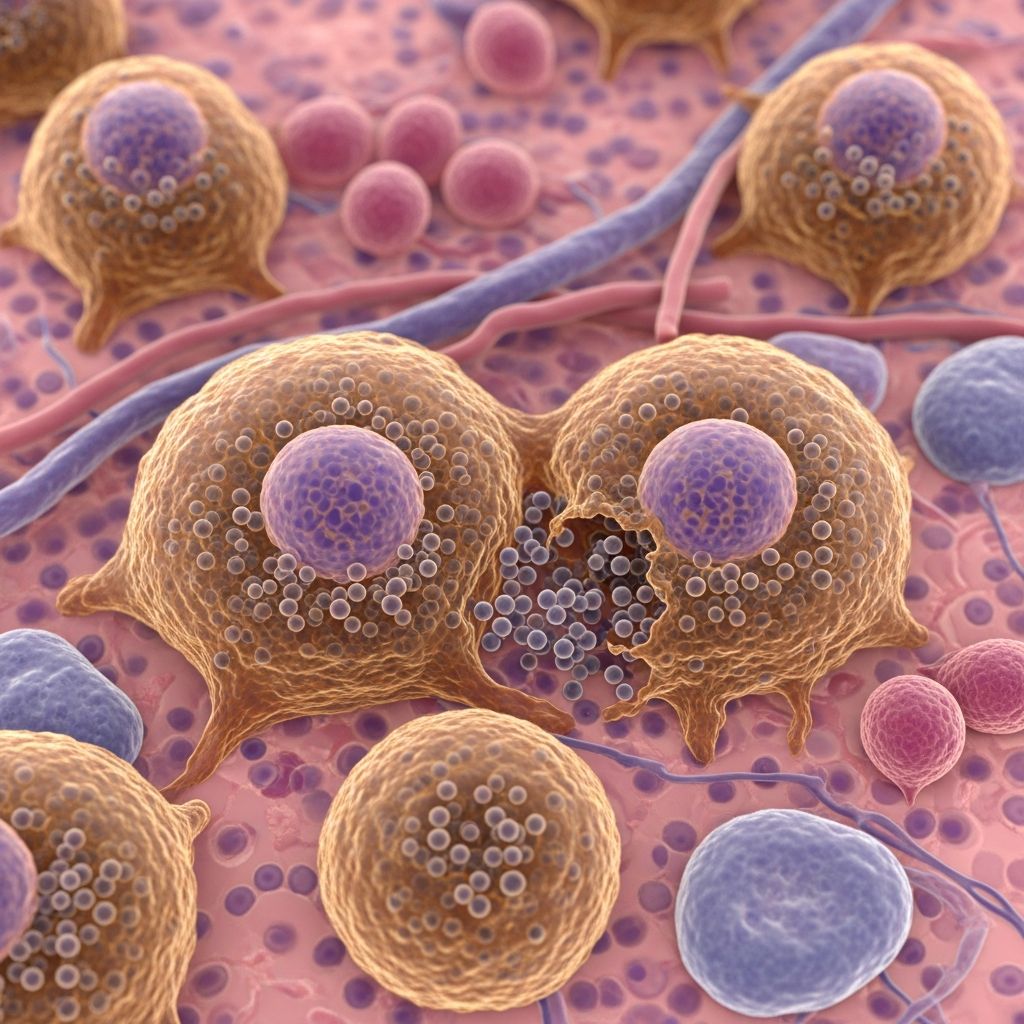
Mastocytosis is a rare disorder characterised by abnormal accumulation and activation of mast cells in the skin and sometimes internal organs. Mast cells are immune cells that release chemicals such as histamine causing allergic-type symptoms during episodes called anaphylactic degranulation. In most people with mastocytosis the condition is limited to the skin (cutaneous mastocytosis) but rarely it can affect multiple body organs and systems (systemic mastocytosis).
What is mastocytosis?
Mast cells are immune system cells that produce histamine and other chemicals involved in allergic reactions and inflammation. Mastocytosis arises from a genetic mutation that results in too many mast cells building up in the skin and/or internal organs. These excess mast cells produce too much of these chemicals.
There are two main forms:
- Cutaneous mastocytosis — limited to the skin (90% of cases).
- Systemic mastocytosis — involves skin and one or more internal organs (10% of cases).
In systemic mastocytosis, the bone marrow, gastrointestinal tract, liver, spleen, and lymph nodes may be involved. Very rarely, mastocytosis is associated with a haematological malignancy (blood cancer).
Who gets mastocytosis (epidemiology)?
Mastocytosis is rare affecting less than 1 in 10,000 people. Cutaneous mastocytosis mostly affects children under 2 years old. About 90% of affected children have skin-only disease that resolves during puberty. Half of adults who develop mastocytosis have systemic disease.
There may be a family history of mastocytosis or associated haematological disorders in 1% of patients.
What causes mastocytosis?
Mutations in the KIT gene that controls mast cell growth and survival are found in over 90% of people with systemic mastocytosis and some with cutaneous mastocytosis. Most mutations occur after conception (somatic mutations) rather than being inherited. The most common mutation substitutes aspartic acid for valine at amino acid 816 (Asp816Val).
What are the clinical features of mastocytosis?
Cutaneous mastocytosis
Skin lesions are persistent red-brown flat or raised lesions. There are three main types:
- Maculopapular cutaneous mastocytosis (MPCM) — formerly urticaria pigmentosa: small red-brown macules or papules that urticate (hives) on rubbing (Darier’s sign).
- Diffuse cutaneous mastocytosis (DCM) — skin all over the body is thickened, red, and has a ‘peau d’orange’ (orange peel) appearance. Blisters may occur.
- Mastocytoma of skin — solitary or few larger orange or brown patches, plaques or nodules.
Systemic mastocytosis
Symptoms result from accumulation of mast cells in organs and episodic release of mast cell chemicals. Common symptoms include:
- Anaphylaxis — low blood pressure, hives, swelling, difficulty breathing, nausea, vomiting, diarrhoea, abdominal pain.
- Constitutional symptoms — fatigue, weight loss.
- Gastrointestinal — peptic ulceration, malabsorption.
- Bone — pain, osteoporosis.
- Lymphadenopathy and splenomegaly — enlarged lymph nodes and spleen.
Mediator release symptoms may occur spontaneously or be triggered by heat, friction, stress, exercise, spicy foods, medications, insect stings. Anaphylaxis can be life-threatening.
How is mastocytosis diagnosed?
Skin
Diagnosis of cutaneous mastocytosis is by clinical examination and skin biopsy. Increased mast cells and Darier’s sign confirm the diagnosis. Special stains such as tryptase, CD117 (c-kit), and Giemsa stains are used.
Related Stories



Blood tests
- Serum tryptase — persistently raised above 20 μg/L indicates systemic mastocytosis.
- Full blood count — may show anaemia, eosinophilia.
- Other mast cell mediators (histamine, prostaglandin D2).
Bone marrow aspirate and trephine biopsy
Recommended if serum tryptase >20 μg/L, anaemia, thrombocytopenia, or exclusion of haematological malignancy. Genetic testing for KIT mutations.
What is the treatment for mastocytosis?
There is no cure for mastocytosis. Treatment focuses on avoiding triggers and controlling symptoms.
Avoid triggers
- Friction, heat, stress, alcohol, spicy foods, medications (NSAIDs, opioids, some antibiotics), insect stings.
- Carry an adrenaline autoinjector (e.g., EpiPen®) for anaphylaxis risk.
- Medical alert bracelet.
Skin-directed treatment for cutaneous mastocytosis
- Topical corticosteroids — potent steroid creams/ointments for limited lesions.
- Phototherapy — narrowband UVB, PUVA for extensive lesions.
- Oral psoralen plus UVA (PUVA) — for adults with extensive urticaria pigmentosa.
Systemic symptoms
| Medication | Indication |
|---|---|
| H1 antihistamines (e.g., cetirizine, loratadine) | Itch, flushing, urticaria |
| H2 antihistamines (e.g., ranitidine) | Gastric symptoms |
| Mast cell stabilisers (cromolyn sodium) | Gastrointestinal symptoms |
| Leukotriene antagonists (montelukast) | Respiratory symptoms |
| Proton pump inhibitors (omeprazole) | Peptic symptoms |
| Corticosteroids (prednisone) | Severe anaphylaxis, cytoreduction |
Advanced systemic mastocytosis: Targeted therapies (midostaurin, avapritinib for KIT D816V), cladribine, interferon-alpha.
Investigations to order
- Skin biopsy if Darier’s sign positive.
- Serum tryptase.
- Bone marrow biopsy if systemic symptoms.
What is the outlook for mastocytosis?
Most children with cutaneous mastocytosis improve by puberty. Adult-onset cutaneous mastocytosis persists but is indolent. Systemic mastocytosis is usually indolent but anaphylaxis risk persists. Advanced forms (10%) have poor prognosis.
Frequently asked questions
What triggers mastocytosis symptoms?
Common triggers include physical stimuli (heat, friction), emotional stress, foods (spicy, alcohol), medications (NSAIDs), and insect stings.
Is mastocytosis hereditary?
Rarely; most cases result from somatic KIT mutations.
Can mastocytosis be cured?
No cure exists; management focuses on symptom control.
Does mastocytosis increase cancer risk?
Advanced systemic forms may progress to haematological malignancies in <10% of cases.
Clinical images
Images would show red-brown maculopapular lesions demonstrating Darier’s sign, diffuse erythroderma in DCM, and solitary mastocytoma.
References
- Mastocytosis – Symptoms, Causes, Treatment — NORD (rarediseases.org). 2023. https://rarediseases.org/rare-diseases/mastocytosis/
- Mastocytosis Diagnosis & Treatment — Columbia Cancer (cancer.columbia.edu). 2024. https://www.cancer.columbia.edu/cancer-types-care/types/rare-blood-disorders/conditions/mastocytosis
- Systemic Mastocytosis Treatment: Options & Care — Patient Power (patientpower.info). 2024. https://www.patientpower.info/systemic-mastocytosis/systemic-mastocytosis-treatment
- What is Mastocytosis? Types, Symptoms, and Treatment — Allergy Asthma Network (allergyasthmanetwork.org). 2023. https://allergyasthmanetwork.org/mast-cell-diseases/mastocytosis/
- Cutaneous mastocytosis treatment: strategies, limitations and challenges — NIH PMC (pmc.ncbi.nlm.nih.gov). 2018-12-21. https://pmc.ncbi.nlm.nih.gov/articles/PMC6320483/
- How I treat patients with indolent and smoldering mastocytosis — American Society of Hematology (ashpublications.org). 2013-04-18. https://ashpublications.org/blood/article/121/16/3085/31589/How-I-treat-patients-with-indolent-and-smoldering
- Mastocytosis: Types, Symptoms & Treatment — Cleveland Clinic (my.clevelandclinic.org). 2024. https://my.clevelandclinic.org/health/diseases/5908-mastocytosis
Similar Articles








Read full bio of medha deb